Stanley Kubrick1968
2001: A Space Odyssey
How Geoffrey Unsworth, John Alcott and Kubrick’s effects crew photographed the film on 65mm, with a desert projected onto a stage, models lit by a single sun, sets that carry their own light and a Star Gate exposed with the shutter open.
Inside the spacecraft of 2001: A Space Odyssey, nearly everything is white, and most of the light comes out of the walls, the floors and the screens. Outside, everything is black, and every ship is lit by one hard sun with nothing to soften its shadows. Then there is red, which keeps breaking in: the chairs in the space station’s lounge, the emergency airlock, the room that holds the ship computer’s memory, and the computer’s eye.
This essay is about how those pictures were made, which in 2001 means the photography and the effects together, because many images needed a cameraman and an effects crew working on the same negative. I have left the story alone apart from what each image needs.
The lighting cameraman was Geoffrey Unsworth. American Cinematographer’s 1968 coverage named him and John Alcott as the film’s cinematographers. Alcott had been on Unsworth’s camera crew since the early 1950s and had worked his way up to focus puller, and by Alcott’s own account Unsworth had to leave after the first six months, so Alcott was asked to carry on. The British Society of Cinematographers says Unsworth left to meet other commitments. Alcott then photographed the Dawn of Man.
The film had four Oscar nominations, for directing, original screenplay, art direction and special visual effects. It won only the last, credited to Kubrick alone, and the cinematography wasn’t nominated. The BSC puts that down to Kubrick generally being given the credit for the film’s visual style. Unsworth did win the BAFTA. Douglas Trumbull, one of the four effects supervisors with Wally Veevers, Con Pederson and Tom Howard, resented for years that Kubrick took the effects Oscar by himself.
Chapter 1: Format
- Super Panavision 70
- 65mm, 5-perf
- About 2.20:1
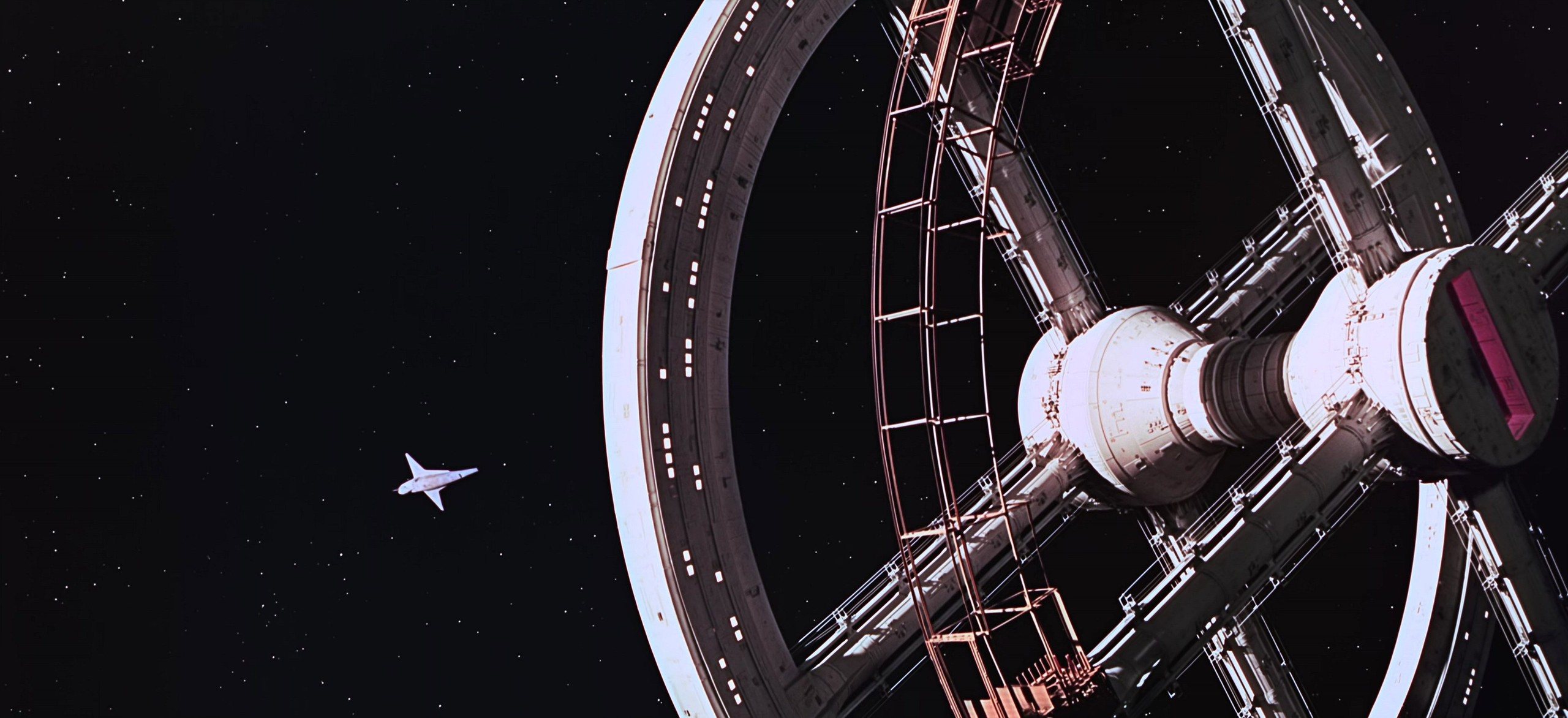
The Orion shuttle drifts toward Space Station V to The Blue Danube, and nothing in the frame is in a hurry. That slowness has a technical reason, and it starts with the format.
2001 was shot in Super Panavision 70: spherical lenses on 65mm negative, five perforations to a frame, for a picture about 2.20 times as wide as it is tall, printed to 70mm for release. Spherical is the important word. An anamorphic lens gets a wide picture by squeezing it sideways onto the negative, and the projector stretches it back out. A spherical lens squeezes nothing. On 65mm the negative is simply wide, and large enough that the wide picture keeps its detail.
The release was sold as Cinerama, but it was a single-camera, single-projector 70mm system, narrower than the original three-strip Cinerama, and full showings on the deeply curved screen were limited to a few major cities. From the autumn of 1968 the film also played in 35mm.
The curved screen set the tempo. Trumbull has said that fast movement or fast cutting would have blurred the stars and made them strobe on it, so Kubrick kept the motion slow, and the effects team set a hard limit on how fast stars could drift, to avoid double stars. It is easy to read the pace of the space scenes as pure mood, but it is also an engineering limit. Each frame is a still picture, and if a star jumps too far between two of them on a screen that size, the eye stops seeing one star moving and starts seeing two.
The two print sizes fought each other as well. On the Orion and Aries sets, the stars outside the windows were holes drilled in sheet metal. Stars that looked right in the 35mm print were too bright in 70mm, and stars that looked right in 70mm vanished in 35mm. Almost all the later stars were shot on the animation stand instead, a 65mm Mitchell on an Oxberry stand.
Chapter 2: Front Projection
- Stage 3, Borehamwood
- 8x10 Ektachrome
- Front projection
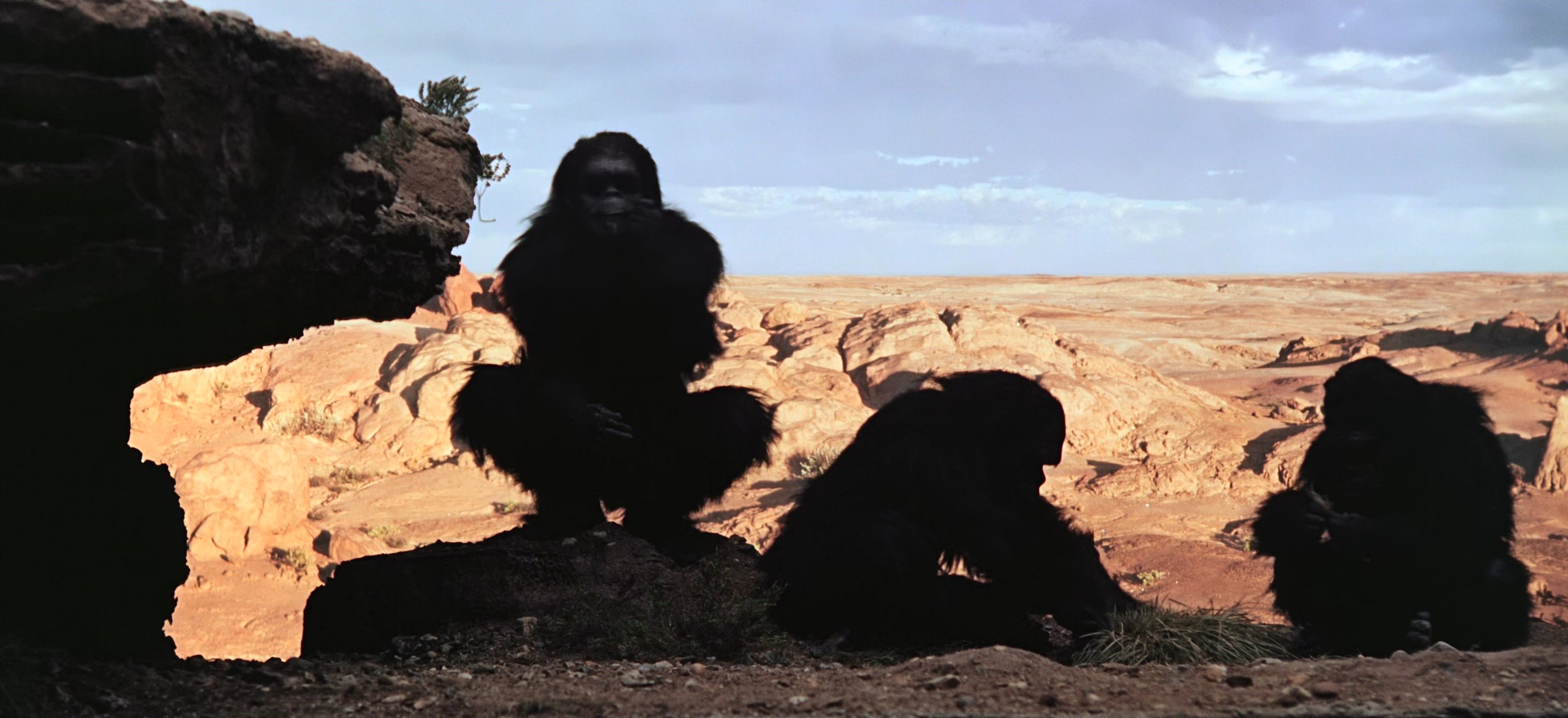
The film begins before there are people. Three ape-men sit on a rock ledge, almost in silhouette, and behind them a sunlit desert runs to a flat horizon under broken cloud. The desert is in Africa and the apes are in England. Nearly all of the Dawn of Man was shot on one stage, Stage 3 at MGM-British in Borehamwood.
Kubrick wanted the landscape of a remote part of South West Africa, now Namibia, and instead of taking a unit there he sent stills crews with 8x10 view cameras for several months. He had ruled out a painted backdrop, blue screen and giant rear projection. A test on 4x5 film was almost good enough, so he moved up to 8x10 transparencies for the extra resolution. Each background, a single sheet of Ektachrome, had to fill a screen that most accounts put at 90 to 110 feet wide.Lightman gives 110 feet, Trumbull 90, Dan Richter 80 and the Prop Gallery about 100.
The trick is to put the projector and the camera on the same line. The projector sat at right angles to the camera and threw its image onto a partially silvered mirror, 36 inches across, set at 45 degrees about eight inches in front of the lens. The mirror turned the beam straight down the lens axis toward the screen, and the camera looked out through the same mirror. A nodal head let the camera pan without the edges fringing.
The screen did the rest. It was 3M’s retro-reflective material, coated with glass beads that send light straight back the way it came, and it returned about 100 times the light falling on it. The actors were standing in the projected picture too, but the desert landing on their fur was so faint next to the screen that it never registered on film. And because lamp and lens shared one axis, each actor stood exactly in front of their own shadow and hid it.
- An 8x10 Ektachrome plate in a projector built for it.
- A half-silvered 36-inch mirror at 45 degrees, about 8 inches in front of the lens.
- Lamp and lens share one axis, so each actor hides his own shadow.
- The glass-bead screen returns about 100 times the light falling on it.
- 75mm camera lens with a 14-inch projector lens, at about f/2.
- A screen roughly 90 to 110 feet wide, on Stage 3 at Borehamwood.
All of the hardware had to be made. No 8x10 projector existed, so Kubrick and MGM’s effects man Tom Howard built one, with a condenser pack 18 inches thick made from standard 8x10 enlarger condensers, a water-cooled arc and heat-absorbing glass, and the condensers still cracked under the heat. The arc could burn the emulsion off a plate in minutes, so real plates went in only while the camera was running, and reject or duplicate plates were used to line up shots. The man who loaded them wore editing gloves and a surgical mask, so his breath would not fog the mirror. Rolls of the screen material varied in how much light they returned, so the crew tore it into small, jagged pieces and pasted them up at random as a mosaic. I love that answer: if you can’t make the material even, make its unevenness random.
The foreground light came from above. Lamps covered almost the entire stage ceiling, each on its own switch, so the light could be shaped to the contours of the set, and Lightman counts 1,500 of them. They made a cloudy bright daylight with no hard sun at all, only straw-gelled Brute arcs for a hint of modelling, which Kubrick preferred to the direct sunlight of a snapshot camera. The usual pairing was a 75mm lens on the camera and a 14-inch lens on the projector. For wider frames the crew went to a 50mm lens and carried the picture past the edges of the screen with foreground boulders or river bank. Even with the projector’s arc, the throw was so long that the sequence was shot at about f/2.
Kubrick chose the desert partly because nothing in it had to move. The stills crews could wait for light that lasted perhaps five minutes a day, and the stage could then hold that light for as long as anyone needed. Once you know this you see it everywhere: the clouds never move.
The best thing on the stage was an accident. When the leopard turns its head into the camera, its eyes flare. They are doing exactly what the screen does: the beam comes down the lens axis, hits the reflective layer at the back of the cat’s eyes and goes straight back into the lens. Kubrick kept it.
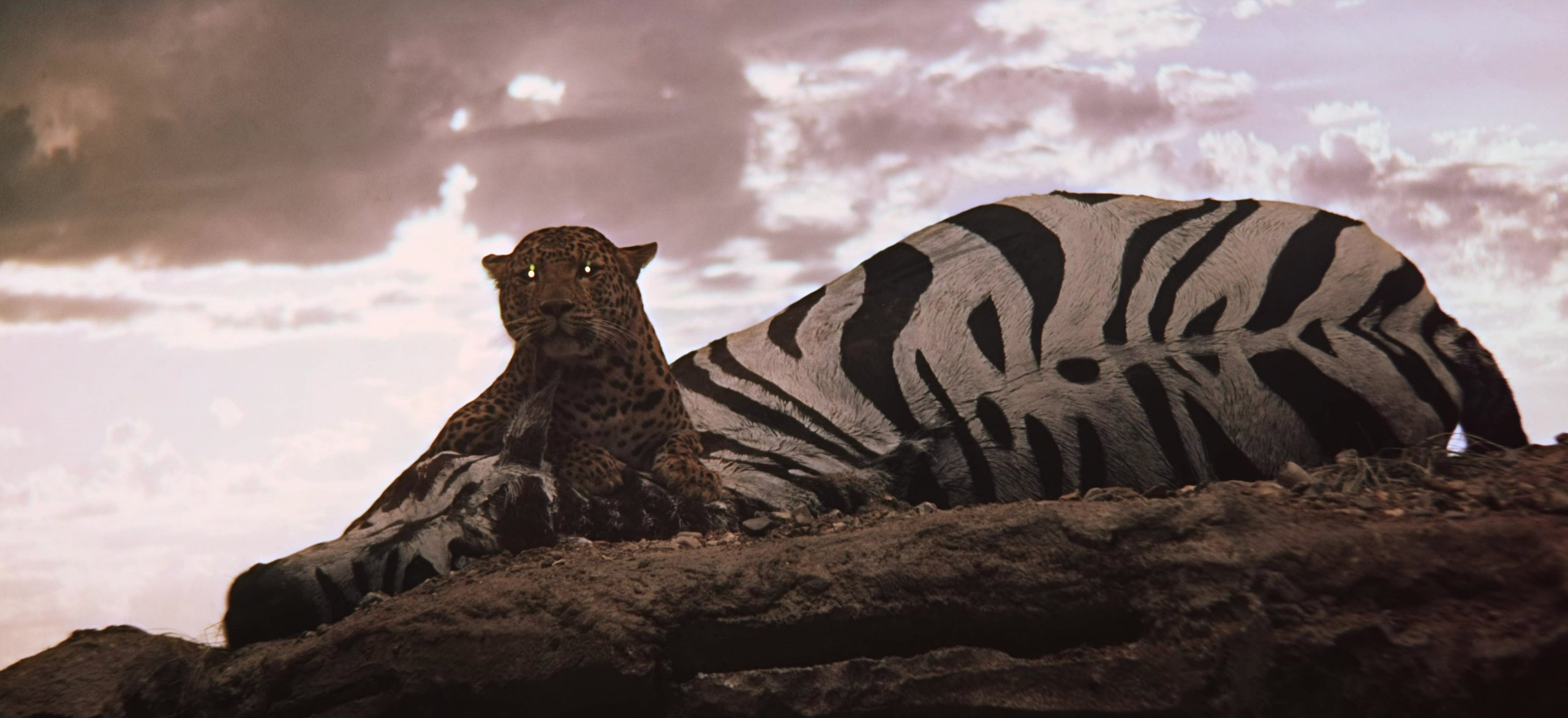
“A happy accident.”
A few shots skip the screen altogether. The low-angle shots of the bones being smashed were made outdoors, on a rostrum Kubrick built so he could shoot Dan Richter, the lead ape-man, from below with real clouds behind him, and Richter has said he could hear buses going past.
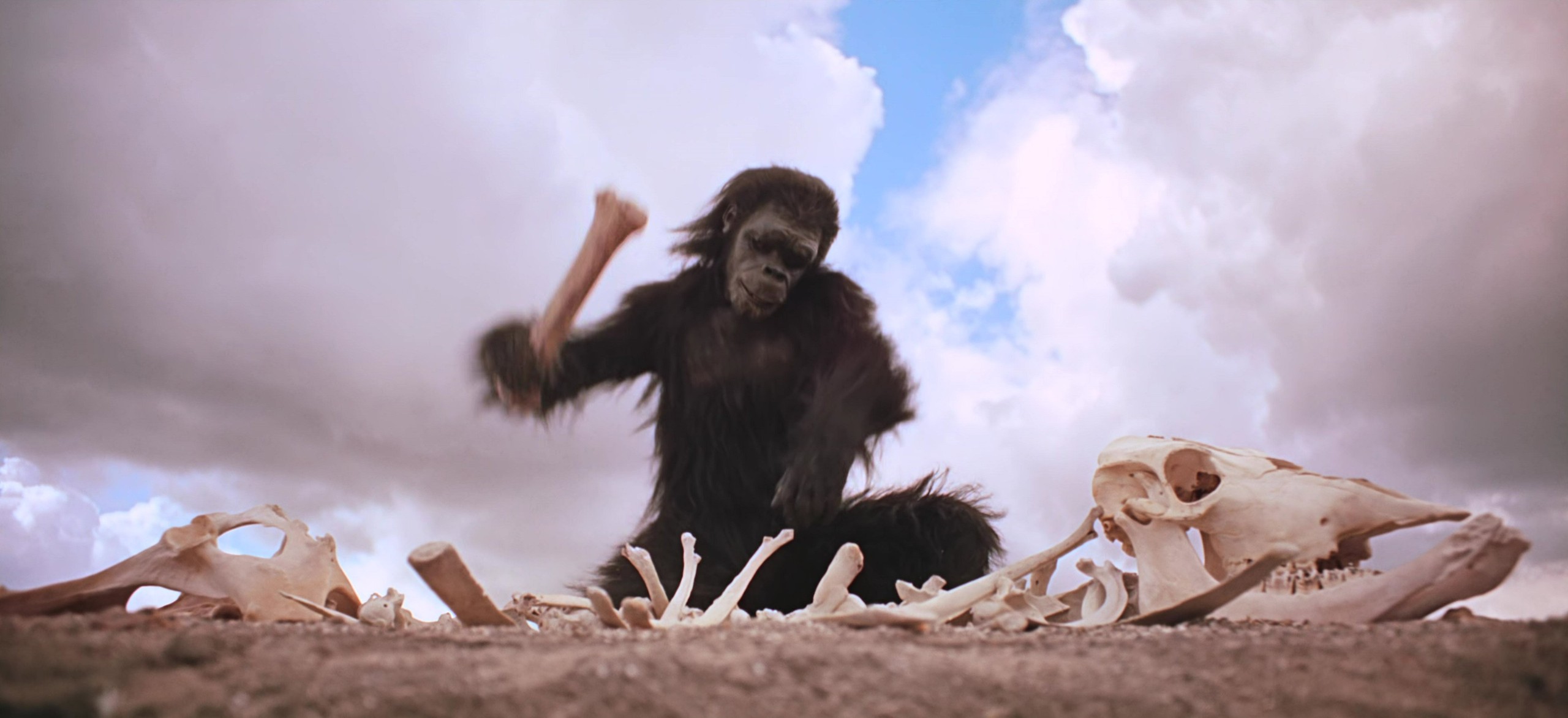
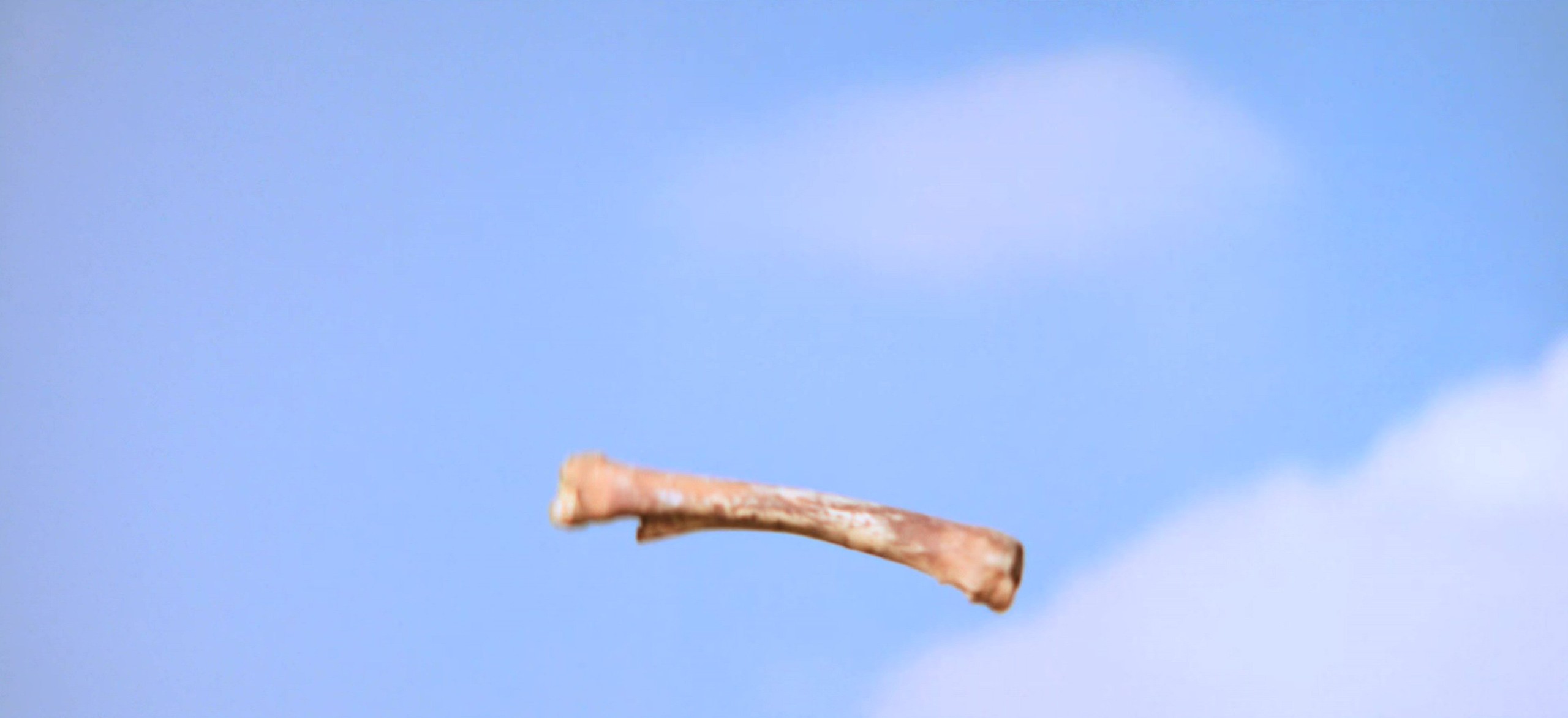
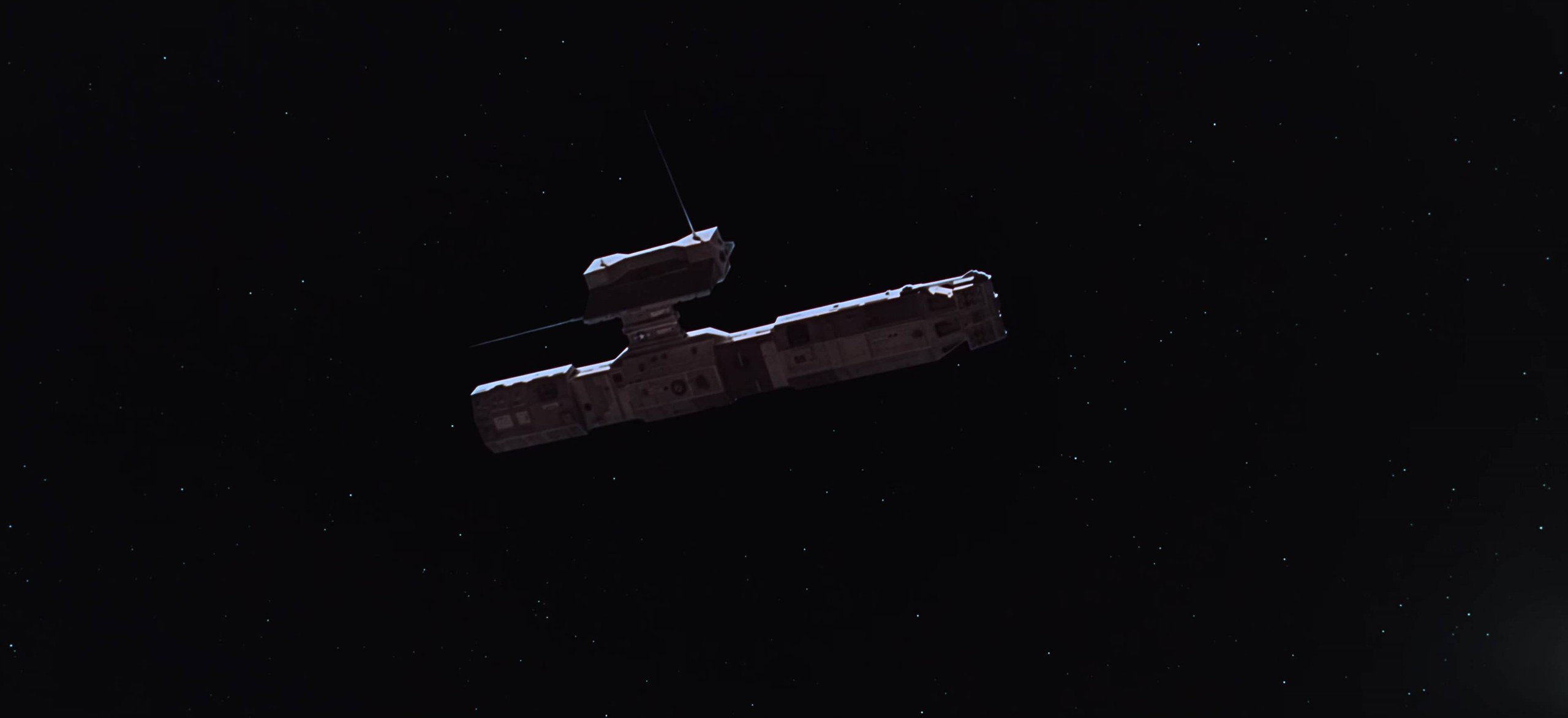
Then the bone goes up into the air, and on the cut it becomes a satellite in orbit, a jump of about three to four million years. The cut also changes the film’s method. Before it, actors stand in front of the lens. After it, a model hangs in black space, matted over its stars by hand.
Chapter 3: Models
- Discovery model
- One point source
- Stopped down
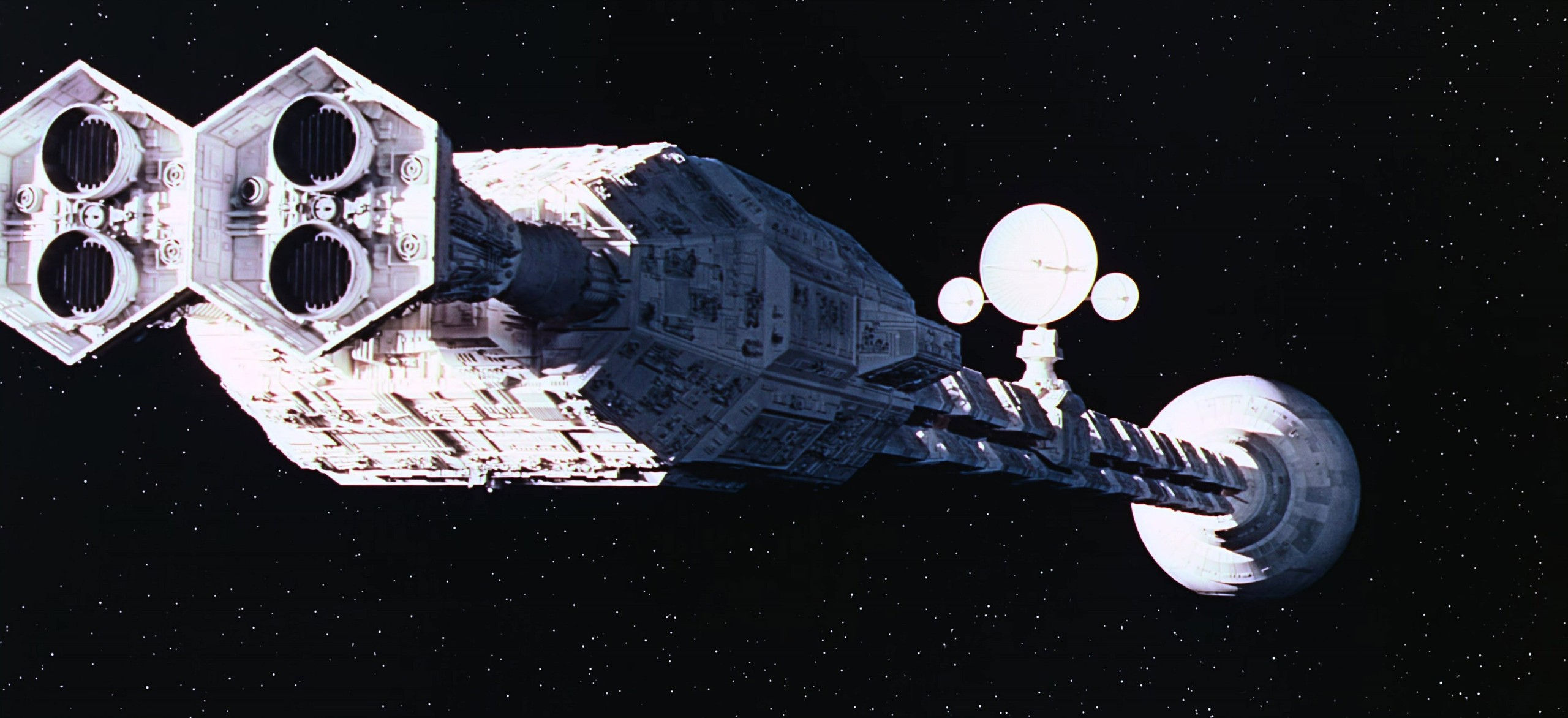
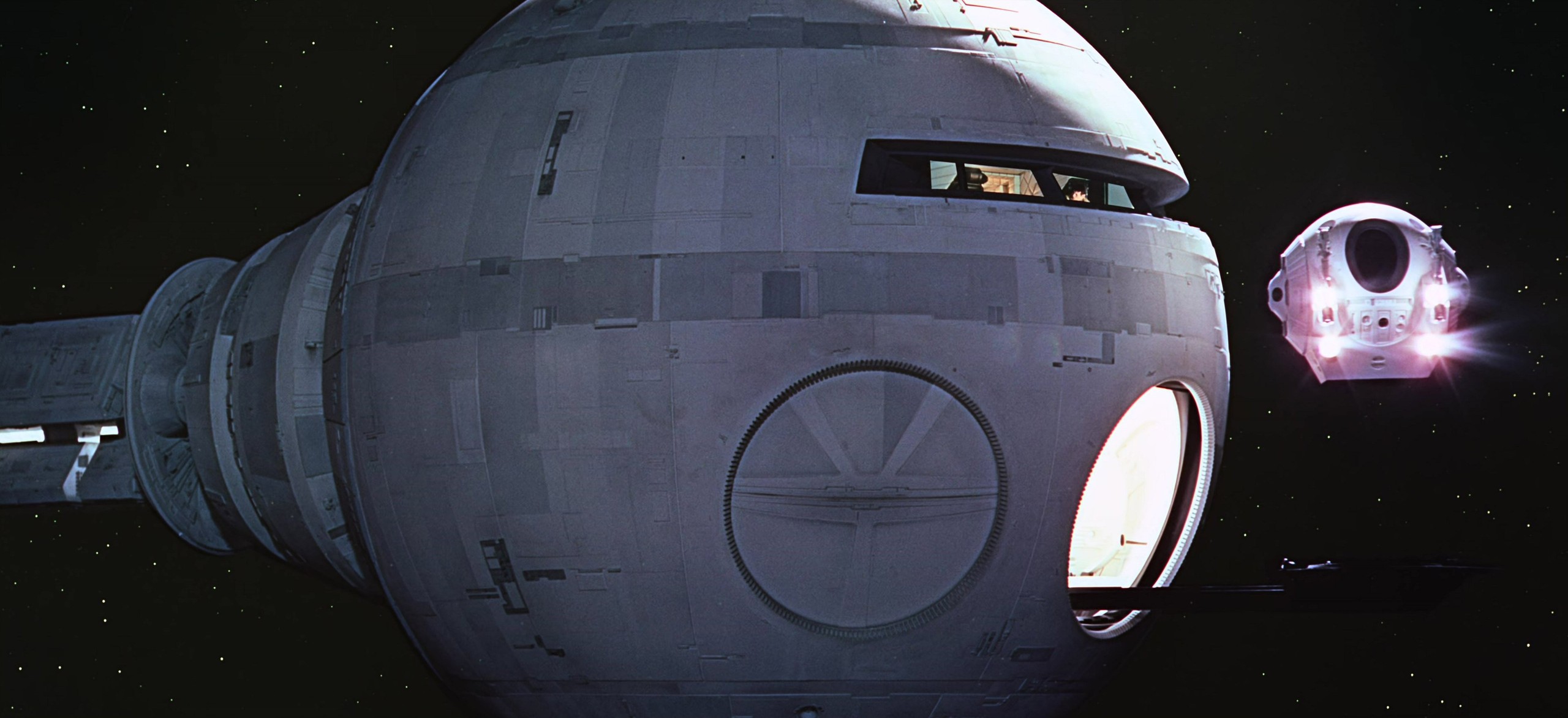
Discovery crosses the frame against the stars, sharp from the command sphere at the front to the engines at the back. The model was more than fifty feet long.Trumbull gives 54 feet; a 1968 American Cinematographer caption says 60. Its command sphere alone was six feet across, and a second Discovery, 15 feet long, was built for long shots. The other ships were small: Trumbull gives the space station as 8 feet across and the Orion as 3 feet long.
Photographing them meant solving one problem over and over, which was depth of field. The smaller the aperture, the more of the scene stays in focus, so to keep both ends of a model sharp the lens was stopped down almost to a pinhole. A tiny aperture lets in very little light, and the obvious fix, more light, was ruled out, because it would have broken the illusion of a single point source. So the light stayed as one hard lamp, the lens stayed nearly closed, and the only thing left to change was time.
The model shots were exposed at about four seconds a frame. One second of screen time is 24 frames, and at four seconds each that is more than a minute and a half of shooting for every second of film, for each pass. Moving parts had to keep pace, so they were driven by motors geared down so far that nothing seemed to move on the stage. Kubrick said that even the rotating space station looked stationary, and one spacecraft door moved about four inches over a five-hour take.
“It was like watching the hour hand of a clock.”
Most shots needed several passes, so the camera had to repeat its move exactly. It rode a rig on a 20-foot worm gear, with a motorised pan and tilt head and selsyn motors, and could repeat a move frame for frame on the same negative. A selsyn is a pair of linked motors that turn in step, and Trumbull’s crew nicknamed one selsyn printing rig the Sausage Factory.
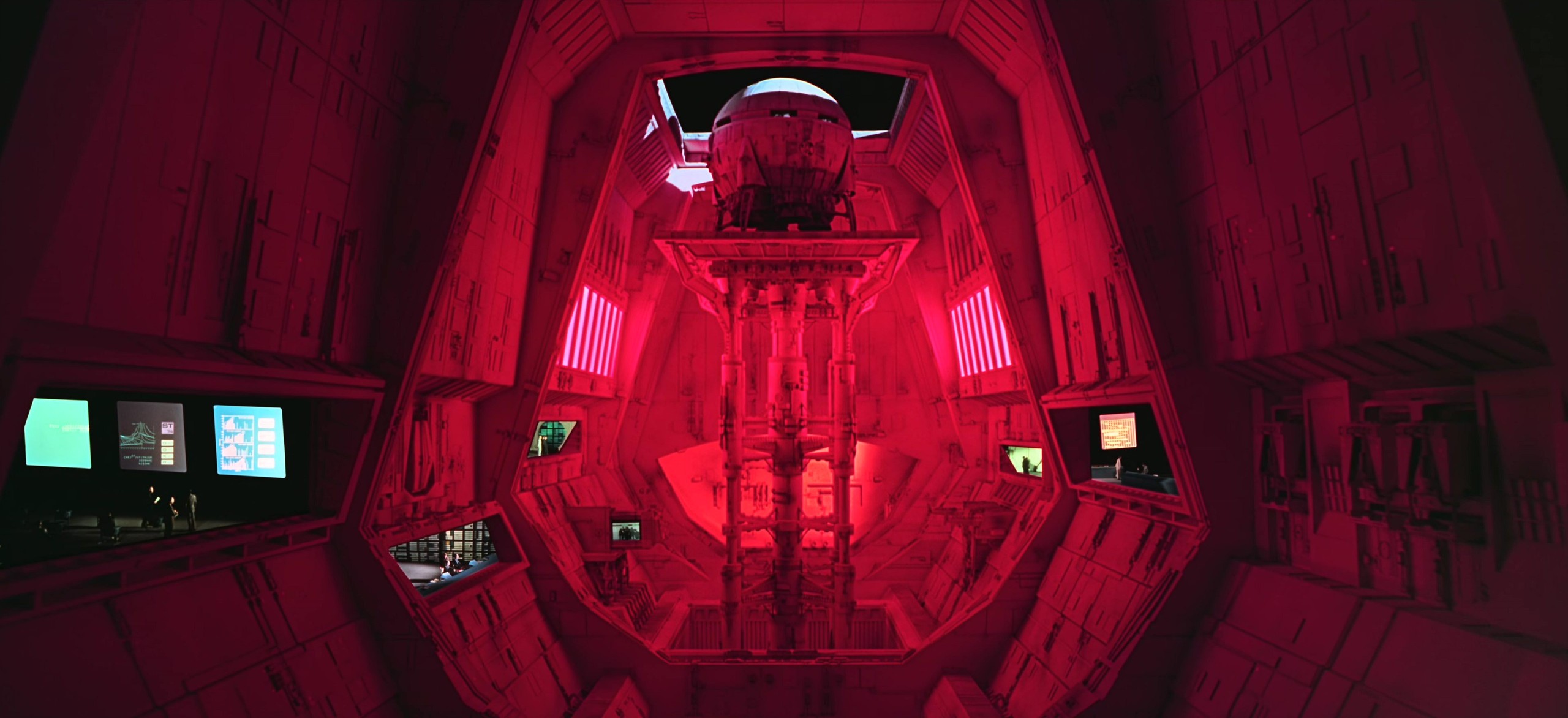
The lit windows were a separate pass. The model was shot once with its windows blacked out, then the film was wound back and the moving interior image was projected into the windows onto the same original negative.Trumbull says all the moving window images were rear-projected. Lightman describes the interior action front-projected onto a glossy white card in the window area. Both may be true for different shots. Discovery’s six-foot command sphere was packed with projection equipment to put the astronauts in its windows. The Aries model had a projector aimed straight down through its top to put astronauts in its cockpit, and when it is lowered into the red-lit hangar at Clavius it passes ports with people moving about in them.
Chapter 4: Held Takes and Mattes
- Stage H, Shepperton
- First live action
- Late December 1965
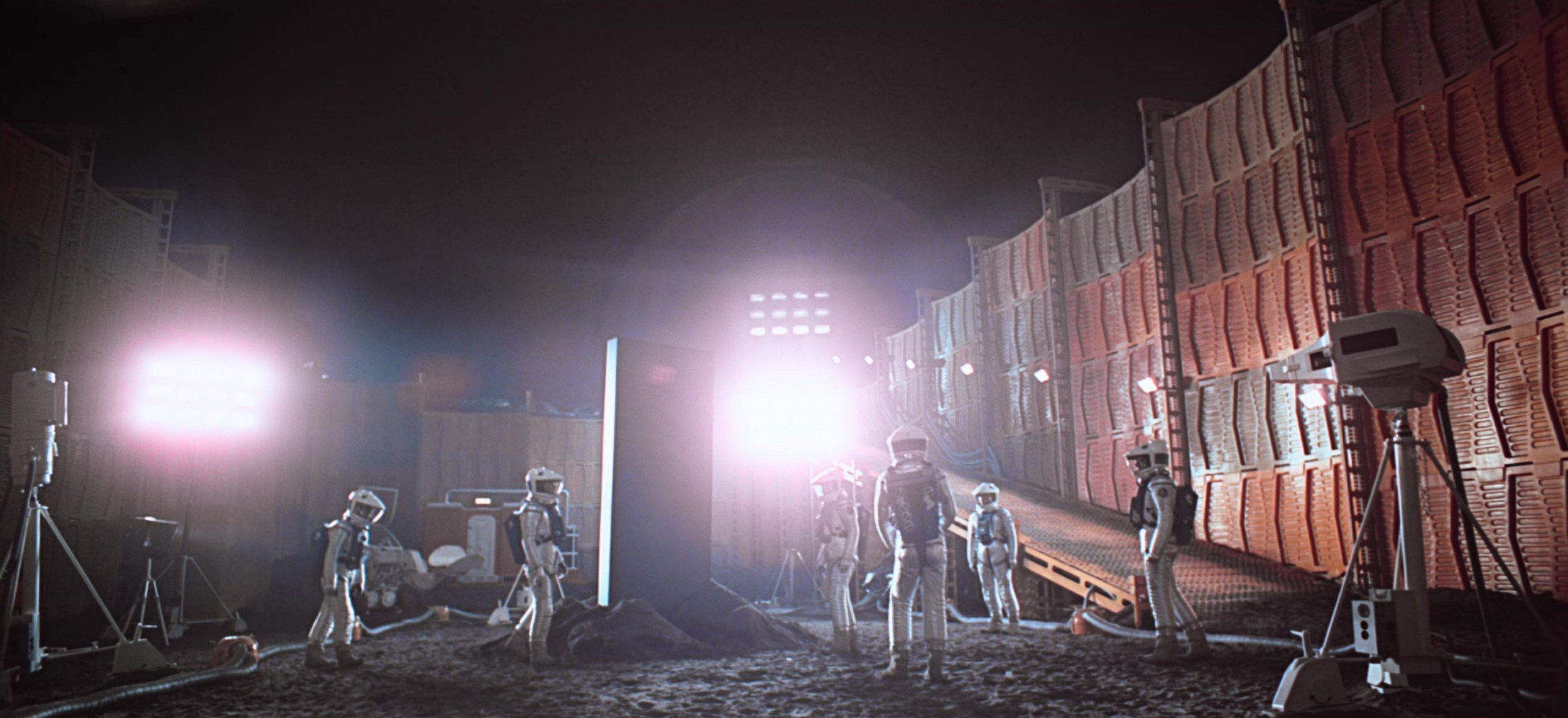
The first live-action scene shot for the film was the Tycho excavation, on Stage H at Shepperton, in late December 1965. Suited astronauts stand around the monolith in a floodlit pit, with banks of lamps blazing behind it and a camera on a tripod at the edge. The set held only a small piece of lunar ground at one end for the astronauts to walk on, so the shots that show the whole moonscape, the stars and the Earth were finished later. Their negative was held undeveloped for nearly a year while it waited.
These were called held takes. One element was exposed onto the original negative, the negative was stored, and months later the next element was exposed onto the same film. Trumbull remembered film going into a freezer between sessions. Every element had to match the same single point source in angle and intensity, and each was wedge-tested first, shot as a strip of frames at stepped exposures so the right one could be picked before the real negative was risked. Kubrick coined a word for the retakes, re-don’ts, and Trumbull recalled five or six failures for every shot that worked.
The sky took just as long. After almost a year of failed moon models, the Moon seen from space came from the Lick Observatory’s astronomical glass plates, and the Earth, Jupiter and its moons were backlit Ektachromes shot from large paintings. The moonscape miniatures used extreme forced perspective in only about five feet of real depth. Where depth of field still failed, the model was photographed as two 4x5 stills, one focused near and one far, which were pasted together and filmed on the animation stand.
Then everything had to be combined, and Kubrick refused the standard way of doing it. A blue-screen travelling matte means shooting the model against a blue backing, and that blue would have spilled into the shadow sides of the white models as fill, the one thing this photography couldn’t allow. So the ships were matted over the stars by hand. Each 70mm frame was projected through an ordinary darkroom enlarger onto a board with registration pegs, and operators traced the ship’s outline onto a cel and filled it in black; Lightman counts 20 of them. The cels were painted slightly oversize, because a star could never be allowed to touch a ship’s edge. The stars were airbrush spatter on glossy black paper, shot on the animation stand, and their speed was tested shot by shot so they would not strobe.
All of this meant duplicating film, and each generation of duplication normally costs grain and contrast. Kubrick said more than half the shots in the film are dupes. Every one went through black-and-white three-colour separation masters, Technicolor’s YCMs, and never through colour interpositives. Each master holds one of the colour negative’s three colour records as a black-and-white image, and Kubrick credited the method for the film’s low grain. Trumbull says most of the original effects negatives were shot slightly over-exposed, so that a higher printer light would protect the blacks through duping. Even so, a shot built from more than two or three sets of masters came out with greyed blacks, and the fix was to keep at least one element as untouched original negative.
Kubrick counted 205 effects shots and said they took up most of his time from June 1966 to the first week of March 1968. A pod hovering beside Discovery’s command sphere is worth studying with all of this in mind. It holds two models, astronauts projected into the sphere’s windows, mattes painted by hand and stars sprayed on paper, and every element had to match the same imaginary sun.
Chapter 5: The Centrifuge
- 38 ft wheel
- Strip lights
- Lens wide open
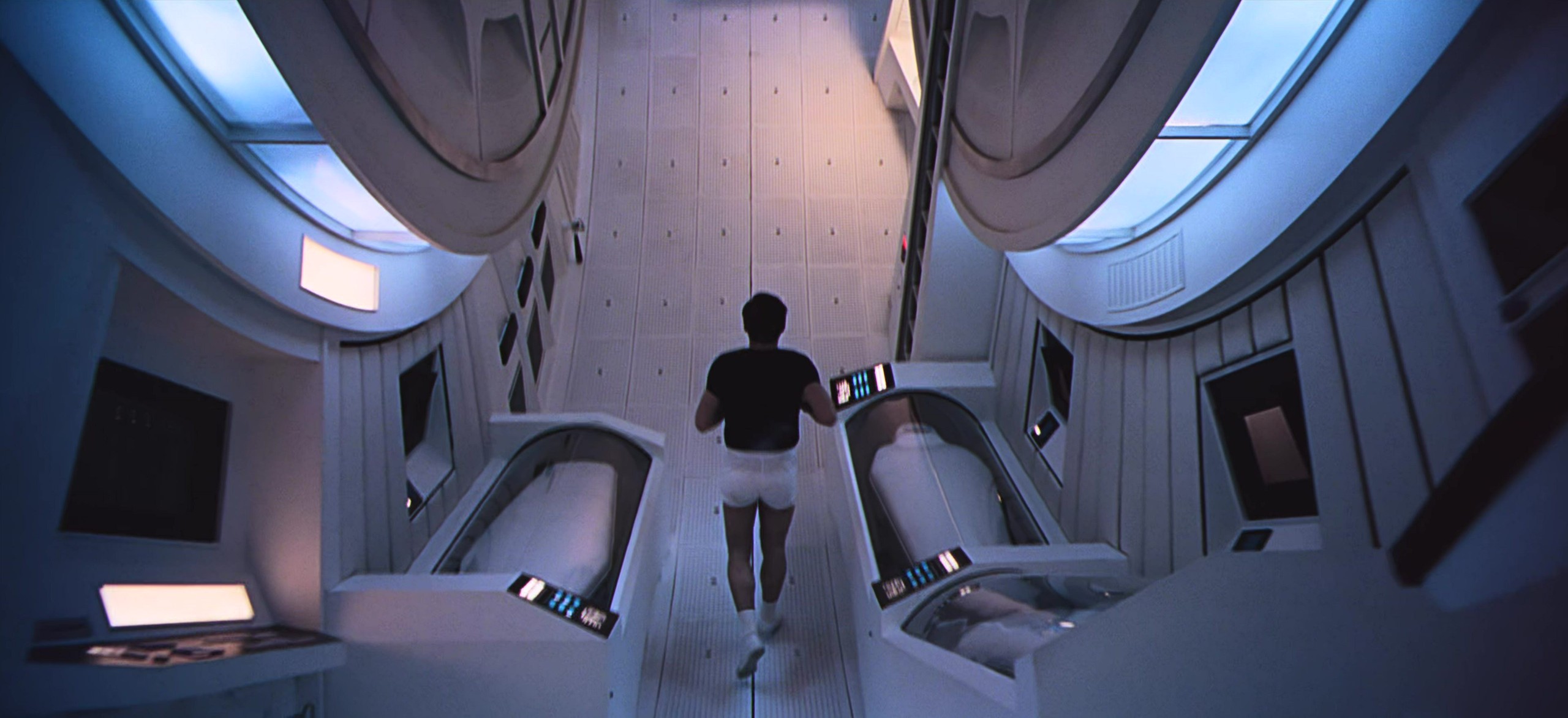
Frank Poole jogs away from the camera around the inside of a wheel, between the hibernation pods, while the floor curves up ahead of him and over the top. The set was built by the Vickers-Armstrong Engineering Group for $750,000: a wheel 38 feet in diameter and about 10 feet wide at its widest, which turned at up to 3 miles an hour.
There were two main ways to film in it. In the first, the camera was bolted to the set and turned with it, so as far as the camera was concerned it wasn’t moving, and on screen the room stays still while the actor walks up the wall and over the top. In the second, the camera stayed with an actor at the bottom while the set moved past. Kubrick describes a miniature dolly held about 20 feet up the wall by a steel cable running through a slot in the floor, hidden under rubber mats. He directed from outside, watching closed-circuit television from a small video camera mounted beside the film camera, in a control area netted with chicken wire.
All the light in the centrifuge came from strip lights along its walls, a scheme Kubrick says he planned with Unsworth and the production designer Tony Masters. Some of the strips are hidden in coves, and others show when the angle is wide. The lights, and the banks of 16mm projectors feeding the console screens, were bolted to the set and turned with it. Bulbs exploded and reels came loose, so hard hats were compulsory.
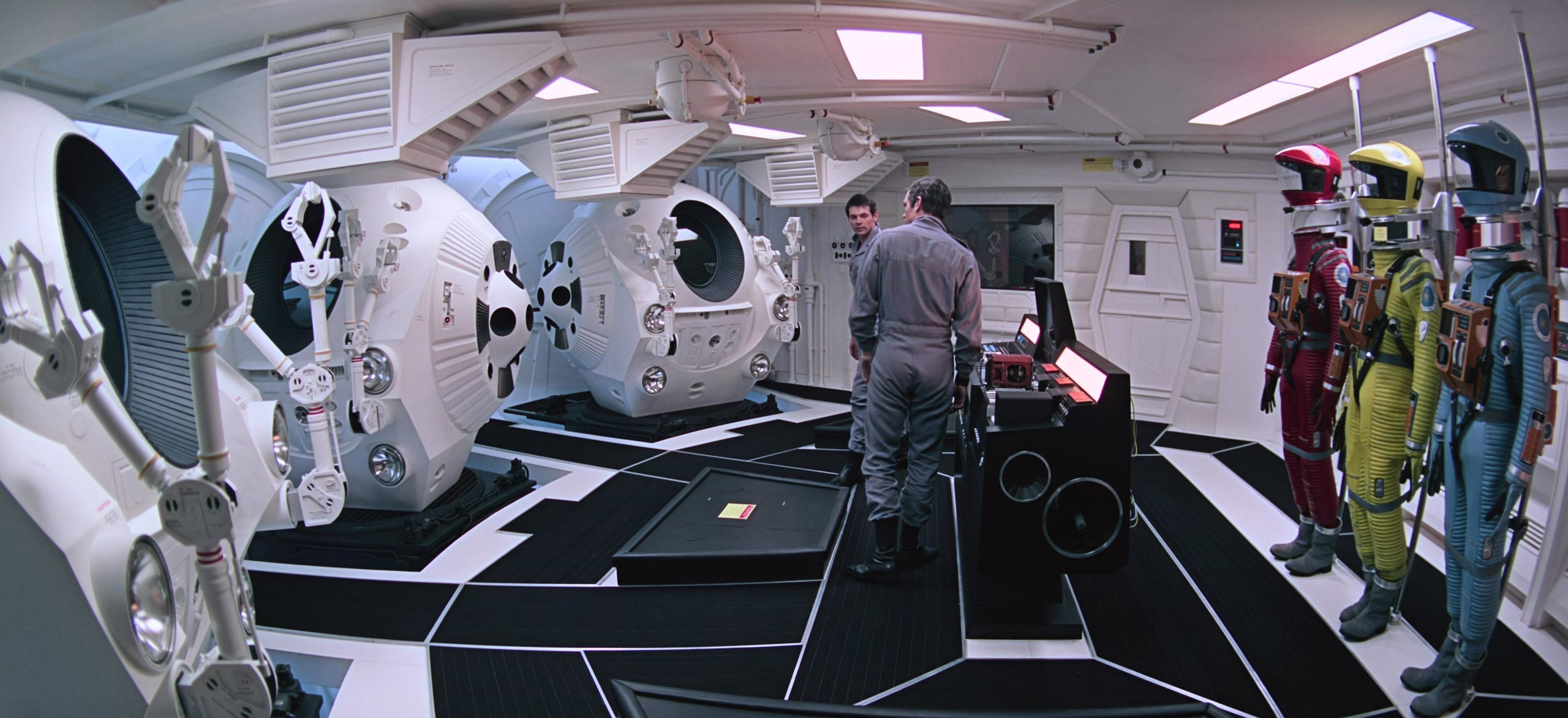
That was the rule across the ship. Trumbull wrote that almost all the lighting was part of the set itself, with extra units only for critical close-ups. The glowing screens in every cockpit were rear-projected animation running on set, not effects added later. Trumbull’s first job on the film was animating them. His team shot up to a thousand feet a day under a stop-motion 35mm Mitchell, and the readouts took nearly a year.
Lighting a set from inside makes exposure hard, because you can’t just add a lamp. American Cinematographer reported that Unsworth worked at the toe end of the film’s latitude much of the time, which means at the bottom of its range, where the shadows only just hold detail, and that he shot in scatter light and straight into exposed practical fixtures. In the centrifuge he had the lens wide open nearly all the time. I love that one film used both ends of the aperture ring: the models stopped down almost to a pinhole, the centrifuge wide open, and both because nobody would add a light the scene didn’t already have.
To judge setups like these, the magazine says, Unsworth photographed each new one on black-and-white Polaroid film, ASA 200, because colour emulsion wasn’t consistent enough, and about 10,000 Polaroids were taken during the production. A black-and-white print throws the colour away and keeps the contrast, and in a white room lit by its own walls, contrast was what had to be judged.
Chapter 6: HAL
- Nikkor 8mm fisheye
- Red filter
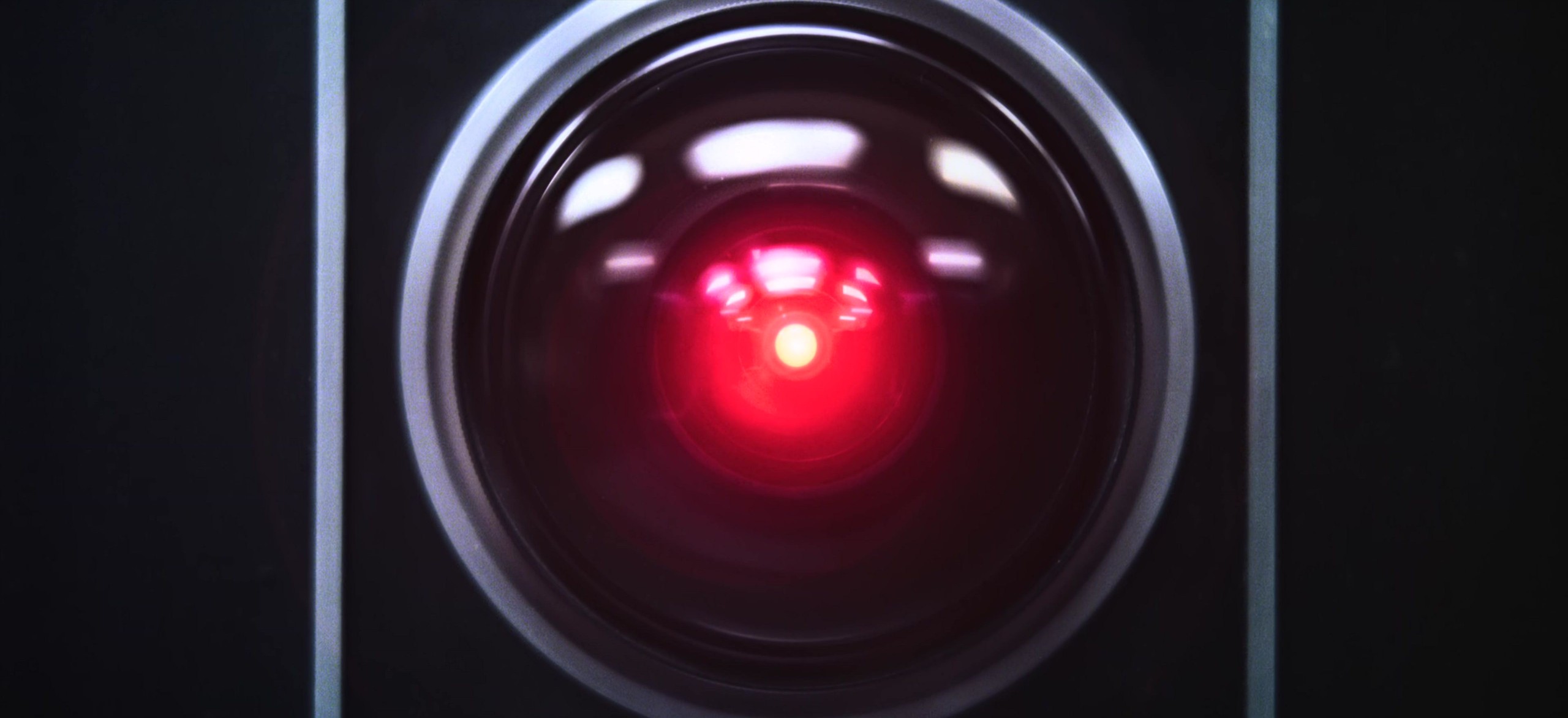
HAL, the computer that runs Discovery, is played by a lens. The eye that watches the crew from every room is a prop built around a Nikon Nikkor 8mm fisheye still lens, with light shone through a red filter behind it. A fisheye’s front element bulges out like an eyeball, so the lens already looks like an eye, and the red light makes it a character. Its whole performance is a glow with a bright point at its centre, and the camera only has to hold on it. I think it is the most economical piece of design in the film.
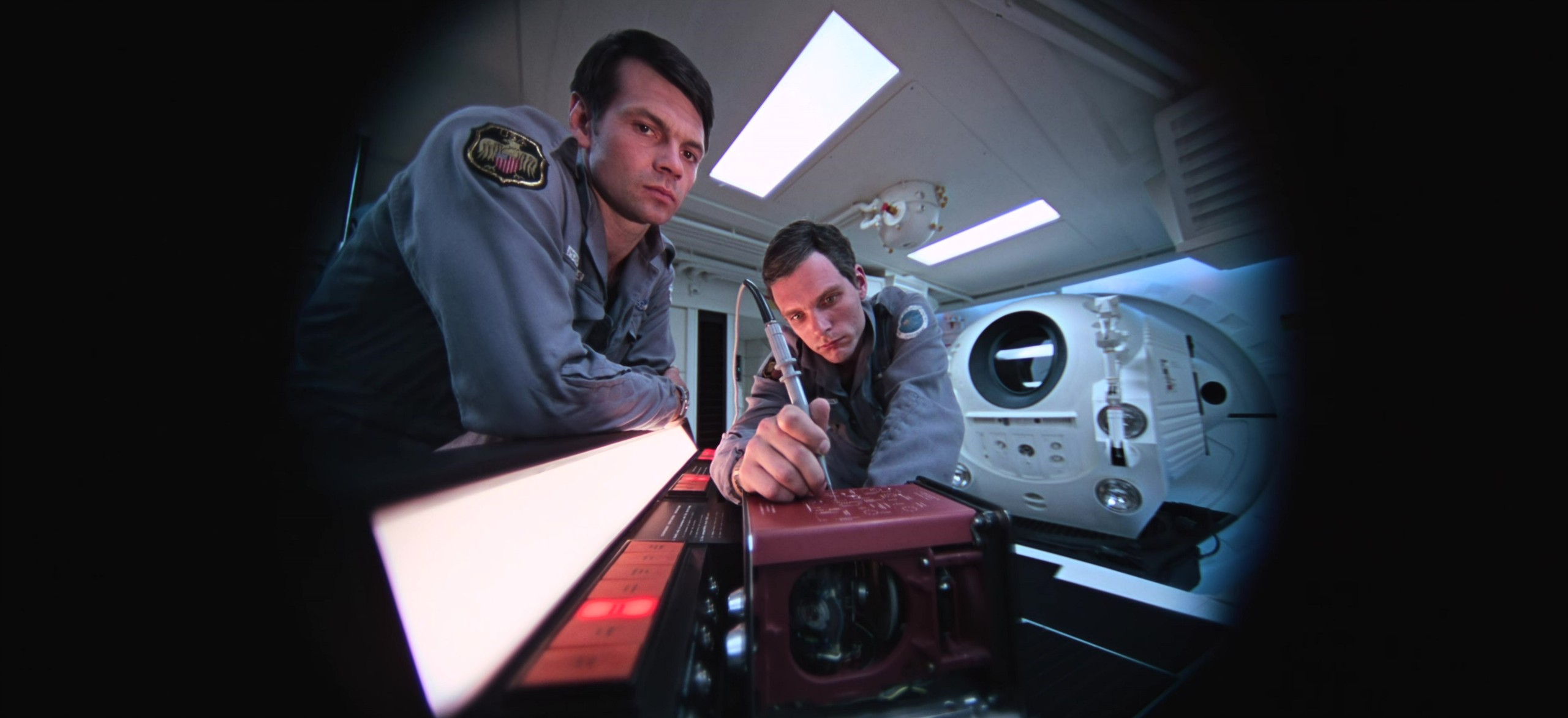
When the film cuts to HAL’s point of view, the picture becomes a distorted circle with dark edges. Bowman and Poole lean over a test bench in the pod bay and look straight into it, and the room bends away behind them. Which lens made those shots is unresolved. Some accounts, including one of Kubrick’s assistants, name a borrowed Fairchild-Curtis 160-degree mapping lens. Trumbull denied it, because that lens fills the 70mm frame and HAL’s view is a vignetted circle. I can’t settle it, so I treat the circle as a framing choice that tells you whose eye you are looking through.
When Bowman goes into the room that holds HAL’s memory to shut him down, the red of the eye fills the whole set.
Chapter 7: Weightlessness
- Built vertically
- Wires
- Overcranked
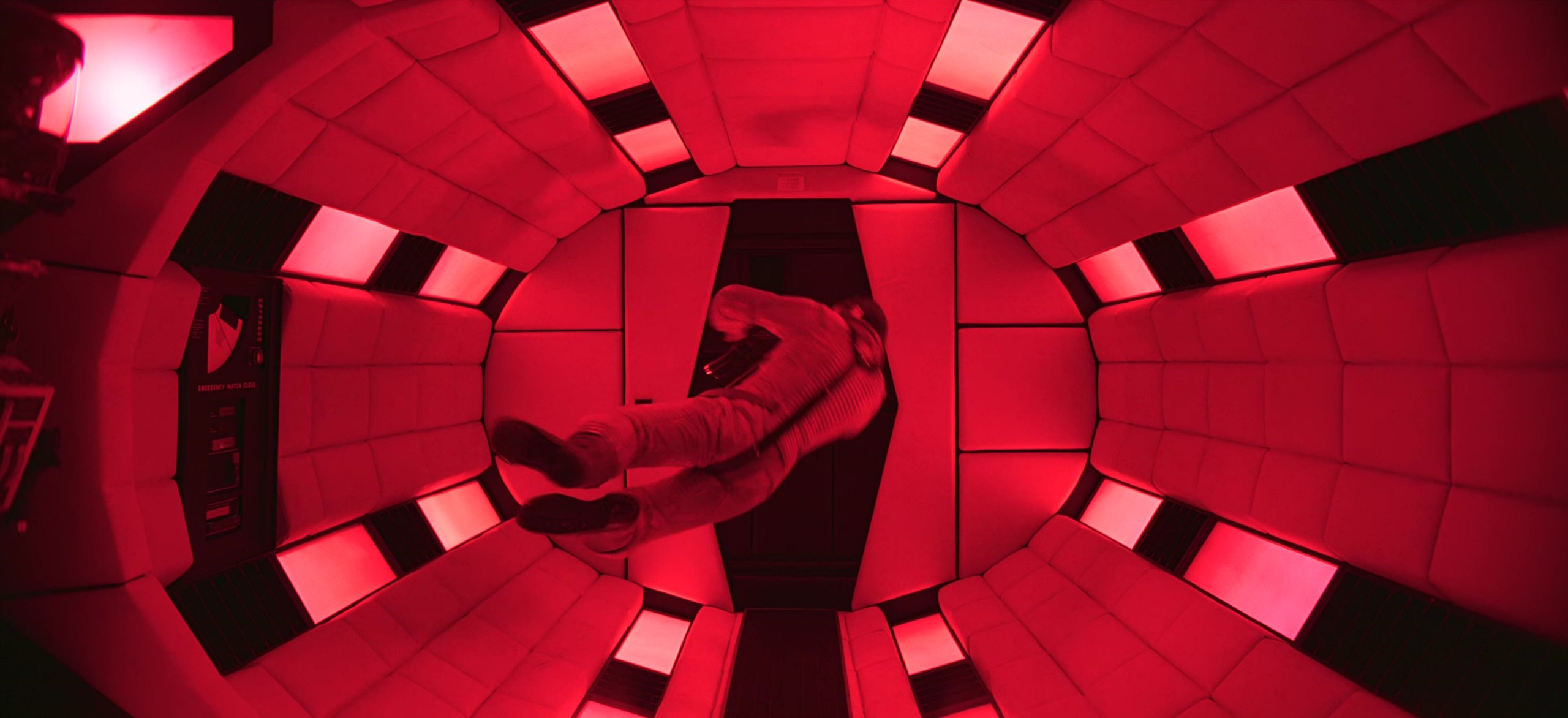
Bowman, without his helmet, blasts across the red-lit emergency airlock. The airlock was built standing up. The blast is the actor dropped on wires toward a camera pointing straight up, his body hiding the wires, and the shot was overcranked, which means the camera ran faster than the normal 24 frames a second, so the fall plays slower on screen than it happened on the stage. Turn the set through 90 degrees and a drop becomes a man blown sideways across a room.
The same idea floats the film’s other astronauts. They hung on wires under a black-velvet ceiling, with the camera pointed straight up so their bodies hid the wires, and hip, high-back and low-back harnesses let them spin in any direction.
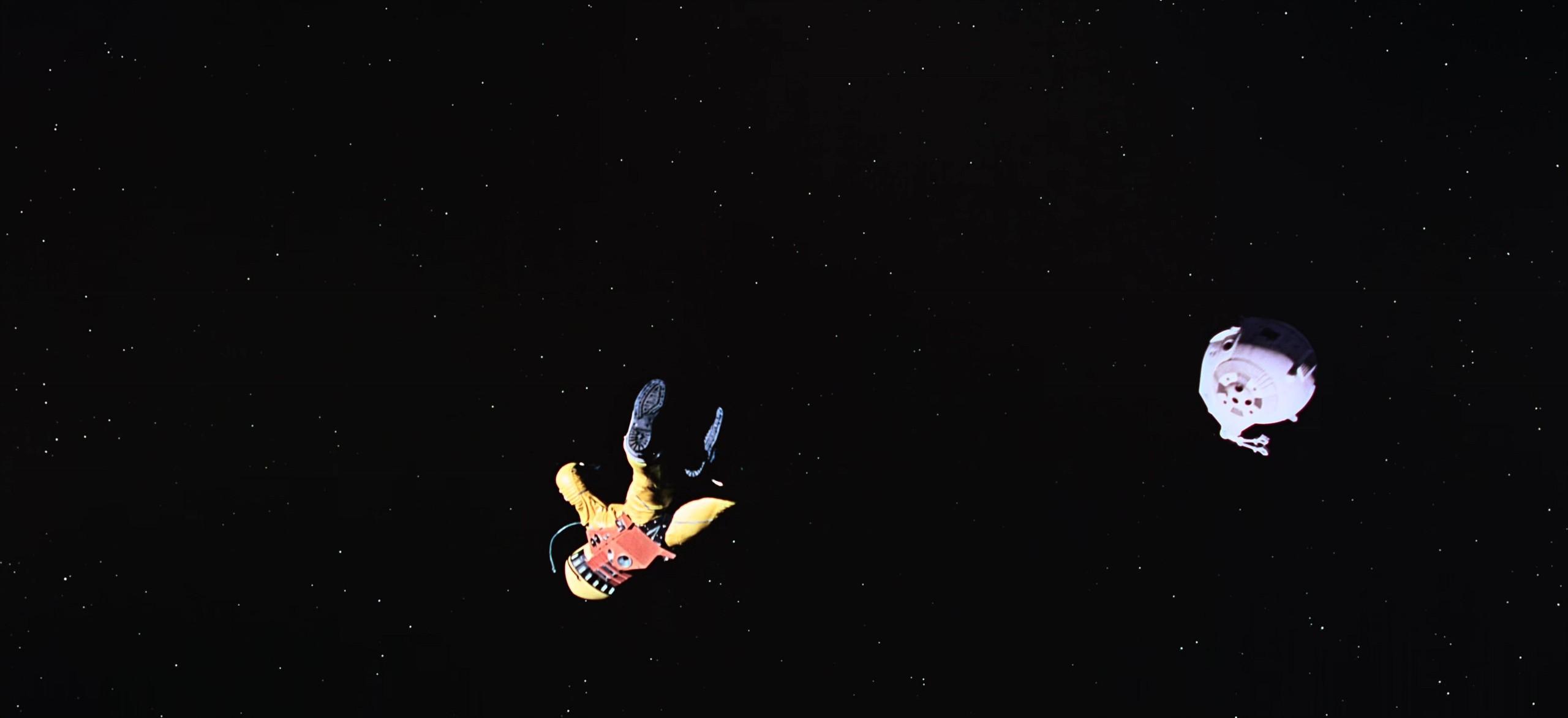
Poole’s death needed a different trick. After the pod kills him, his body tumbles away from the camera until it is a speck. Tracking back from a real man that far would have needed about 2,000 feet of track. Instead, 65mm footage of the actor tumbling was projected as a six-inch image onto a white card against black velvet, and the camera tracked away from the card on the worm gear. Trumbull says the same small card carried many of the film’s tumbling astronauts. The tiny image stayed free of grain, which makes sense: a whole 65mm frame was being shrunk to a speck.
On the Orion, the pen floating beside the sleeping Dr. Floyd hangs on monofilament in the long shots, and for the close-ups it was glued to a rotating glass disc, eight feet across by Trumbull’s account.
Chapter 8: The Star Gate
- Slit-scan
- Backlit artwork
- Minutes per frame
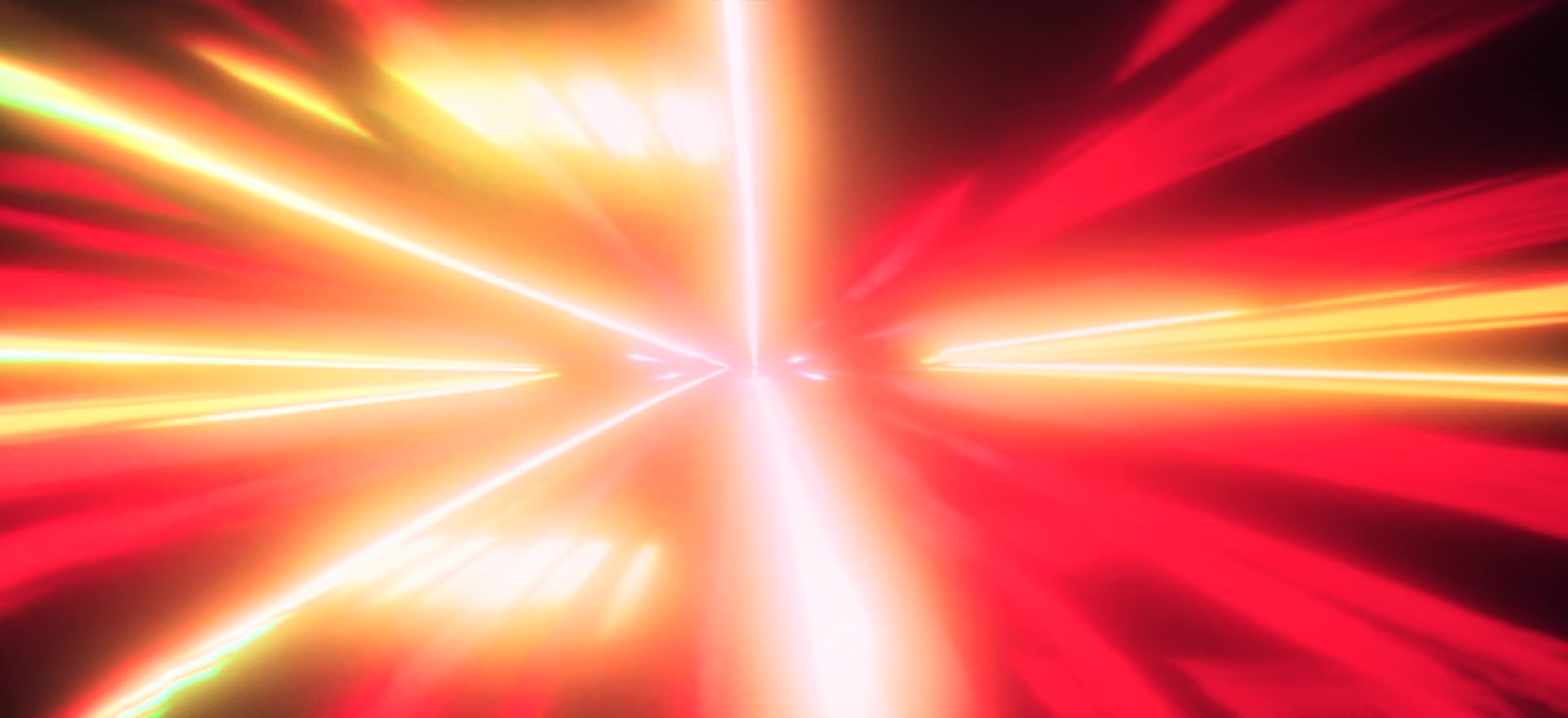
Near the end, Bowman leaves Discovery in a pod, and the screen opens into two walls of streaming light that rush toward the camera on either side of a vanishing point that never arrives. Trumbull made it on his Slit-Scan machine, adapting the principle from John Whitney’s experiments, in which the camera moves while the shutter is open.
Backlit artwork, abstract paintings, photo blow-ups and the like, slid sideways behind a narrow slit in a black mask. The camera crept toward the slit on a worm-gear track with its shutter open, so each frame was a single time exposure lasting minutes.Trumbull’s 1968 article says about a minute a frame. In 2018 he said four minutes, and another account says five. With the camera far away, the slit is a thin line near the centre of the frame. As the camera creeps closer, the slit’s image grows and slides outward toward the edge, painting the artwork across the frame as it goes. All of that lands on one frame, so the slit sweeps out a whole plane of light from the vanishing point to the edge of the picture. A second pass with the camera moved builds the opposite wall. By the next frame the artwork has slid a little further, so the pattern on the walls changes, and at 24 frames a second the walls stream past.
- After John Whitney: the camera moves while the shutter is open.
- Backlit artwork slides behind a narrow slit in a black mask.
- Each frame is one long exposure: minutes per frame.
- A second pass builds the opposite wall.
- Depth of field from 15 ft to 1.5 in at f/1.8.
- It ran 24 hours a day; about a quarter of the output is in the film.
Trumbull’s 1968 figures say the depth of field held from 15 feet to an inch and a half from the lens, at f/1.8. The machine ran 24 hours a day, and he estimates that only about a quarter of what it produced is in the film.
The film keeps cutting back to Bowman’s face, and the bright colours flashing across his visor are reflections of the pod’s instrument panel, filmed at 12 frames a second. The cosmic clouds and exploding stars that follow the first corridor were made very small. They are chemicals interacting in a camera field no larger than a pack of cigarettes, so some of the biggest-looking images in 2001 would fit in a pocket.
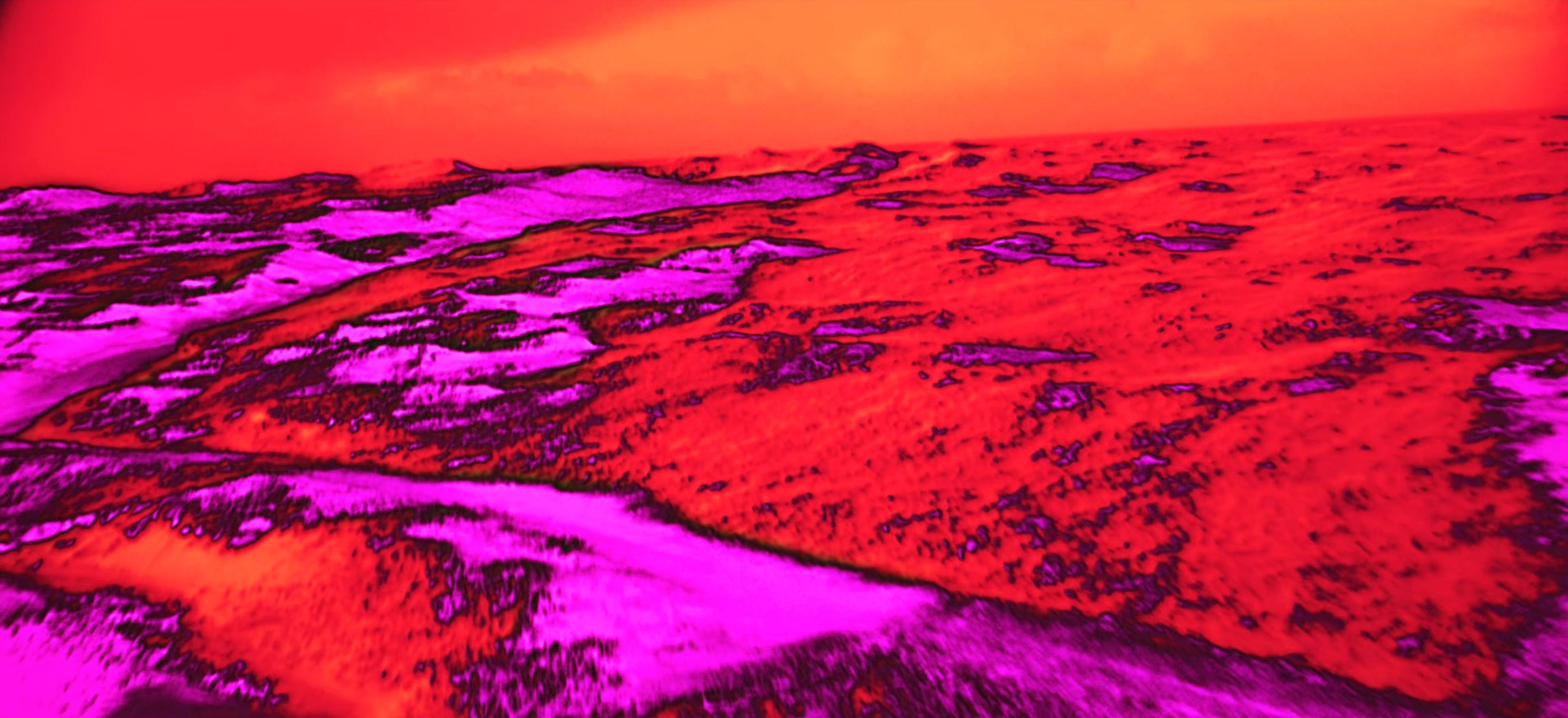
Then come the landscapes. They are aerial footage whose colours were scrambled by juggling the colour filters at the YCM separation stage, through the same black-and-white masters as the effects shots, and Trumbull says finding the key took months. Scottish newspapers place some of the flying over the east side of Harris, in the Outer Hebrides, and Monument Valley is also named among the locations.
Chapter 9: The Room
- Luminous floor
- Stage 4, Borehamwood
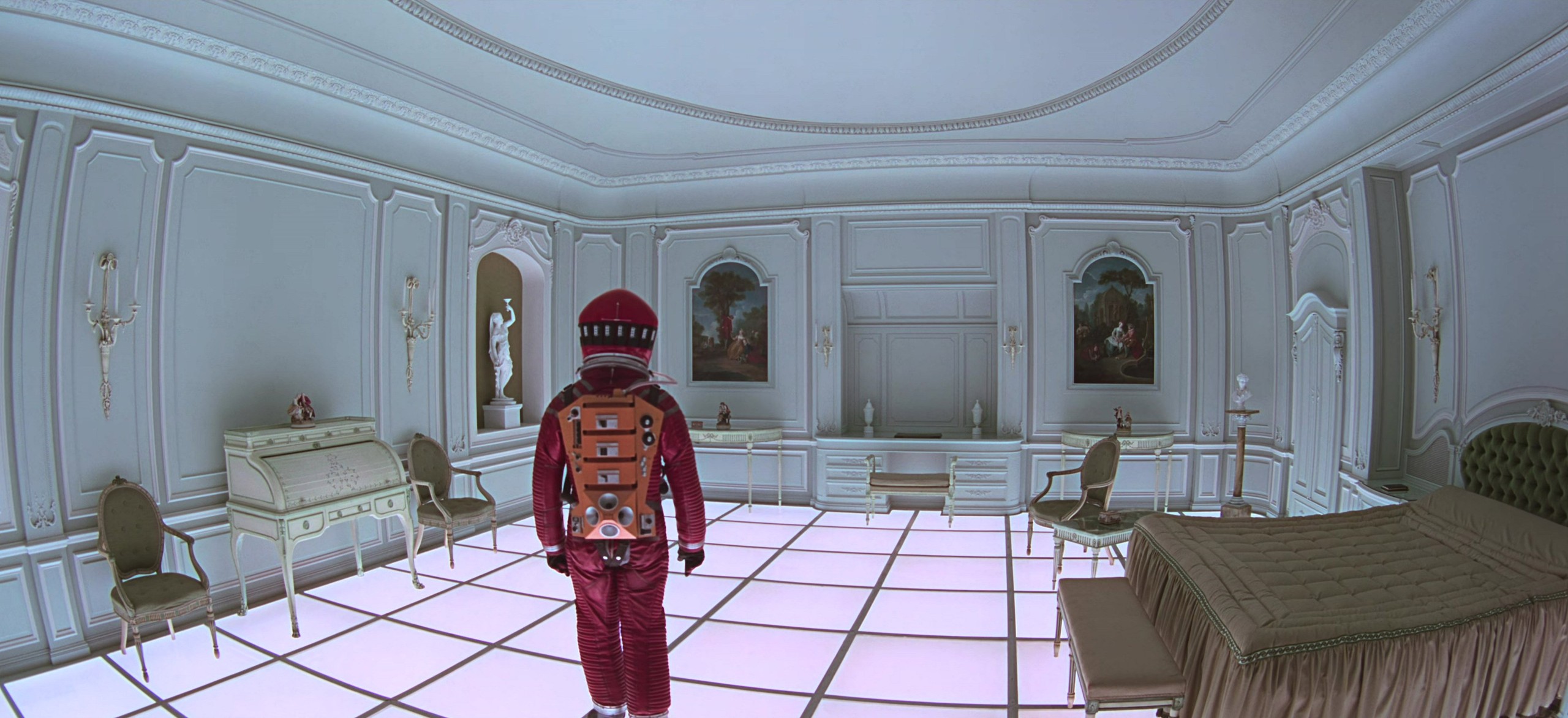
The pod comes to rest in a white bedroom, an 18th-century-style French room, and the light in it comes up through the floor. Lightman describes a luminous floor, and the Smithsonian says Tony Masters kept only the softly lit floor from an earlier design of the room. It was built on Stage 4 at Borehamwood, the same stage as the centrifuge and the emergency airlock.
After a film of single hard suns, the room is the reverse. The light comes from below, soft and even, and almost nothing casts a hard shadow. It is still light built into the set, the rule from the centrifuge carried as far as it will go, with the whole floor as the source. Bowman grows old in it in a few cuts, and ends up in its bed.
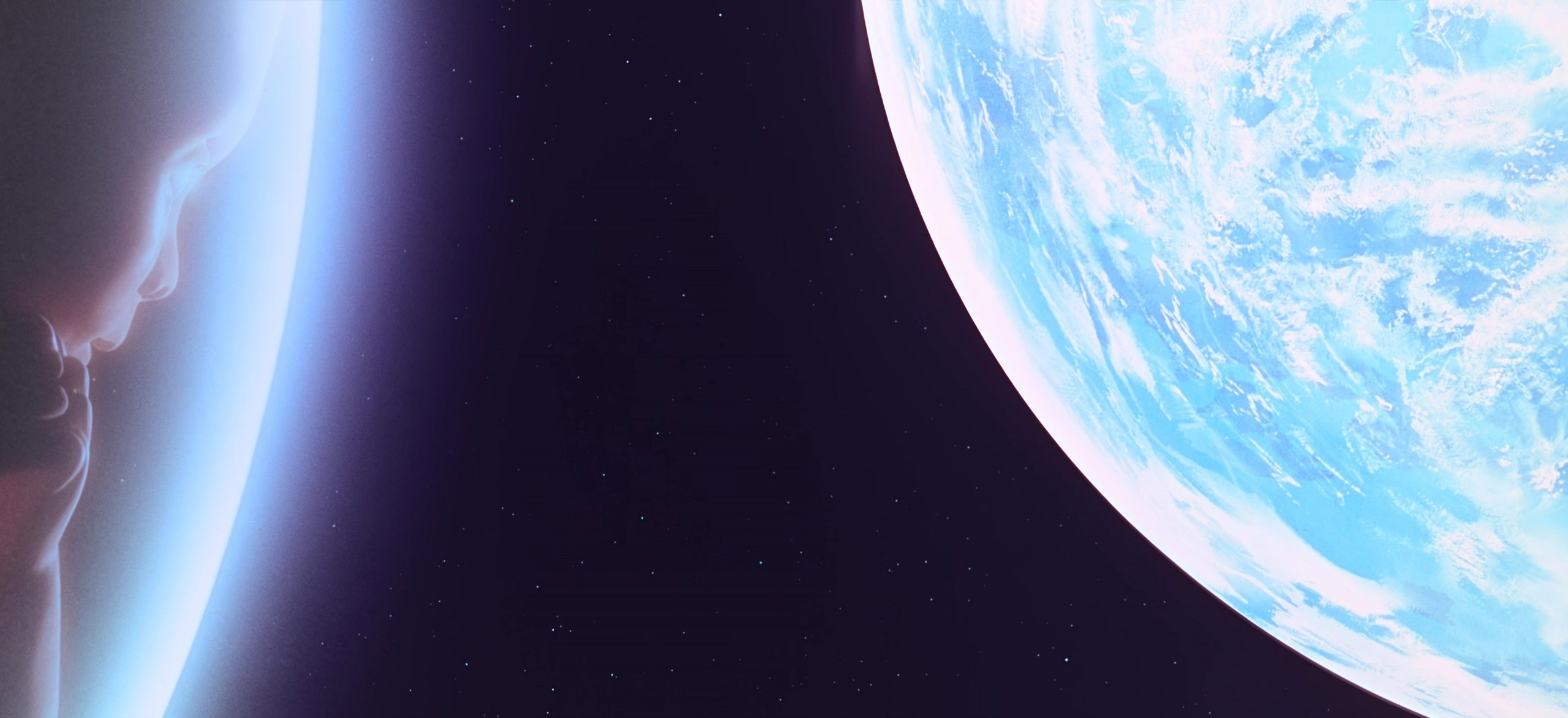
The last image is a made object too. The Star Child is a sculpture by Liz Moore, made after test shots of a real baby on black velvet didn’t satisfy Kubrick, and its features were modelled on Keir Dullea, who plays Bowman. It hangs in its sphere beside the Earth, against black, the way every spacecraft in the film was shown.
The film is full of solutions like that. A desert came in through a half-silvered mirror, and the ships were lit by one lamp and given four seconds a frame to take it in. The rooms carried their own light and the camera rode with them. The Star Gate is a slit and a long exposure, and the colour of another world came out of a set of black-and-white masters. Unsworth and Alcott weren’t nominated for any of it, and the effects Oscar went to one man, but in almost any frame of the film I can’t pull the photography and the effects apart. Fifty-eight years on, I think that is why it still looks like the real thing.
The Shot List