Barry Lyndon
Stanley Kubrick, 1975
How John Alcott and Stanley Kubrick photographed the eighteenth century by its own light: candles alone on a lens made for NASA’s Apollo-era programme, daylight from lamps kept outside the windows, and slow zooms that pull back until a scene becomes a painting.
Barry Lyndon was made without a single set. Every room in it is a real room in an existing building, most of them great houses in Ireland and England, and several of those houses stayed open to the public while the crew worked, so some scenes were shot between tour groups. By day the light in those rooms comes in through the windows. At night it comes from candles, with no film light added at all. To photograph a room lit like that, Stanley Kubrick’s production bought three lenses that Carl Zeiss had made for NASA’s Apollo-era programme, and Ed DiGiulio of Cinema Products adapted a Mitchell BNC camera to take them without ever meeting Kubrick in person.
The director of photography was John Alcott, and he won the Oscar for it. He had got his break on 2001: A Space Odyssey, when Geoffrey Unsworth left after the first six months and Kubrick asked him to carry on, and he had shot A Clockwork Orange for Kubrick since. He described that film as cold and stark, and this one as softer and more pictorial. I think Barry Lyndon may be the most beautiful film I have written about here, and nearly all of that beauty comes from decisions about light.
The story follows Barry, a young Irishman, from his first duel into a marriage with Lady Lyndon, and then through the loss of most of what that marriage gave him. I have kept it to what each picture needs.
Format
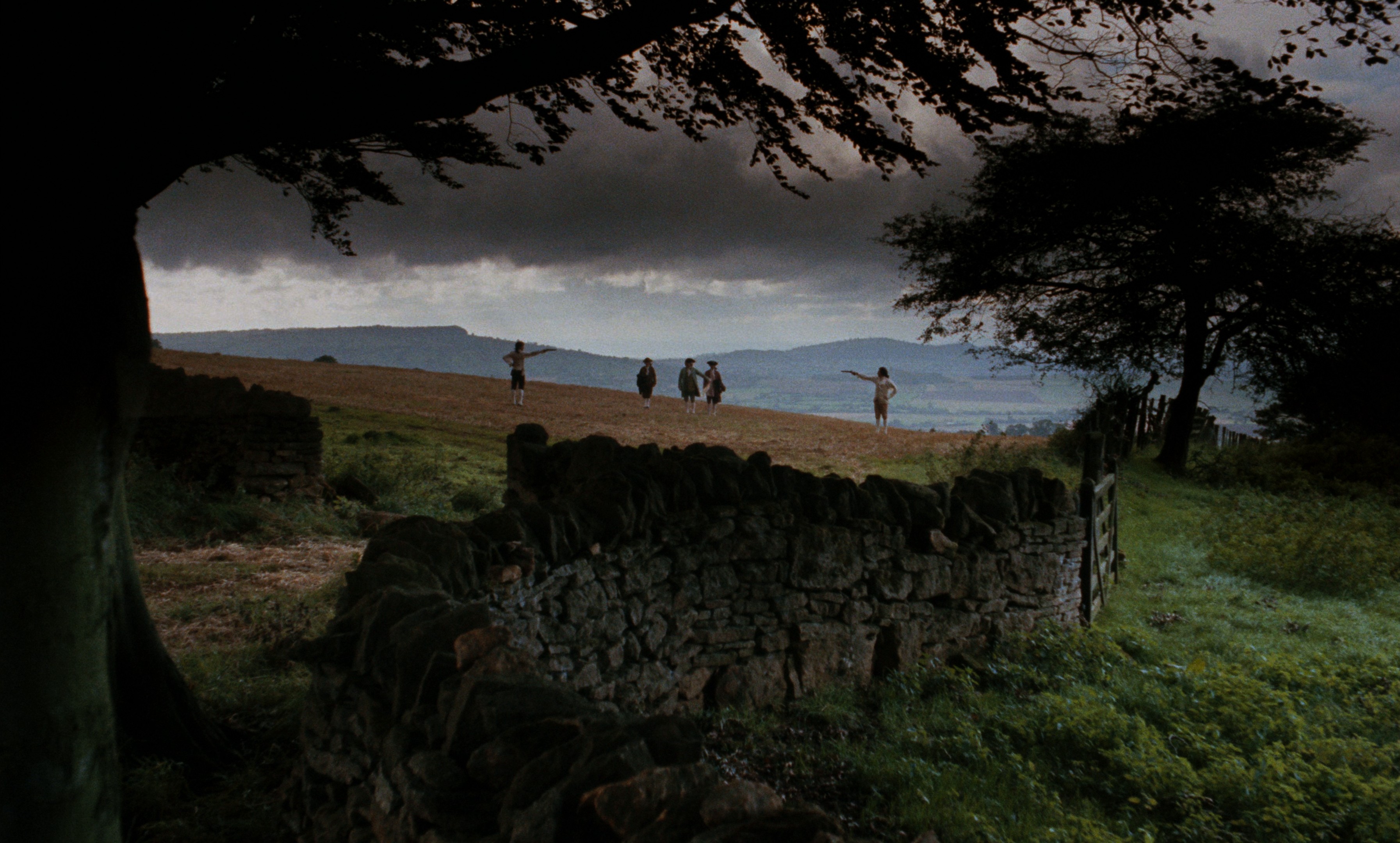
The film opens on a killing seen from very far away. Barry’s father dies in a duel, and Kubrick shows it in a static extreme long shot of open country, so the men are figures in a landscape before they are people. It is a cold way to begin, and it sets the distance the film likes to keep.
The look of that frame, and of every frame after it, starts with the film stock. Alcott shot on Eastman 5254, a colour negative rated at 100 ASA and balanced for tungsten light, and he had all of it push-processed by one stop, interiors and exteriors alike. Pushing means developing the film for longer, so that it behaves as if it were twice as sensitive, and the push took 5254 to an effective 200 ASA. The candle scenes needed that extra stop. The scenes that didn’t need it got it anyway, so that the whole film would look the same from the first reel to the last.
Outside, he left off the 85 filter normally used to correct daylight for a tungsten stock, which kept the look consistent and saved two-thirds of a stop. In front of the lens he used no gauzes and no diffusion. A Tiffen No. 3 Low Contrast filter stayed on throughout, lifting the shadows slightly and softening the contrast without blurring the picture. The one exception is the wedding, where he added a brown net to the filter to control the highlights on faces. He kept diffusion off because he wanted the clarity of the Irish air, and he called Ireland a paradise for photographers.
White marble fireplaces, wall panels and door frames glared, so the crew covered them with black net of about half-inch mesh. Bright areas that couldn’t be netted were held down with graduated ND3 and ND6 filters, and a custom matte box on the Arriflex 35BL took three filters at once. The 35BL shot almost the whole film. The exception was a Mitchell BNC, kept for the candle scenes, for reasons that take up the next section.
The shape of the frame matters too. Kubrick composed the film for 1.66:1, a little squarer than a widescreen television, and he specified it in a letter to projectionists dated 8 December 1975. Warner’s 2011 Blu-ray was framed at 1.78:1 and was criticised for it.Warner and Kubrick’s assistant Leon Vitali said Kubrick preferred 1.77:1. That conflicts with the 1975 letter, and I have gone with the letter. Criterion’s 4K restoration was made from a 4K scan of the original 35mm camera negative, which is open matte, exposed beyond the area meant to be shown. It was scanned at 16-bit and matted to 1.66:1, and its colour reference was the 2000 high-definition master supervised by Vitali. If you watch it, find the 1.66:1 version.
The Lens
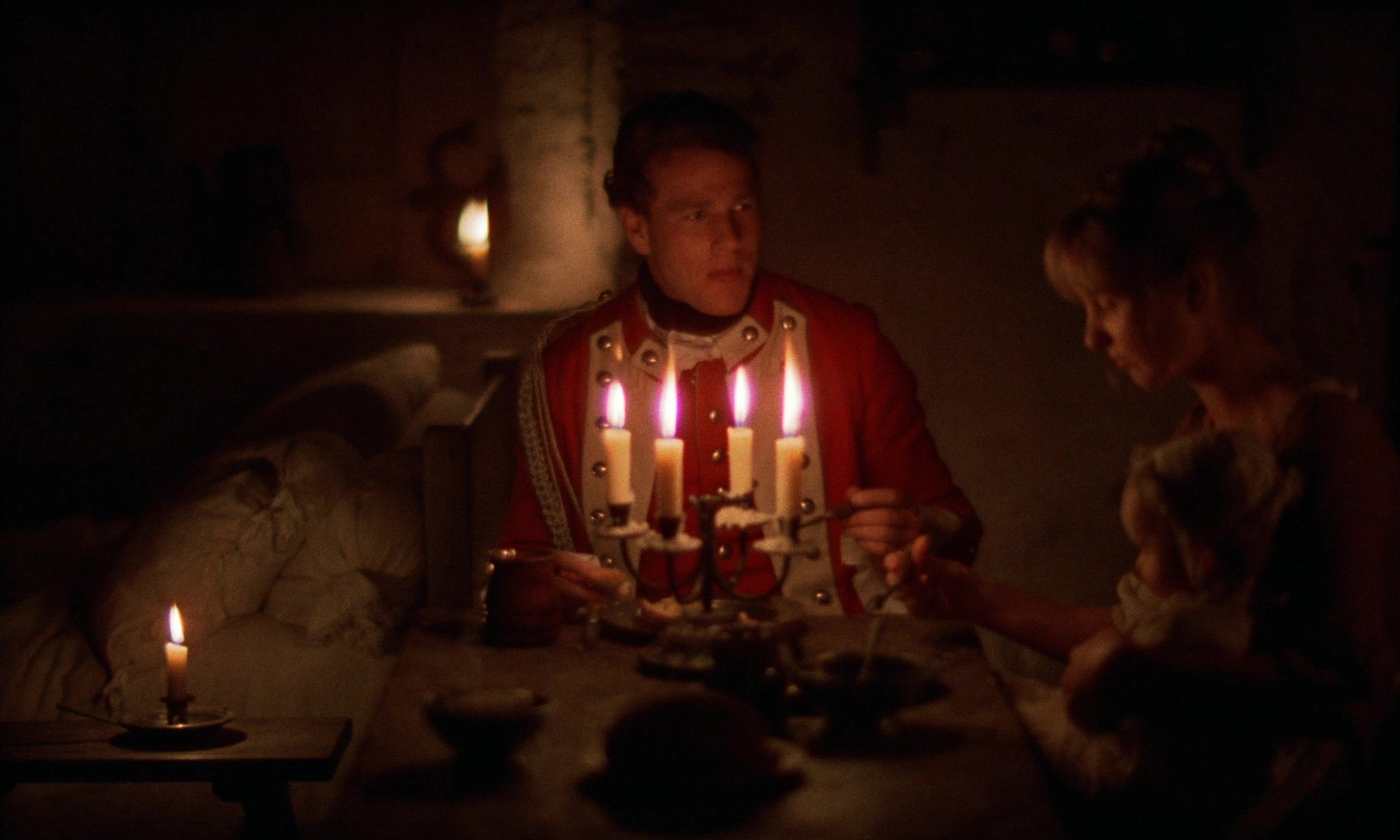
Barry’s supper with Lischen is lit only by candles, like every candlelit scene in the film. To see why that was hard, you have to know how little light a candle gives a movie camera.
Alcott says he and Kubrick first talked about shooting by candlelight alone when Kubrick was planning Napoleon, around the time of 2001. No lens was fast enough then. Barry Lyndon followed the collapse of Napoleon and reused its period research, and by the time it went ahead, there was a lens.
Carl Zeiss made only ten Planar 50mm f/0.7 lenses. Six went to NASA, and Alcott and DiGiulio both describe them as still-camera lenses made for NASA’s Apollo-era programme.Many accounts say NASA used the lens to photograph the far side of the Moon. Zeiss says there is no evidence for that story, and that its Biogon lenses took the lunar photographs of 1968 and 1969. Kubrick’s production obtained three. Zeiss says Jan Harlan bought one first, collecting it in Oberkochen in 1972 directly from its developers, and then two more, for possible conversion to other focal lengths.
The number that matters is 0.7. An f-number is a lens’s focal length divided by the width of its opening, so a 50mm lens at f/0.7 has an opening about 71mm across, wider than its own focal length. The light a lens lets through goes with the area of that opening, so halving the f-number quadruples the light: f/0.7 passes (1.4/0.7)², four times the light of an f/1.4 lens. Add the one-stop push and you have eight times the exposure of an f/1.4 lens on unpushed film. Kubrick called it twice as fast as the fastest movie lens then in use, and his reasoning was arithmetic. A 35mm movie camera exposes each frame for about a fiftieth of a second, and candlelight cannot fill that time without a lens nobody had used before. He told Michel Ciment that “with this lens it was now possible to shoot in light conditions so dim that it was difficult to read.”Alcott writes t/0.7, but f/0.7 is the marked aperture, and no measured T-stop for the lens has been published.
Getting it onto a movie camera fell to DiGiulio, the president of Cinema Products Corp., to whom Haskell Wexler had referred Kubrick while Kubrick was preparing A Clockwork Orange. DiGiulio’s first answer was that it couldn’t be done. The barrel was too wide for Kubrick’s BNC, and the rear element sat a few millimetres from the film,Accounts of the gap differ: about 4mm according to DiGiulio and Alcott, 2.5mm according to Kubrick, and just over 5mm according to Zeiss. too close to leave room for a reflex mirror. That ruled out every reflex camera, and left the non-reflex BNC.
DiGiulio’s account of what Cinema Products did reads like a series of small operations. As a still lens, the Planar had a Compur leaf shutter built in, so they dismantled it and reworked the iris leaves for manual operation. There was no room for a focusing mount, so the whole lens barrel turns inside the BNC’s lens port to focus, with a second locating pin to keep it concentric. They took out the camera’s adjustable shutter blade and machined the body housing and the aperture plate inward, so that a fixed blade could sit nearer the film.
The BNC is a rack-over camera: to compose, the body slides sideways to put a viewfinder behind the lens. With the rear element so close to the film, DiGiulio added an interlock to protect it. The lens had to be unscrewed nine full turns before a micro-switch would let the camera rack over to the viewing position.
When Kubrick asked for a wider lens at the same speed, Dr Richard Vetter of Todd-AO suggested a Kollmorgen adapter, built originally to adjust 70mm cinema projection lenses. In front of the 50mm it gave an effective 36.5mm, still at f/0.7. Alcott says the plain 50mm covered almost all the medium shots and close-ups, and the 36.5mm the wider coverage. A Dimension 150 adapter on another of the lenses made an effective 24mm, but Kubrick rejected it, because its distortion would not intercut with the other two.
Then it had to be focused. The barrel used a very fine thread: two full turns, 720 degrees, took it from infinity to about 5 feet. Alcott says the picture in the finder looked as if it had huge depth of field, but the test footage showed almost none. So the crew calibrated the focus scale by hand from film tests, from about 200 feet down to about 4 feet, marking distances to the inch. The usual prism side-finder lost too much light, so they fitted a mirror viewfinder taken from an old Technicolor three-strip camera.
How thin is almost none? For a medium close-up at 2.5 metres with the lens wide open, the band in focus is about 4 to 9 cm deep, depending on how strict a standard of sharpness you use.Neil Oseman’s stricter calculation gives about 4.3 cm. The standard thin-lens formula with a 0.025mm circle of confusion gives 8.6 cm, which is what the interactive below uses. Put the eyes in focus and the ears are already going soft.
The focus puller, Douglas Milsome, held it with television. A closed-circuit video camera stood at 90 degrees to the film camera, looking across the set, and its monitor, with a grid laid over it, was mounted above the lens scale. The actors’ positions were taped on the floor and transferred to the grid, which meant they could move a little and stay sharp. I love this solution. Seen from the side, a person’s distance from the lens becomes their position across a screen, so a problem in depth turns into a problem in left and right, which a focus puller can follow by eye.
Start at the default, f/0.7 focused at 2.5 metres, and look at how little of the room is sharp. Then stop down to f/8. The band of focus opens to about a metre deep, and the light needed for the same exposure climbs to 131 times. That is the trade Kubrick refused.
Candlelight
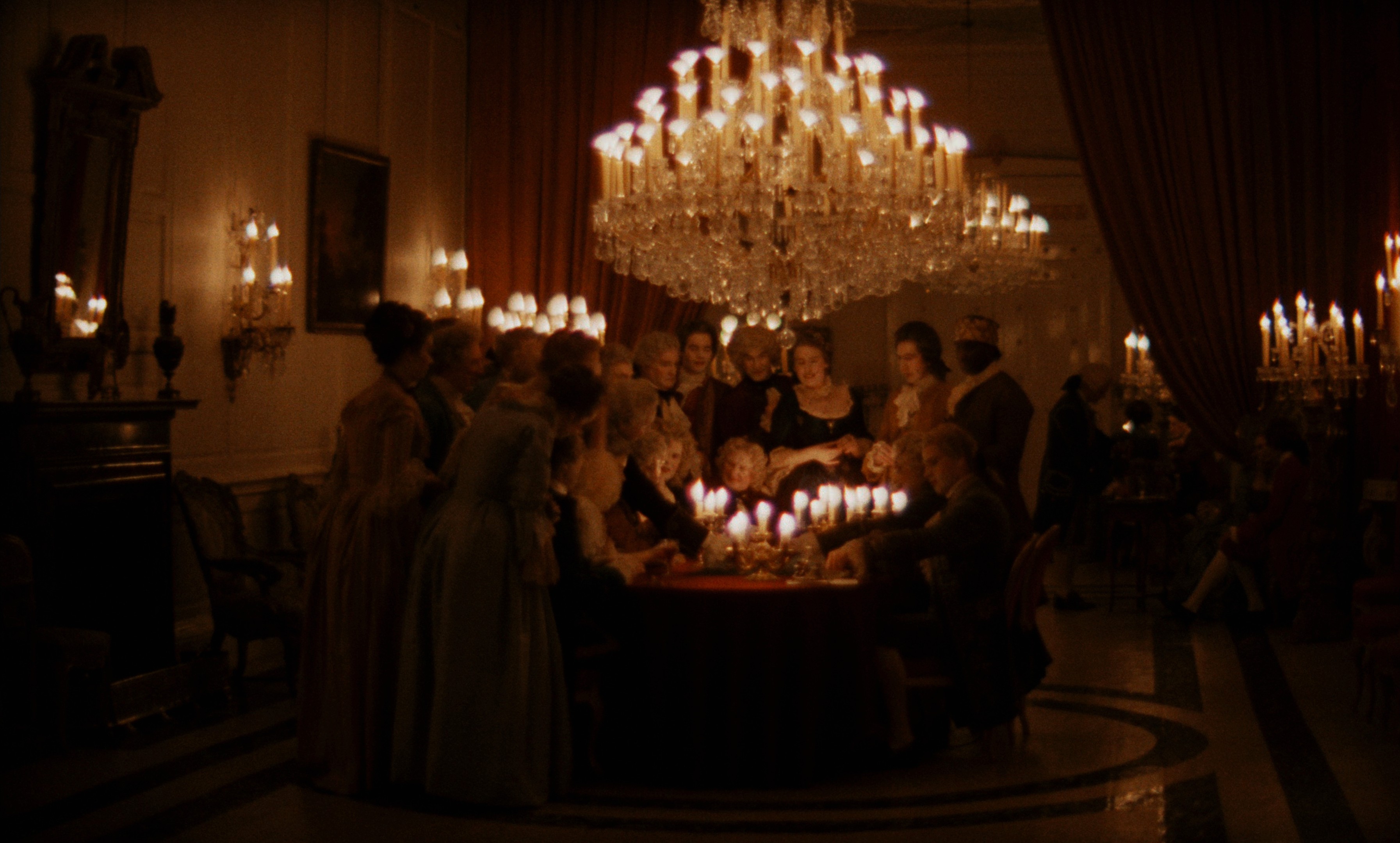
Alcott names the card game with Lord Ludd as a scene lit entirely by candles. Two chandeliers of 70 candles hang in the gaming room, and in the wide shot above, candelabra burn on the card table and sconces on the walls. Above each chandelier hung a metal reflector, which kept the candles’ heat off the ceiling and also bounced a soft toplight back down over the room.
The key light in these scenes was roughly 3 foot-candles. A foot-candle is about the light a single candle throws on a surface a foot away, so that is very little light to make a feature film with. Alcott metered it with a Gossen Panalux electronic meter, which reads down to half a foot-candle. Film and Digital Times has run the physics and works out that about seven triple-wick candles, two and a half feet from a face, give the required 3 foot-candles at f/0.7 and 200 ASA. A handful of candles is enough.
These were special candles. Each had three wicks, which made it brighter, and Film and Digital Times says the props department made them. The gaffer, Lou Bogue, says candlelight carries so little distance that the few candles you see in a frame were backed by many more out of shot. They burned down as the camera ran, so after a failed take the crew blew them all out and started again with new ones, and Kubrick ran a lot of takes: Ryan O’Neal recalls an average of 30, and TCM reports up to 50. Milsome and Bogue both remember how much of the room’s oxygen the candles used up, and Milsome remembers the smoke. Criterion’s account of the shoot says the reflectors were the answer: more light without more heat and smoke.
What Alcott did with that light surprised me. On the faces he went bright.
We actually went for a burnt-out effect, a very high key on the faces themselves.
Before the shoot, he and Kubrick had studied the Dutch masters and found their lighting a little flat, so they decided to light more from the side. Combine side light at a high key with a lens that holds a few centimetres of focus, and you get the look of these scenes: a face close to white against a room that falls away into brown and black, and often little is sharp except the face.
Marisa Berenson, who plays Lady Lyndon, says Kubrick’s only request of her was that she stay out of the sun, so that her pallor would match the period portraits. Under a key like Alcott’s, pale skin is exactly what you want.
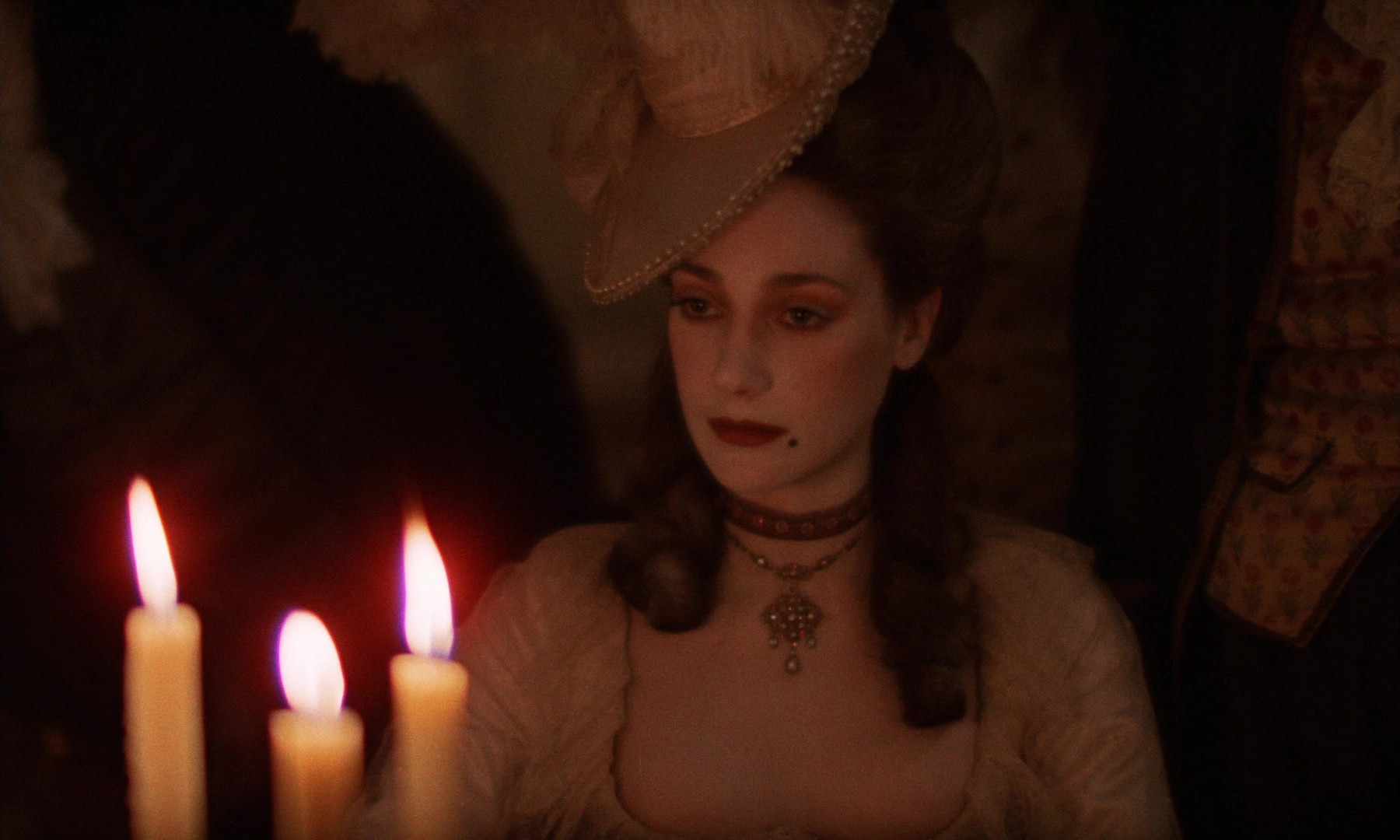
Window Light
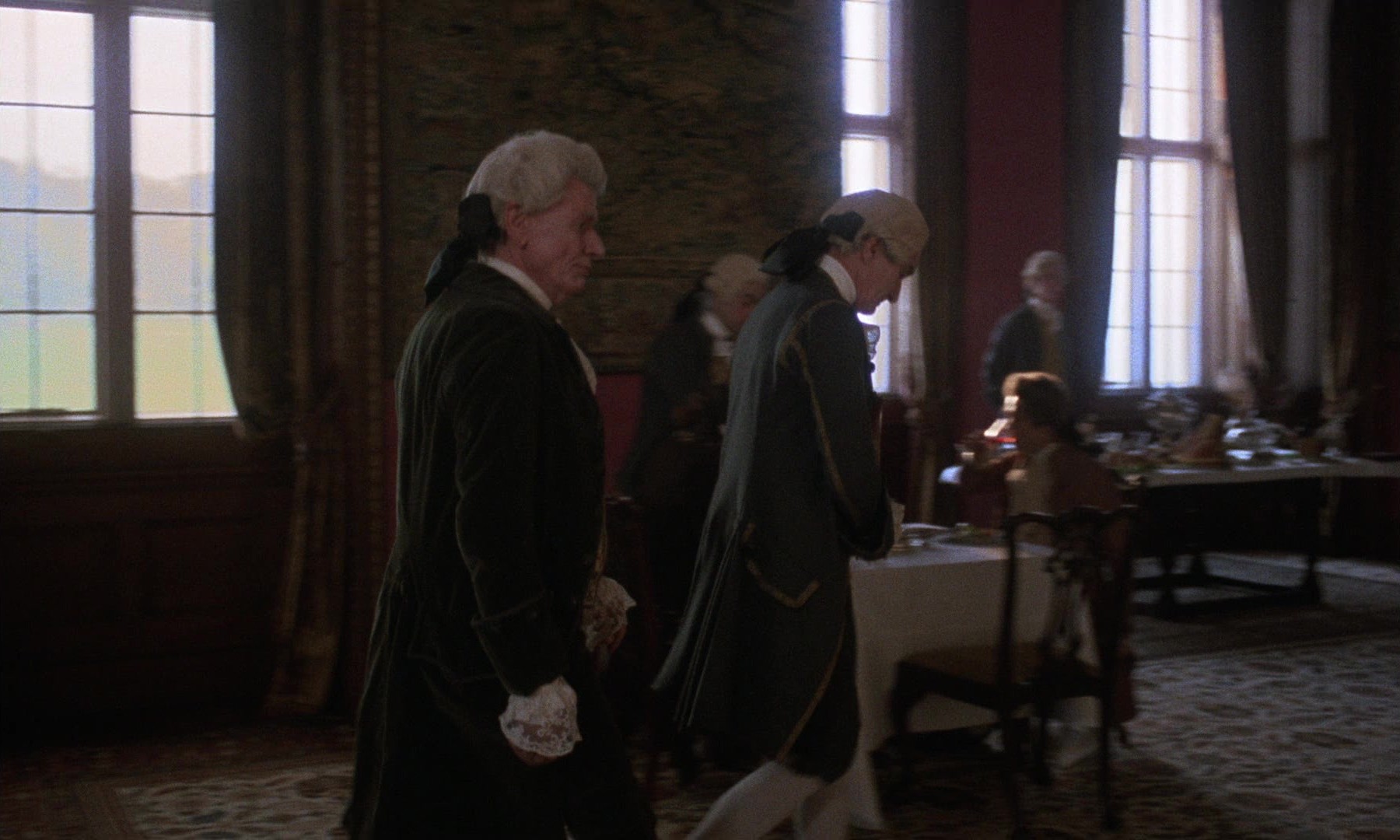
Alcott called this the hardest lighting job of the film. Lord Wendover snubs Barry, and the camera pans through 180 degrees past many windows, with the lamps hidden behind brickwork and the weather outside changing while they shot. A shot-by-shot study of the film places it in the Saloon at Longleat. A pan that sees most of a room leaves almost nowhere to put a lamp, and the light had to hold steady while the sky outside did not.
The day interiors worked on one principle: the lamps stayed outside. Mini-Brutes, banks of powerful lamps, stood outside the windows and shone through tracing paper, or a plastic equivalent, taped to the glass. Kubrick explained the advantage. With all the lamps outside, the camera can look straight at a window and get a realistic flare. Inside, the overall fill came from Lowel-Lights bounced into umbrellas, and the windows were usually gelled with custom ND3, ND6 and ND9 to match the light outside. Sometimes Alcott let uncorrected blue daylight into the background. For reverse angles that show the view outside, as in Lady Lyndon’s bedroom, the lamp rostrums outside the windows were wheeled away.
There was a practical gain too. Winter daylight lasted roughly from nine to three, and with lamps doing the sun’s work they could shoot from about eight until seven with a consistent look.
Alcott’s clearest example of shaping that light is the dining room where Bryan, Barry’s son, asks whether his father has brought him a horse. The room had five windows, the centre one much taller than the rest. Alcott let the light come from one source only, simulated with Mini-Brutes, falling on the centre of the table, and let the room fall off around it.
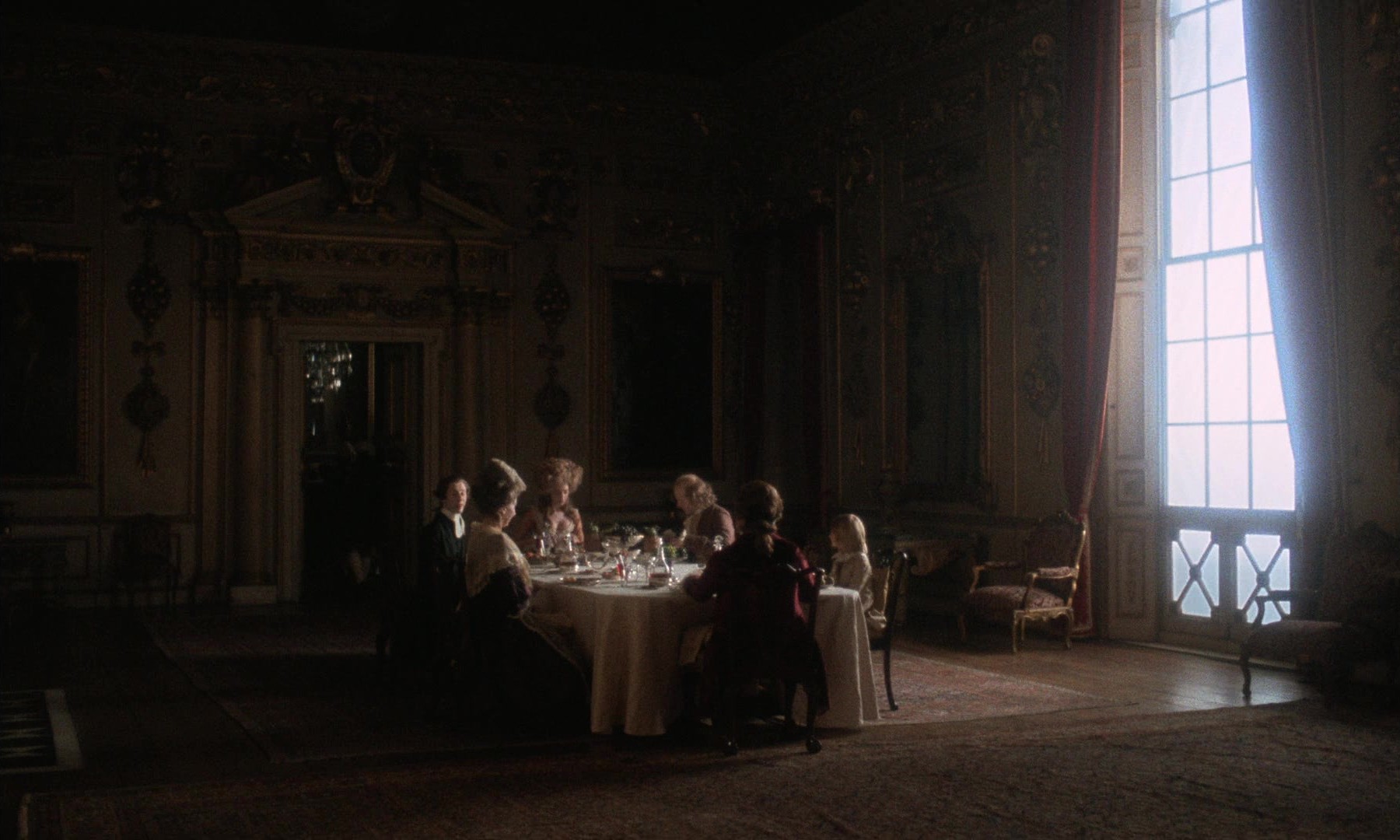
I think this is the most useful idea in the film for anyone who lights anything. Five windows would fill a room with soft, even light. One source gives the table a centre and lets the corners drop into shadow, and the result looks more like a painting of a dining room than a photograph of one.
The real sun still came and went, and the crew rode it. The 35BL’s finely geared aperture control let them adjust exposure during a take as the sun went in and out, as in the scene where Barry buys a horse for Bryan, so the iris followed the clouds.
Colour mattered as much as direction. After Barry’s leg is amputated, Alcott put a half-sepia gel on the window light in his room at the inn, warming the back light and the side light. He called it a 50% overcorrection: the light is pushed warmer than any correction would need. He used a similar effect on Barry as his son is dying.
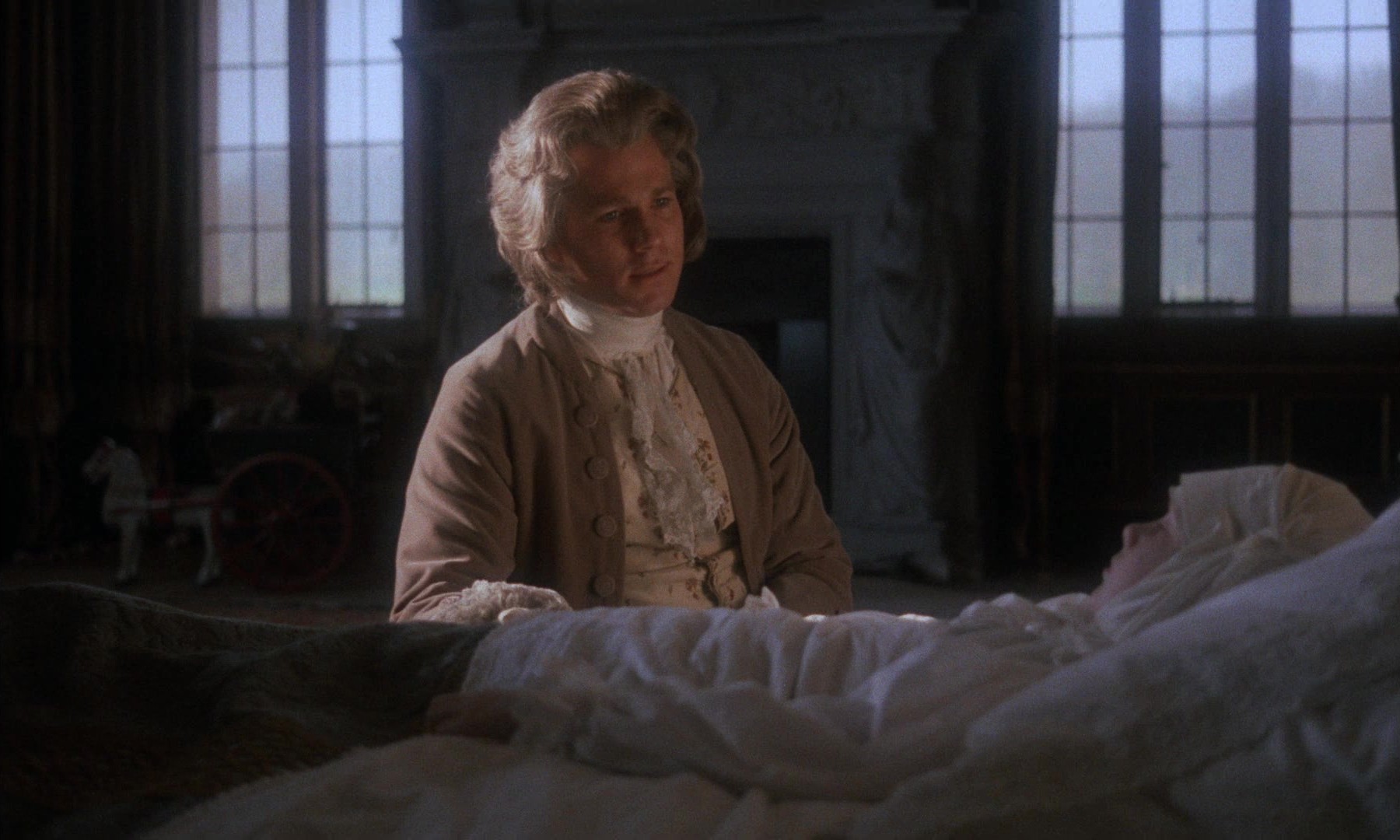
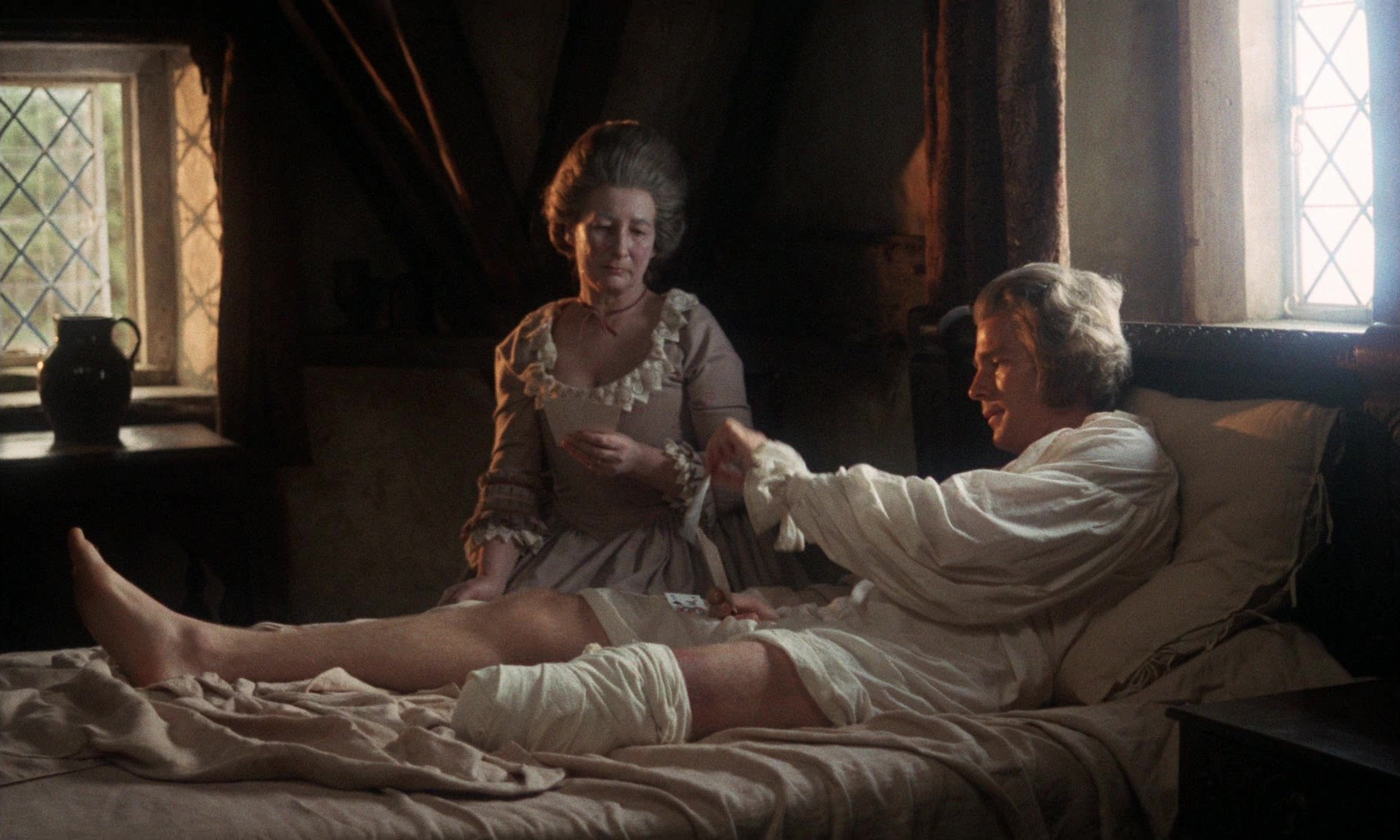
Alcott names only these two scenes for the warmed light, and both come at moments of loss. It is a quiet device, a sheet of gel on a window, and I like it more for being quiet. The room looks like the same plain room, and the light on the man in it has turned.
The Zoom
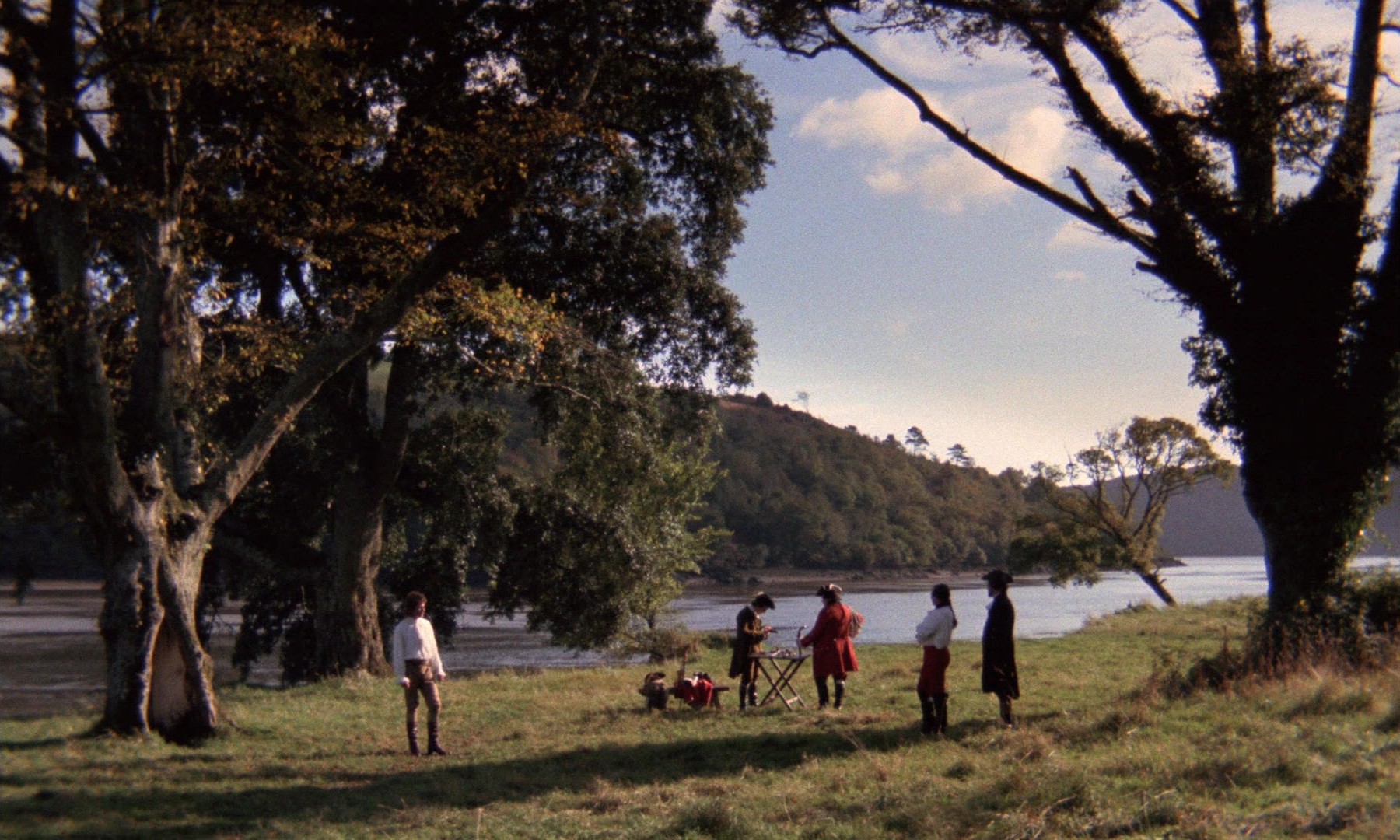
The duel with Captain Quin opens close on pistols being prepared on a table by the water. Then the camera zooms out, in stages, past the two seconds loading them, until the duellists are standing in an extreme long shot with the water behind them. Jeffrey Bernstein, who has timed the film’s zooms, makes this one 30 seconds.
It is the film’s signature move. Bernstein counts 36 slow zooms in all. In the first 21 minutes alone he counts six, and six of the first eleven scenes open with long zoom-outs. One of the earliest opens Barry and Nora’s ribbon game: it starts close on a shell fountain topped by a child’s figure and pulls back to the two of them at cards.
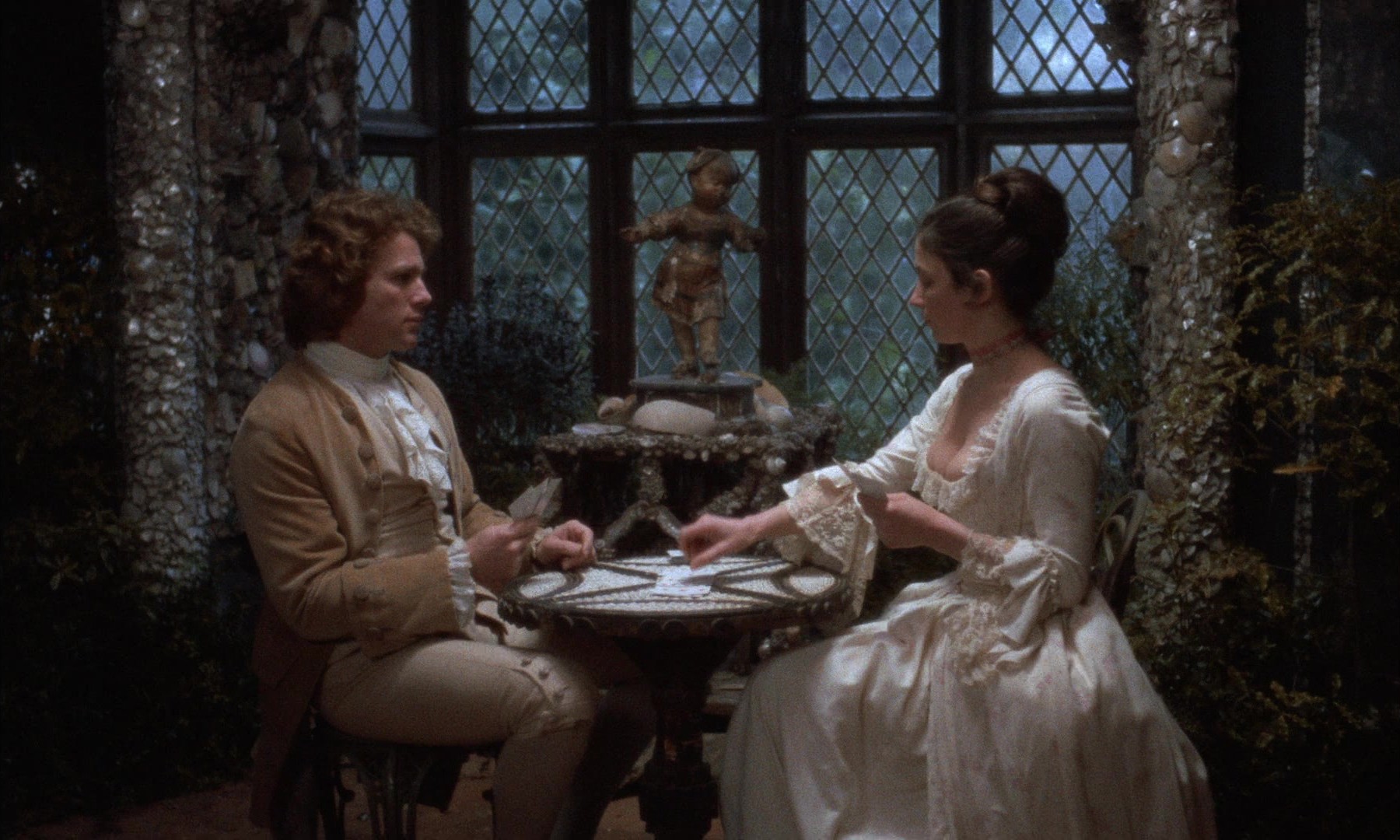
The equipment was built for slowness. The 35BL carried an Angenieux 10:1 zoom, driven by Cinema Products’ Joy Stick control, which Alcott says started and stopped without a jolt and could zoom so slowly that it seemed almost nothing was happening. At Kubrick’s insistence DiGiulio also built a 20:1 zoom from Angenieux components, the Cine-Pro T9 24–480mm, and an unfinished prototype of it was used in a number of exterior sequences. Nobody has recorded which lens made which zoom, so I won’t guess.
A zoom and a camera move look alike for a moment, and then they come apart. A zoom only changes magnification. The camera stays where it is, so everything in the frame keeps its proportions, near and far alike, and the picture gains more border all round, like stepping back from a painting. A track moves the camera itself, so near things rush away while distant things barely change. Because the Quin shot is a zoom, the water and the far shore behind the pistols keep the same size relative to them all the way out. The picture just grows.
I haven’t found Kubrick or Alcott saying why they used it, so the explanations all come from critics. Jim Emerson, and separately Branch and Izod in Kinema, argue that the zoom flattens the picture and holds the viewer at its surface. A video essay by Cinema Tyler, drawing on the critic Thomas Allen Nelson, ties the zooms to Barry’s rise: until he is a titled gentleman, many of his scenes are marked by slow zooms in or out. I find that reading the more interesting, because it ties the move to the story. While Barry is climbing, the camera keeps pulling back to show how small he is in the world he wants to join. Once he is inside it, the camera has less to show him.
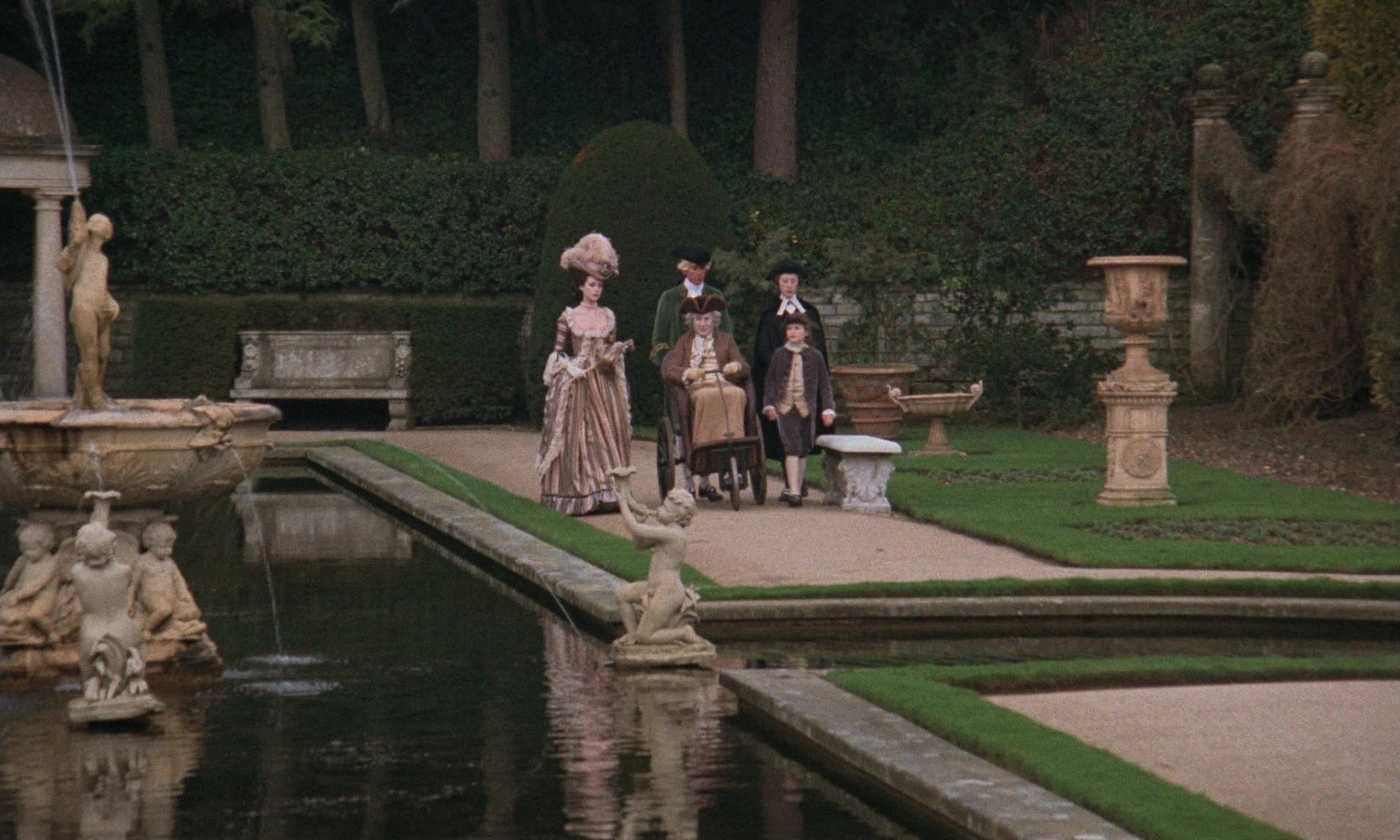
The zoom also runs the other way. When the Lyndons are introduced beside a reflecting pool, it closes in on them in several stages, speeding up at the end.
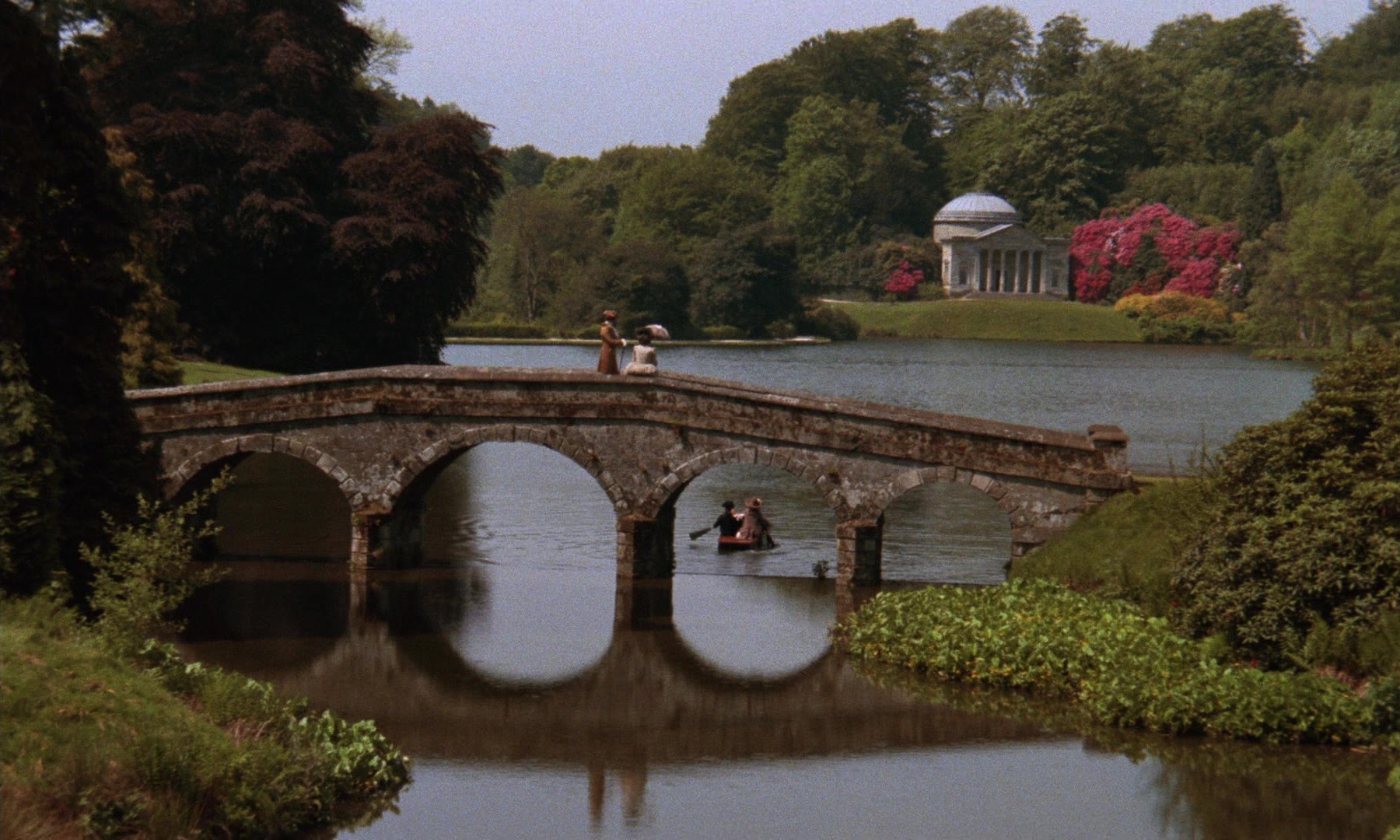
Later, at Stourhead, a zoom begins on a rowing boat seen through one arch of a stone bridge and pulls back to the whole bridge, the lake and the Pantheon beyond. I like this one best of all the zooms, because it starts inside a frame that was already standing in the landscape and then lets the landscape take it over.
Camera Movement
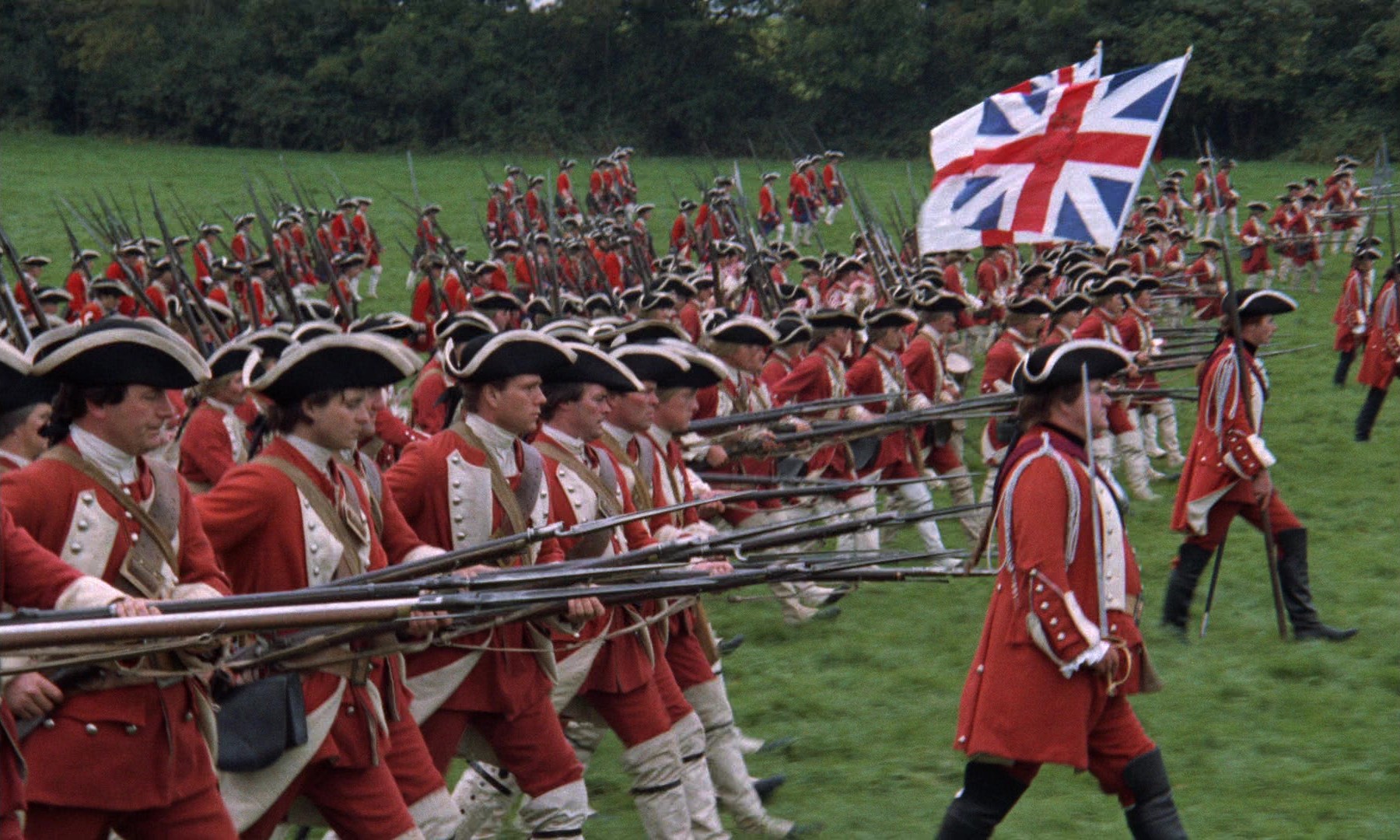
For the battle, Kubrick chose a track. Three cameras ran on an 800-foot track alongside the advancing troops, on an Elemack dolly fitted with bogie wheels that ran on metal platforms, with a wheel span of 5 to 6 feet, to damp vibration. Nearly all the close-ups taken from the track were at the 250mm end of the zoom.
That last detail is why the bogies mattered. A long lens magnifies every bump in the track along with the picture, so at 250mm a small jolt in the dolly becomes a large one on screen. A wide wheel span means that a bump under one wheel tilts the camera less.
Against that formality, the camera goes handheld at least twice. When Barry attacks Bullingdon during the recital, in front of the guests, the camera is down in the fight with them, and the frame smears with motion blur. Later, a shot-by-shot study logs Lady Lyndon taking poison as one long handheld shot.
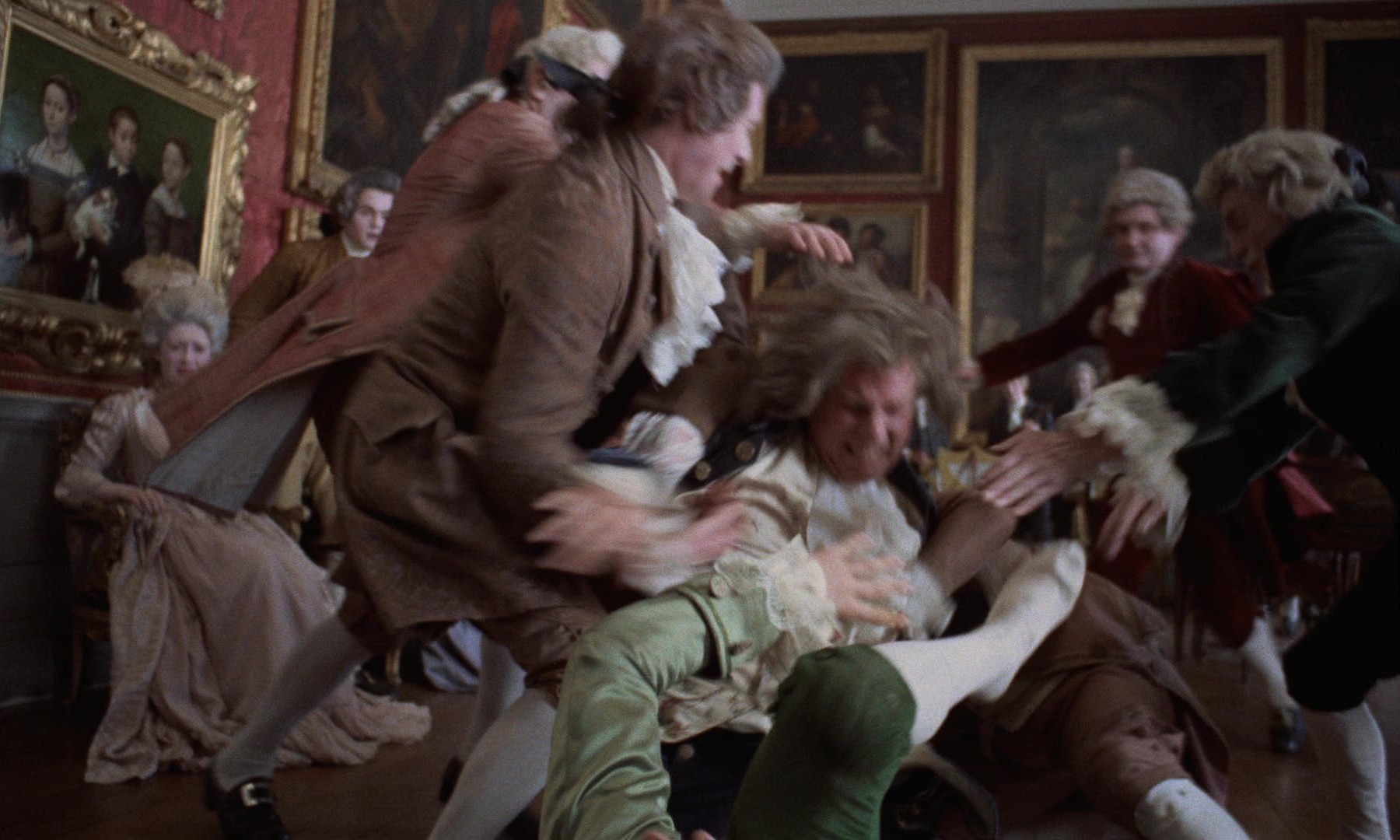
After more than two hours of fixed frames and slow zooms, a handheld camera feels violent by itself. I think that is the point. The film spends all that time teaching you that the camera keeps its distance, so when it stops keeping it, you feel the rules break along with Barry’s temper.
Locations
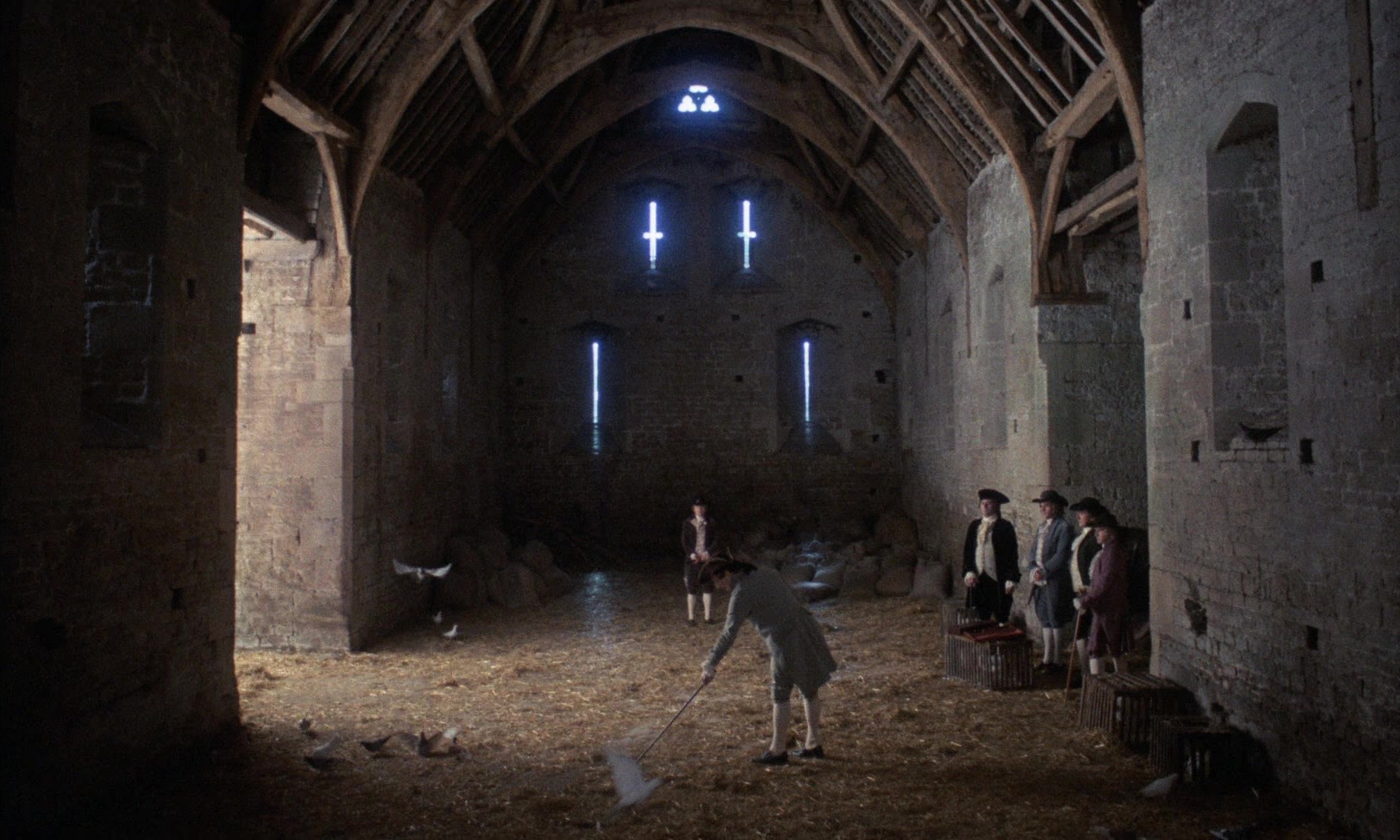
Kubrick put the last duel in a tithe barn with pigeons in the rafters. He found it when a location scout brought back photographs of it. The barn stands at what is now the Somerset Rural Life Museum in Glastonbury.
No sets were built, and every interior is a room in a real building. Kubrick first wanted to film near his home in Borehamwood, and Ken Adam, the production designer, set up a kind of war room in Kubrick’s garage, with Ordnance Survey maps marked with radius circles from 5 to 40 miles and about six young photographers out scouting for it. The production went to Ireland instead, and Adam was sent to find Irish sites for the German and French scenes as well as the Irish ones.
Interiors were shot at Powerscourt House in County Wicklow, months before a fire gutted it in November 1974. In the Comeragh Mountains, Adam remembers taking the whole unit up a narrow track and a dramatic sky appearing over them, one he compared to Goya. Then, after a threat in early 1974, the production left Ireland and finished mainly in England, with a few exteriors in Scotland and Germany. The English locations include Corsham Court, Stourhead and Wilton House, Longleat for the club scene, and Castle Howard, which plays Castle Hackton, Lady Lyndon’s estate. Principal photography took about 300 shooting days across 1973 and 1974, with a pause of some weeks late in 1973, and the strain of it led to a breakdown for Ken Adam.
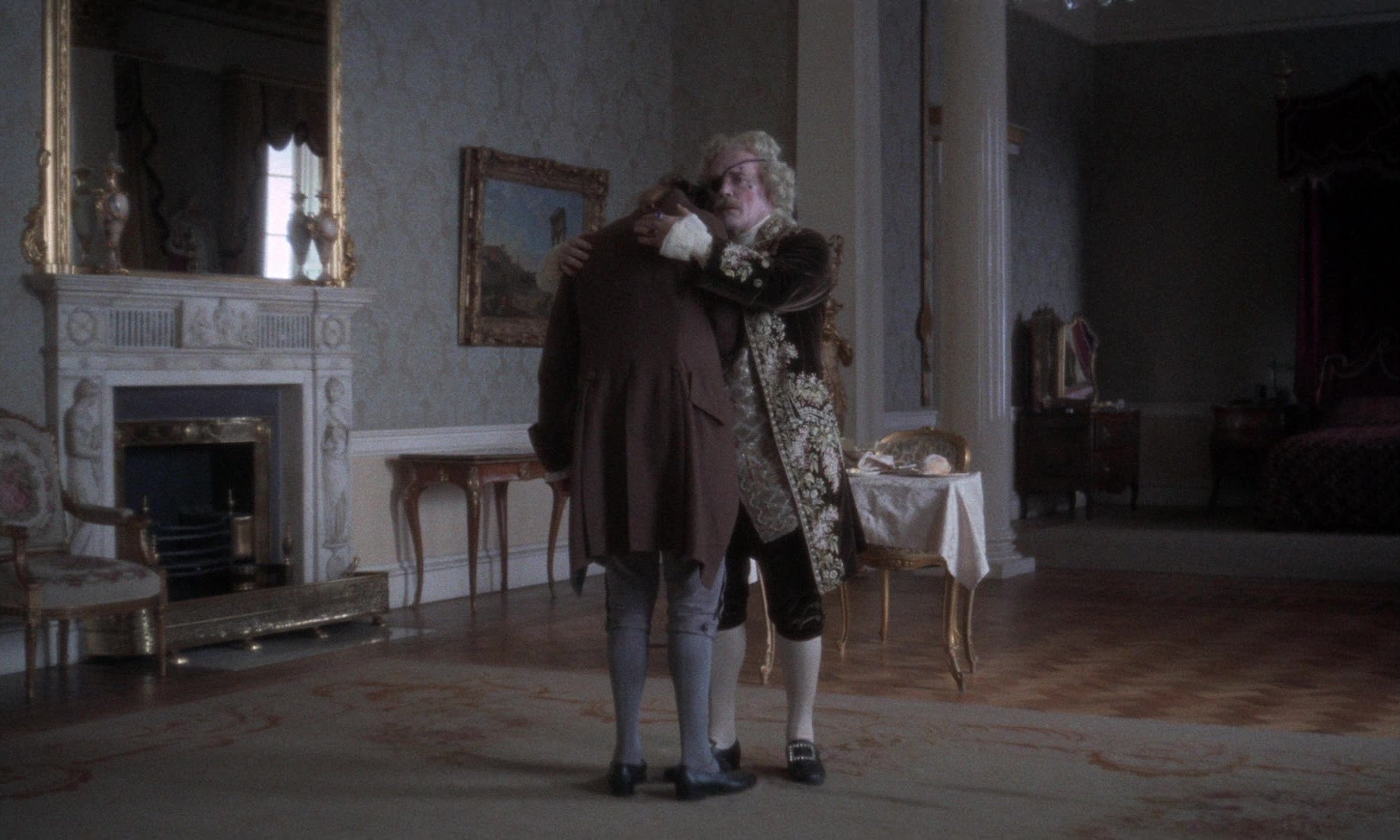
The Chevalier’s drawing room, where Barry makes his confession, is one of those real rooms. A shot-by-shot study of the film places it in Dublin Castle.
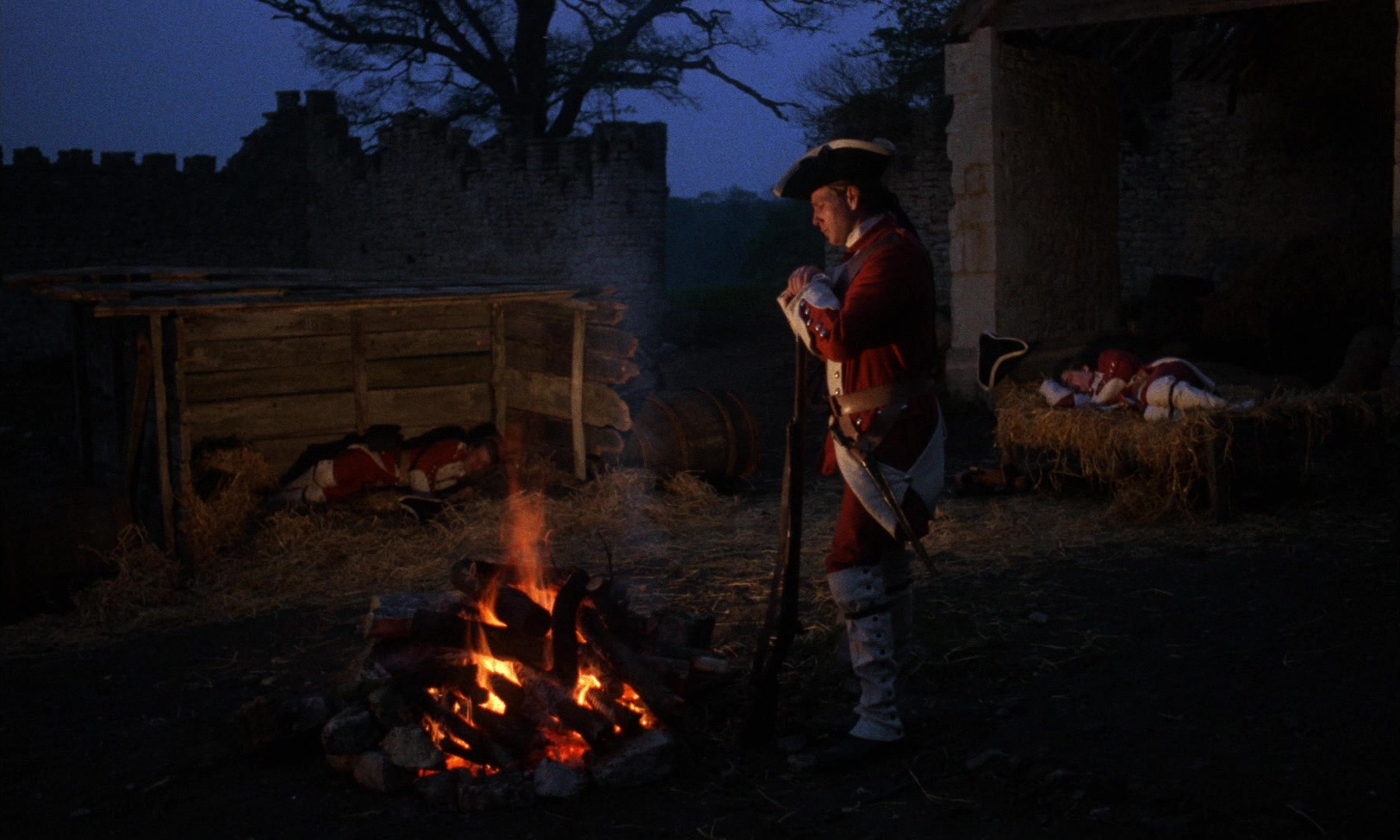
Shooting in real places meant shooting in real weather, and Kubrick kept going whether the sun went in or came out. Captain Feeney’s holdup ambush began in good light, but by its last part the day had turned so dull that Alcott shot with a Canon T/1.2 lens wide open. Alcott says the film has no true night shots. The twilight scene of Barry by a fire in camp, after he has joined the army, was shot at magic hour.
Painting
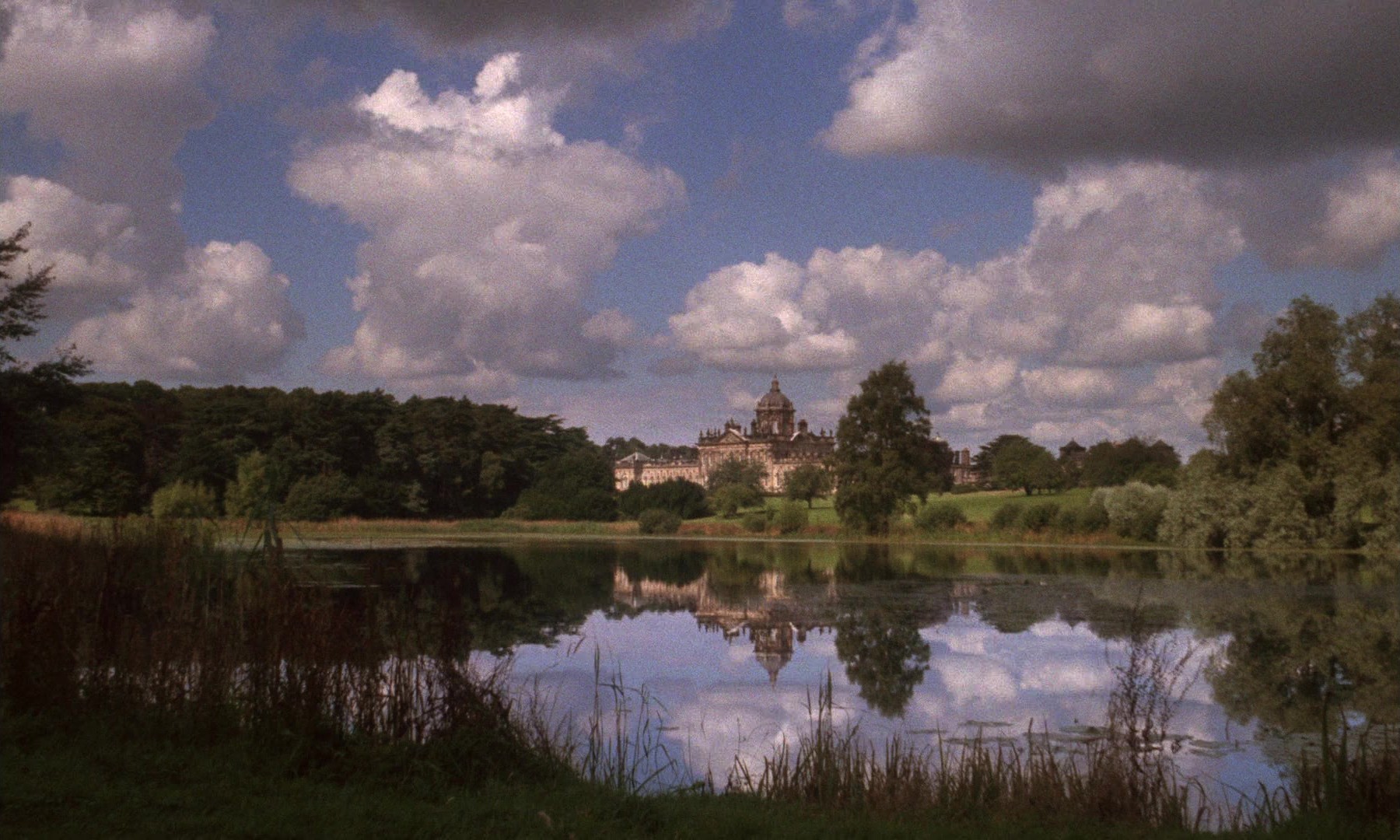
Apollo pairs the film’s view of the Lyndon house, filmed at Castle Howard, with Constable’s Malvern Hall of 1821. Kubrick built the look of the film out of paintings. He kept a large file of drawings and paintings torn from art books, and it was the reference for costumes, furniture, props, architecture and vehicles. Alcott says the compositions, and the way the rooms were lit, followed the same research into period drawings and paintings.
Gainsborough and Hogarth are named influences, and so are Constable’s landscapes. Critics have named Watteau since the New York Times review in 1975, and Reynolds alongside Gainsborough for the portraiture. Apollo goes further and matches particular works to particular scenes: Hogarth’s A Rake’s Progress III: The Orgy to the tavern debauch, his Marriage A-la-Mode 2: The Tête à Tête to Barry gone to seed, a sorrel horse in the film to Stubbs’s horse portraits, and Fuseli’s The Nightmare to Lady Lyndon’s suicide attempt.
How literally did Kubrick copy? Apollo says that once or twice he duplicated a composition exactly. Bill Krohn, in his Kubrick book for Phaidon, disputes the idea that the film copies paintings shot for shot, and says no one has produced a single literal example. My guess is that both are partly right: a few frames look like quotations, but mostly the file gave the film a painter’s way of placing people and lighting them.
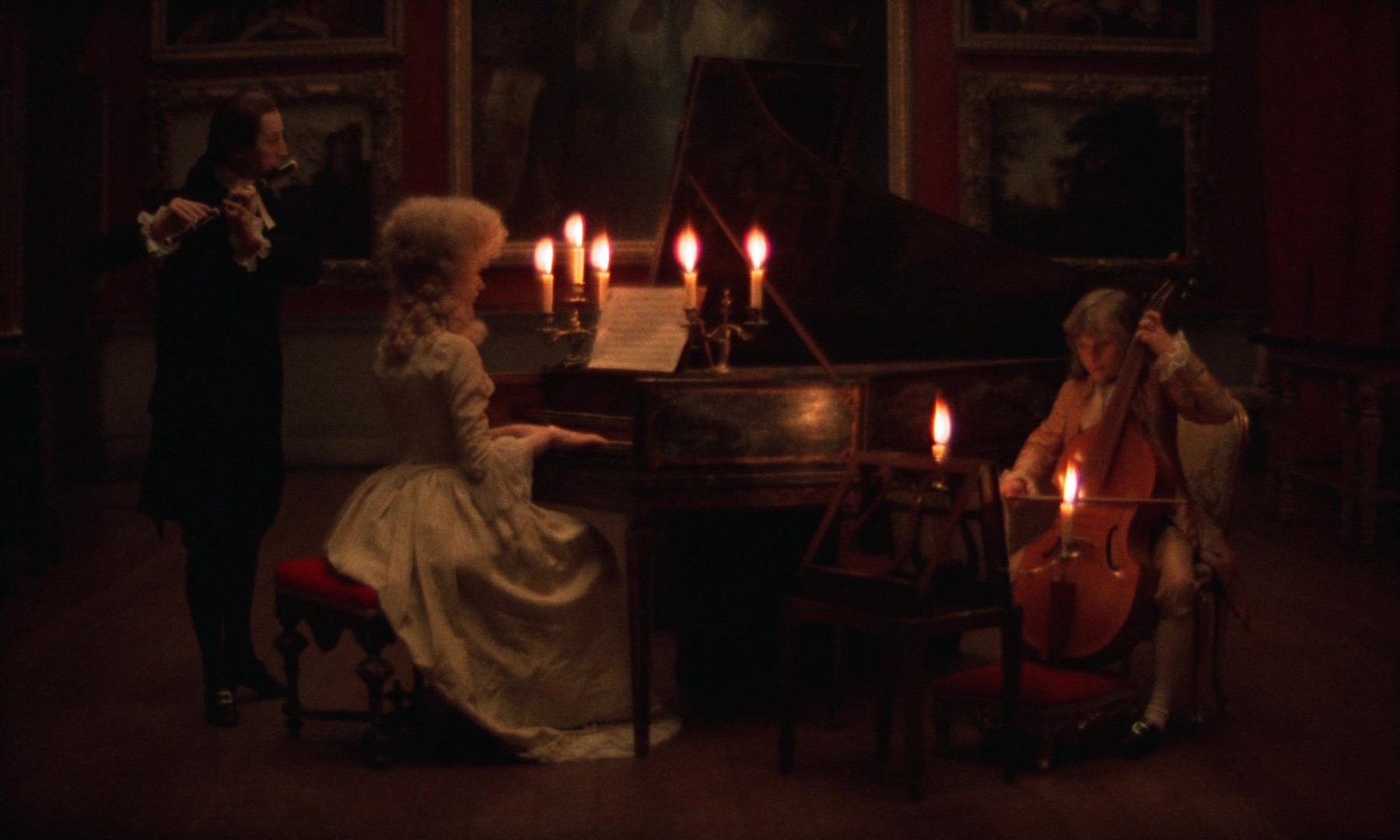
The picture I keep coming back to is a scene at night: Lady Lyndon at the harpsichord, Reverend Runt on the flute and her son Bullingdon on a bass viol, playing by candlelight. To me it looks very like Adolph Menzel’s Flute Concert of Frederick the Great at Sanssouci, finished in 1852, whose concert room, in the Berlin state museums’ own description, shimmers in the light of candles and a chandelier. No production source I have found names Menzel, so I offer it as a likeness, not a documented reference. Menzel had to paint his candlelight. Kubrick could photograph it, with three-wick candles and a lens fast enough to see by them.
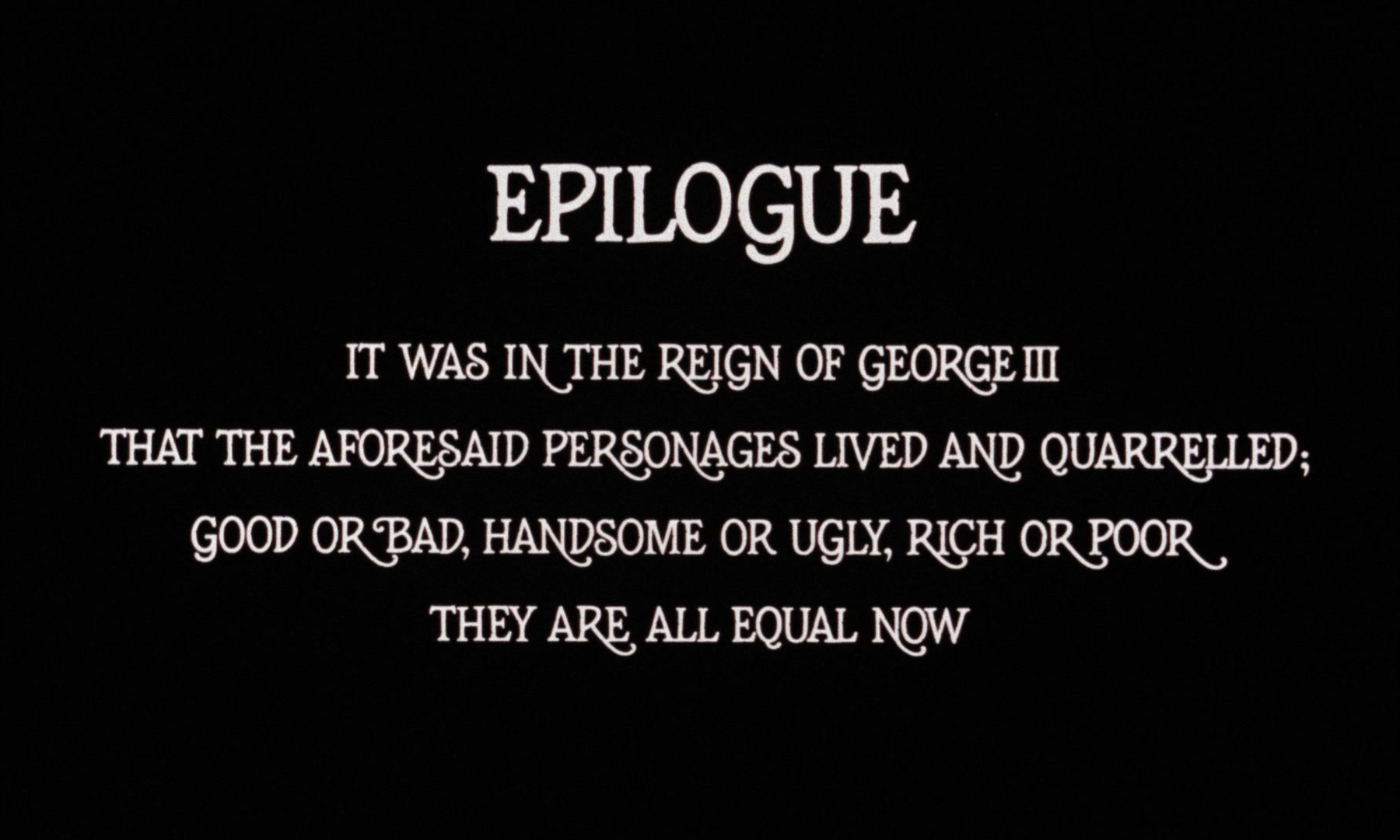
The film ends on words. After three hours of pictures arranged like paintings, it closes on an epilogue card, plain text with nothing to look at but the letters.
Alcott won the Oscar for Best Cinematography at the 48th Academy Awards, and the BAFTA and the BSC Award too. In 2019 the American Society of Cinematographers named it one of its 100 Milestone Films in Cinematography of the 20th Century.
What stays with me is how much of this film’s light comes from where the eighteenth century got its own. At night there were candles, three wicks each, burning down through every take. By day the light came through the windows, even when the lamps making it stood outside the glass. Kubrick and Alcott spent their engineering on the camera, on a lens made for NASA’s Apollo-era programme and a focus system run by television, so that at night the candles could be the only light. Fifty years on, the film still looks like the eighteenth century seen by its own light.
The Shot List