
Christopher Nolan 2014
Interstellar
How Hoyte van Hoytema and Christopher Nolan photographed the film on IMAX and 35mm, with space projected outside the cockpit windows, cameras bolted to full-size spacecraft and a black hole rendered to match real lenses.
Black hole rendered in real time with the author’s own Kerr ray tracer.
Interstellar is remembered as a film about ideas: wormholes, relativity, a black hole drawn from real equations. When I watch it now, what I watch is the photography. Christopher Nolan and his cinematographer, Hoyte van Hoytema, shot it on film, in two formats, and they put as much of it as they could in front of the lens. Space was projected outside the spacecraft windows, bright enough to light the actors. Full-size spacecraft were carried to Iceland and set down in real water and on real ice.
The big IMAX cameras were bolted to hulls and carried on shoulders. Even the black hole was rendered to look as if it had been photographed through the production’s own lenses, with their flare and their shutter.
This essay is about those choices. I have left the story alone, apart from the little each image needs, and organised what follows by craft, starting with the man who held the camera.
Hoyte van Hoytema
- Part 01/09
- Frame 01
- Scope 2.39:1
- Interview
- Low key
- Dust Bowl reference
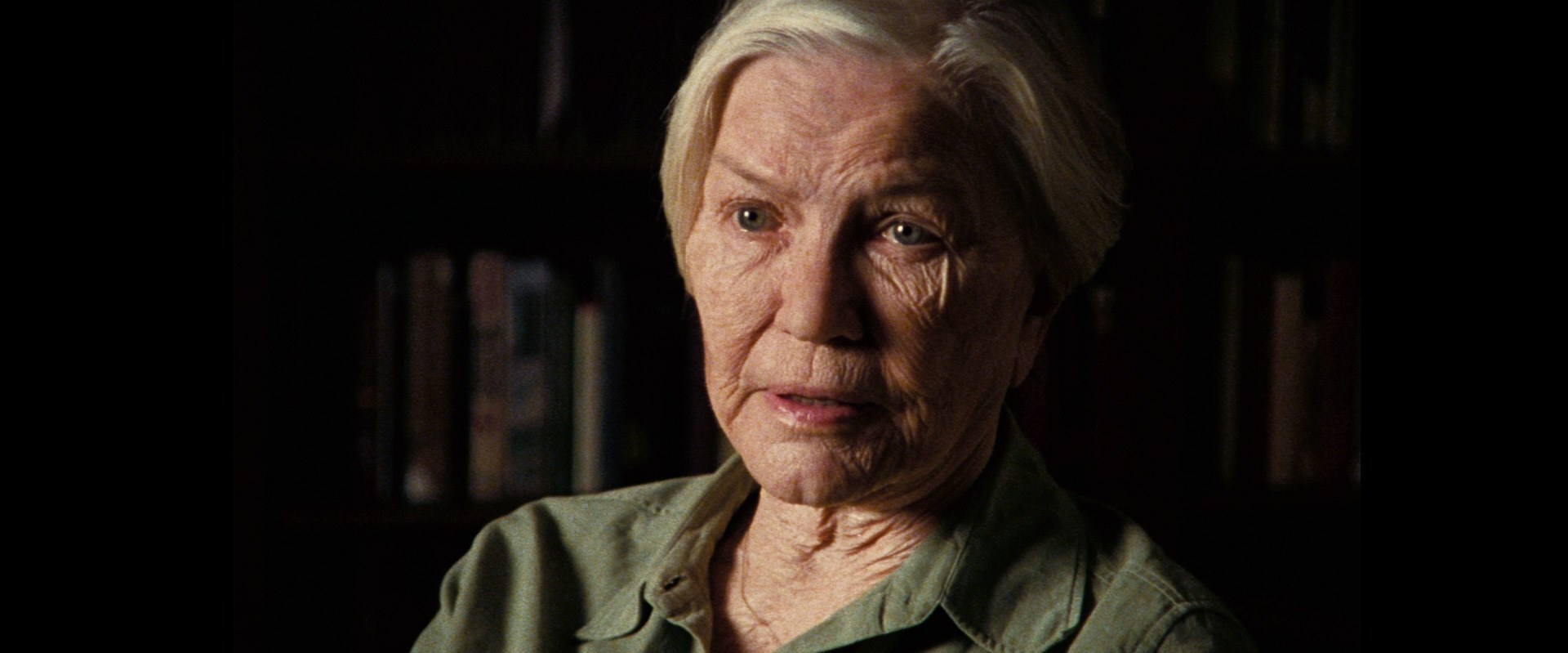
The film opens on a face. An old woman sits in front of a bookcase that has gone almost black and talks, in soft light, to someone just off camera. Other faces follow, framed the same way, remembering the dust. It is the grammar of a television documentary, and it is there on purpose. Van Hoytema has named Ken Burns’s The Dust Bowl among his references, and Burns let Nolan use interviews he had filmed for it with real survivors of the 1930s storms. One face belongs to an actor, Ellen Burstyn, and her memories include a blight that belongs only to the film’s future. The film cuts her in among the real witnesses and never says which is which.
Van Hoytema was new to Nolan. Interstellar was his first film with him, and his first time shooting with IMAX cameras. He replaced Wally Pfister, who had shot seven of Nolan’s previous eight features and had left to direct his own first film, Transcendence. Van Hoytema was born in Switzerland in 1971 to Dutch parents, trained at the Łódź Film School in Poland and built his career in Sweden. Before Nolan he had shot Let the Right One In and Tinker Tailor Soldier Spy for Tomas Alfredson, The Fighter for David O. Russell and Her for Spike Jonze. Those are mostly films of faces in rooms. He loves film above everything else, he says, though he refuses to treat the choice as a fight between film and digital.
His references show what he was after. He brought Tarkovsky’s Mirror to the project and has said that parts of its approach seeped into the film. The others he has named are 2001, Alien, The Right Stuff and The Dust Bowl. Nolan has said the team studied Tarkovsky for his fire and wind, as a way to make a harsh Earth beautiful without glamorising it. Before the shoot Nolan screened The Right Stuff for the crew, and its practical approach, rear projection included, shaped how the film would handle its spacecraft.
Then there was the camera itself. IMAX, van Hoytema said, had always been treated as a clumsy thing, a camera people would only put on a track. He wanted to use it the way you use a small film camera, close to people and free to move. That decision comes back in almost every section below.
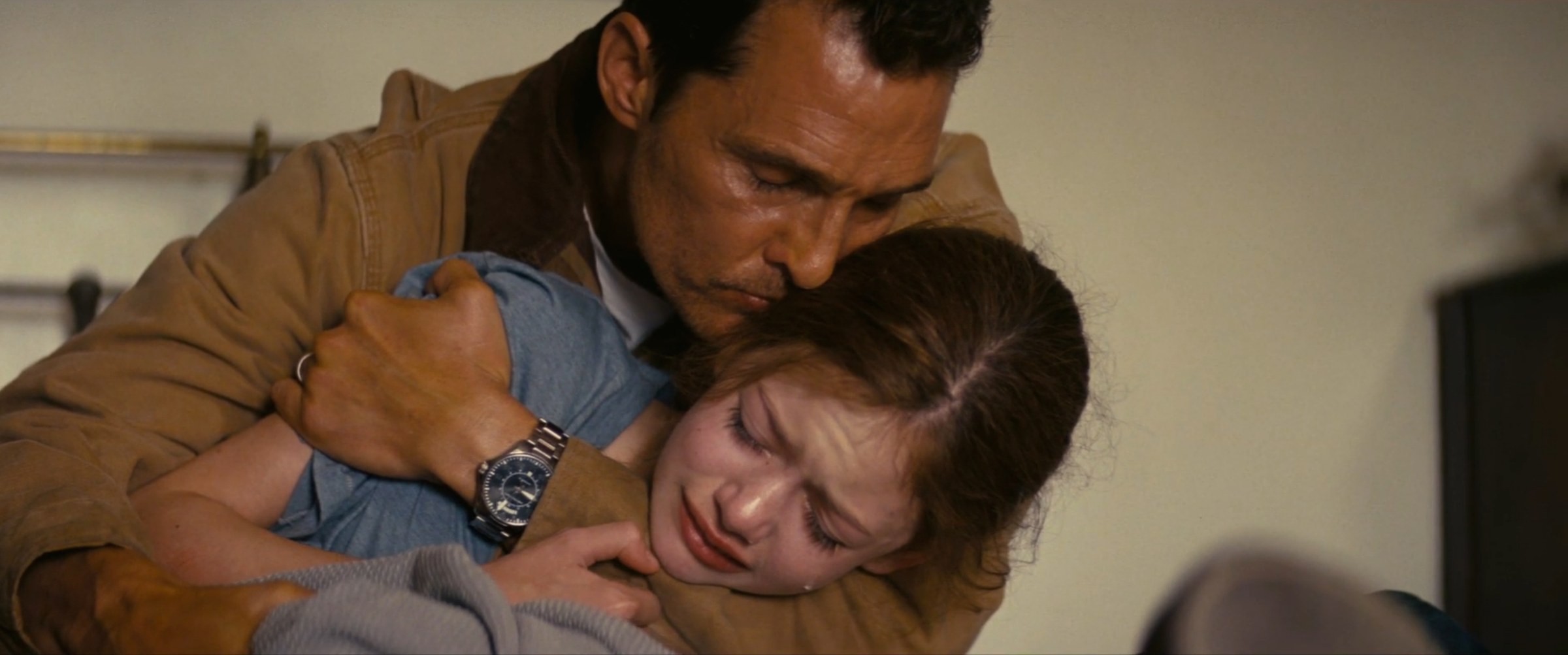
You can see the instinct all through the Earth scenes. The goodbye in Murph’s bedroom is shot so close that Cooper’s jacket fills half the frame. The wall behind them falls soft, and the watch on his wrist is as sharp as their faces.
Format
- Part 02/09
- Frame 10
- Scope 2.39:1
- Double Negative
- IMAX resolution
- Wave about 4,000 ft
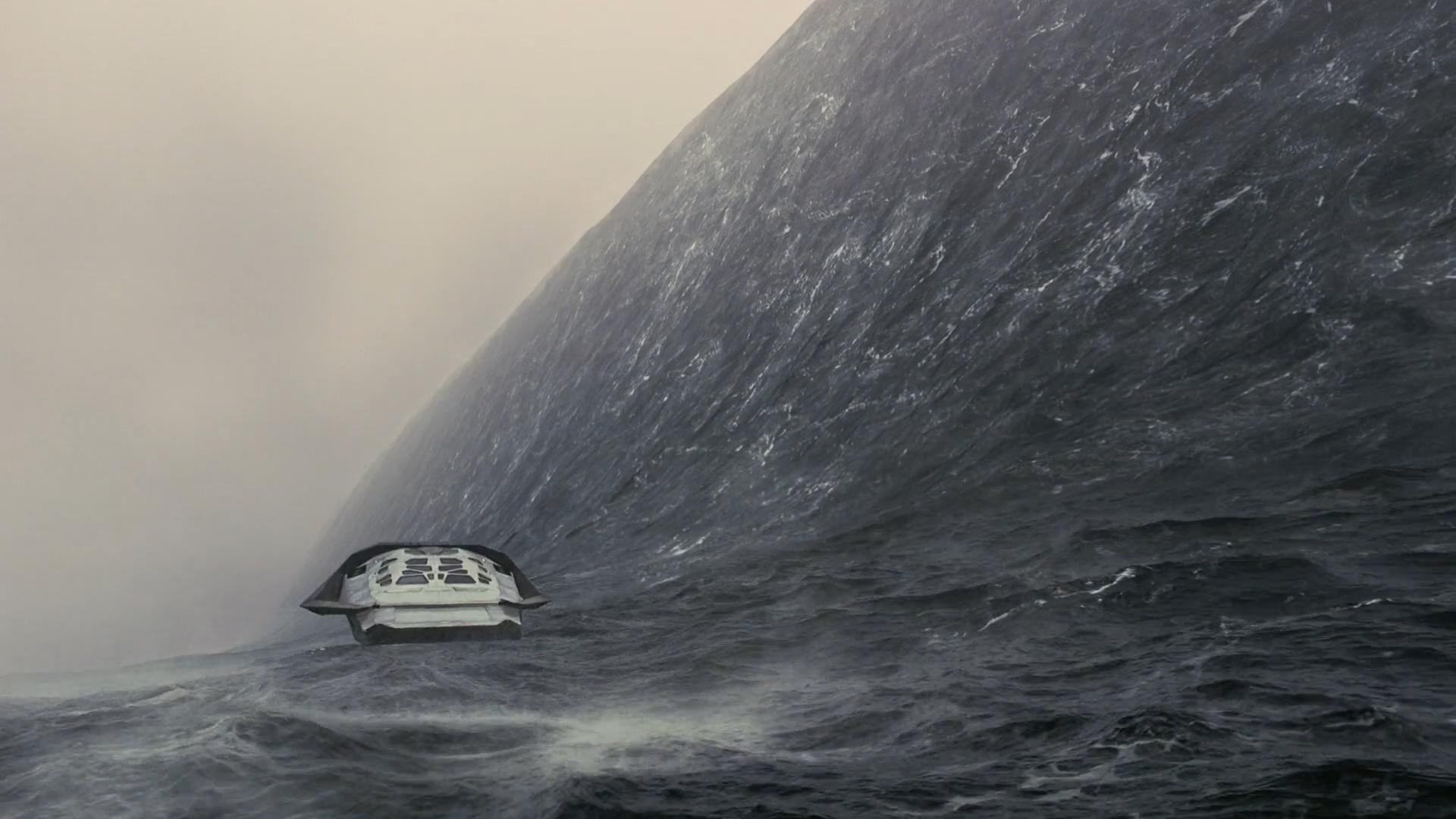
The wave on Miller’s planet, a wall of water some 4,000 feet tall, took Double Negative about a month and a half per version, because it had to hold up at IMAX resolution. That left them about three attempts. I start with a computer-generated image because in Interstellar the IMAX frame sets the terms for everything, even the pictures made in a computer. In the frame above the light is flat and grey, and mist swallows the horizon. The only thing of known size is the Ranger at lower left, and the wave takes up most of the frame.
The official format notes say the film was shot on a combination of 35mm anamorphic film and 65mm, 15-perforation IMAX film. The 35mm work was done with Panavision cameras and lenses, and Panavision’s Dan Sasaki has said that van Hoytema’s C Series anamorphic lenses were first used on this film. The IMAX share came to about an hour of the finished film, or a little more.There is no official minute count. CBS reported more than an hour, and Variety one hour. IMAX’s president, Greg Foster, said Nolan was designing the film around IMAX before a single frame was shot.
Here are the two frames side by side, to scale.
Each frame drawn at its true size relative to the other
| Measure | 65mm 15-perf IMAX | 35mm 4-perf anamorphic |
|---|---|---|
| Gate | 70.41 × 52.63 mm | 21.95 × 18.59 mm |
| Area | 3,705.5 mm² | 408.0 mm² |
| Travel | Sideways, 15 perfs a frame | Vertical, 4 perfs a frame |
| Picture | Shown at 1.43:1 | Squeezed 2×, shown at 2.39:1 |
| At 24 fps | 335 ft a minute | 90 ft a minute |
| 1,000 ft roll | About 3 minutes | About 11 minutes |
An IMAX camera runs 65mm film sideways, fifteen perforations to a frame, so the long side of the picture lies along the strip. Its gate is 70.41 by 52.63 millimetres. A 35mm anamorphic camera runs its film vertically, four perforations to a frame, through a gate of about 21.95 by 18.59 millimetres, and the anamorphic lens squeezes a wide picture into that nearly square space at half its width. Multiply out the areas and the IMAX negative is about 9.1 times larger.The often-quoted ten times is a rounding up. These are camera gates; the IMAX image area usually given for projection, 69.6 by 48.5 millimetres, is a little smaller. Sources differ on the anamorphic width, 0.864 or 0.866 inches, which moves the ratio only from 9.08 to 9.06.
That size has costs. The two gauges share the same perforation spacing, so each IMAX frame pulls almost four times as much film through the gate. At 24 frames a second a 1,000-foot roll of IMAX lasts about three minutes, against about eleven for 35mm. The cameras are loud, because so much film has to move through them so fast, and that rules out clean sound in quiet scenes. It was the standing reason Nolan’s IMAX films of this period kept their quiet dialogue scenes on 35mm, a practice documented on The Dark Knight Rises.
What the big negative gives back, van Hoytema has said, is a very shallow depth of field and a textured image, because of the way a lens renders on a frame that size. On a big screen I notice it most in faces. Skin has grain and weight, and the background drops away faster than you expect it to.
In a 70mm IMAX print you can see the two formats as two shapes.
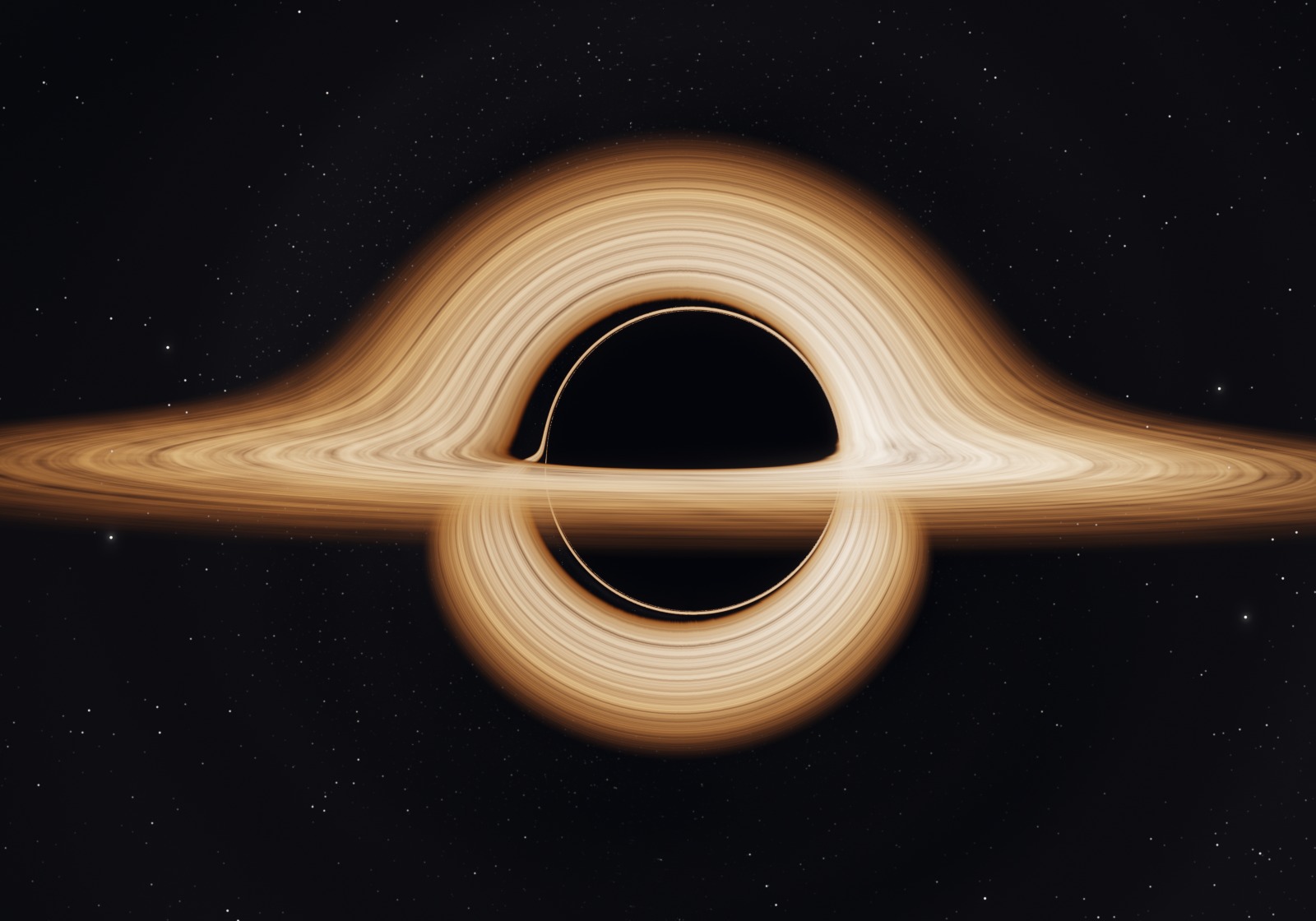
2.39:1The IMAX frame is 67% taller
Image: the author’s Kerr ray tracer
The 35mm footage plays as a wide band across the middle of the screen, at 2.39:1. When the IMAX camera takes over, the picture opens upward and downward to 1.43:1; in digital IMAX theatres it opens only as far as 1.90:1. Some viewers find the switch distracting. I never have. The frame grows when the film wants you to feel the size of something, a planet or a face, and settles back when the moment has passed.
Light
- Part 03/09
- Frame 07
- IMAX 1.43:1
- Earth orbit
- Hard sun
- No stars
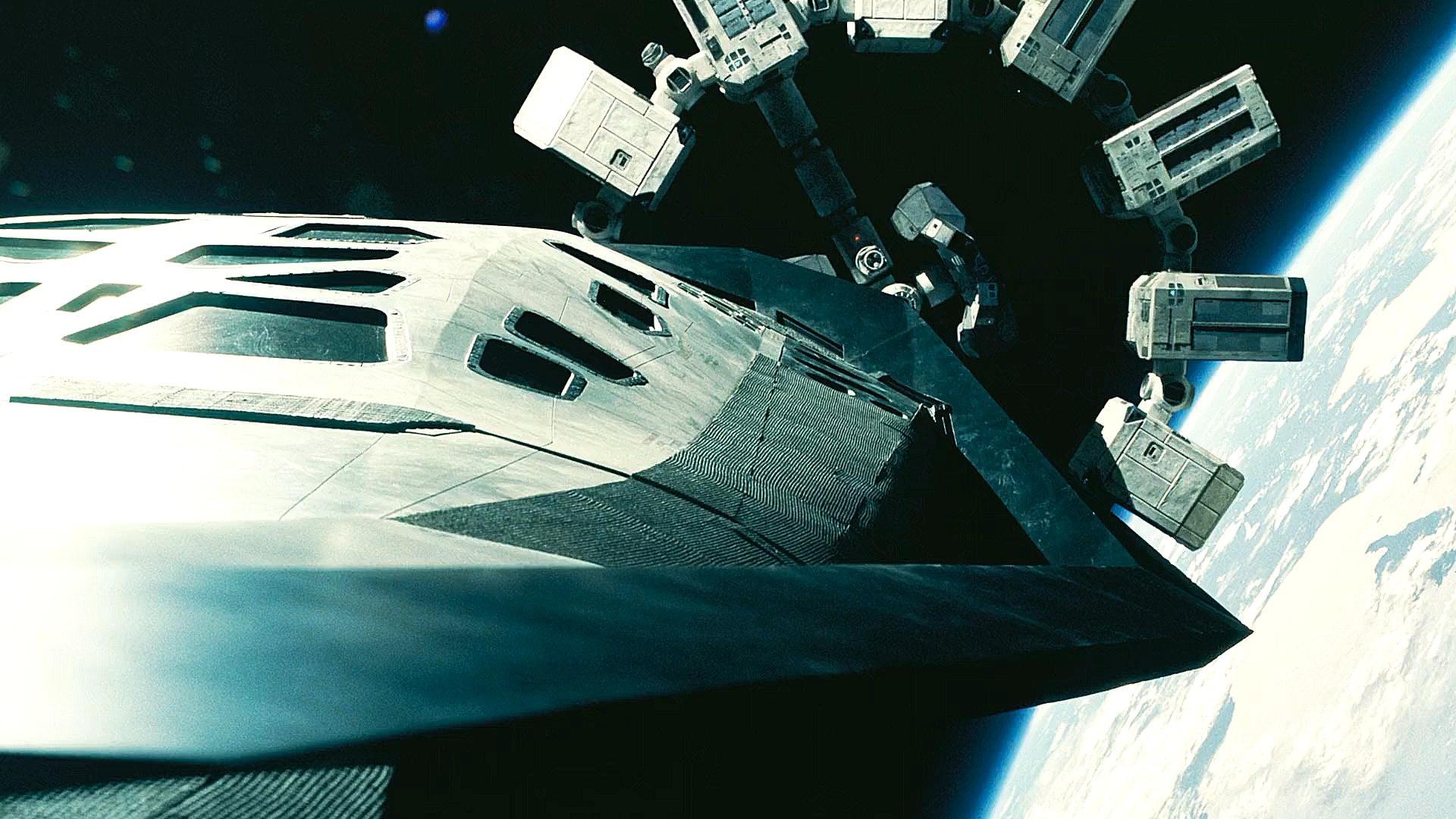
The Ranger is closing on the Endurance in Earth orbit, and the viewpoint sits on the Ranger’s back, looking forward over its nose. One hard light comes from the left. Whatever it touches goes close to white, and whatever it misses falls straight to black. There are no stars.
“I’ve never shot a film with as much hard light as this one,” van Hoytema has said. In space there is one source, the sun, with no air to soften it and nothing nearby to bounce it back into the shadows. On the spacecraft sets, the projected views showed the crew where the sun would be as a craft flew past it or spun, and they tried to reproduce its light, and the light from the black hole, as closely as they could. So the light on the actors moves when the ship moves.
The miniatures were lit the same way, as a real ship in sunlight would be. For the turning shots the key light was locked off while the model rotated, so the shadows sweep across the hull. Fill, key, the ship’s own small lights and the lit interiors were all shot in a single pass instead of separately, which is why they sit together so naturally.
The empty sky follows from the same logic. Paul Franklin, the visual effects supervisor, made a photographer’s point: if you expose for a spacecraft in daylight, the stars are far too faint to register. So stars went into the film only where no strong light would have hidden them. Much of the space in Interstellar is plain black, and I think that black is why it feels so large.
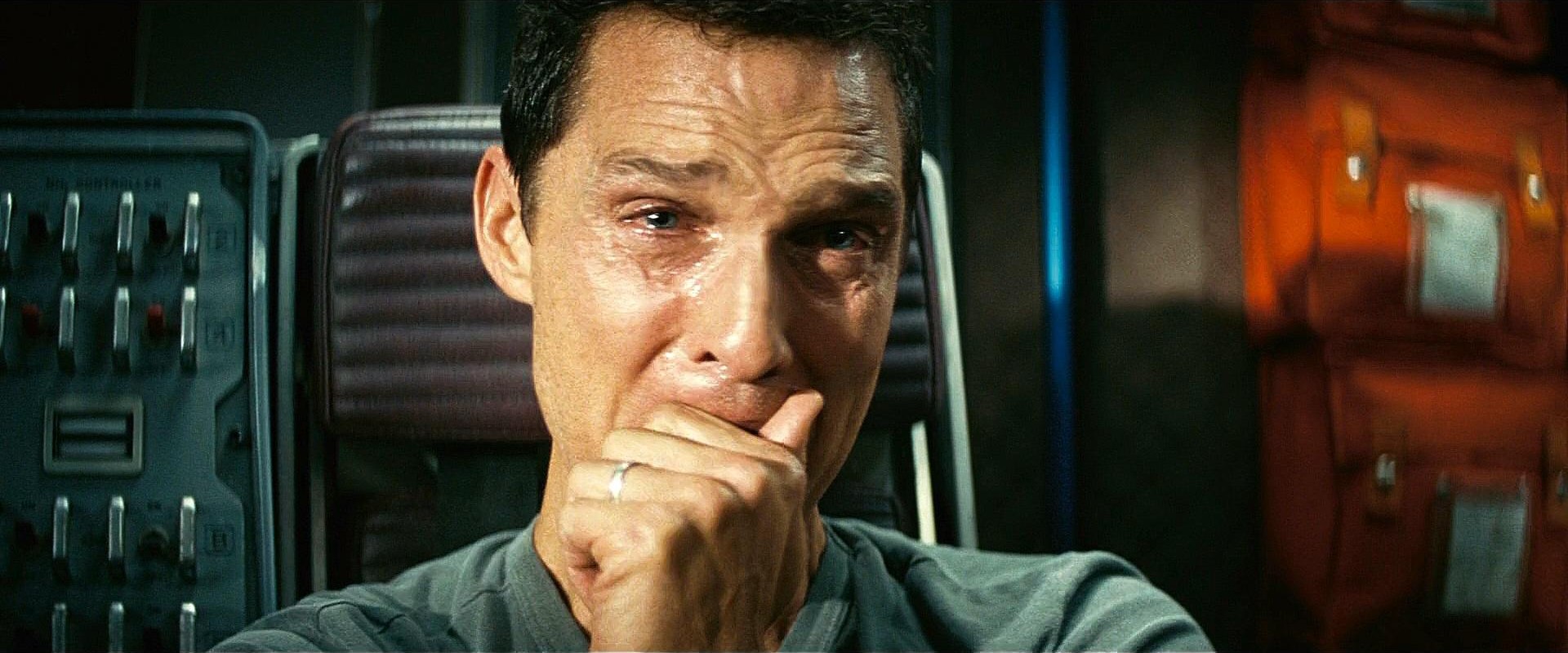
Inside the ships, the light comes from the sets. Van Hoytema and the production designer, Nathan Crowley, built a base level of lighting into the fabric of the spacecraft so that it would feel as if it belonged there, and he adjusted it with diffusion as he shot. You can see it when Cooper sits alone in the Endurance, watching messages from home. The light on his face is soft and frontal, from the direction of the screen, and behind him the set supplies its own colour: a thin blue line of light, and orange stowage bags thrown out of focus. Nothing in the frame looks like a film light.
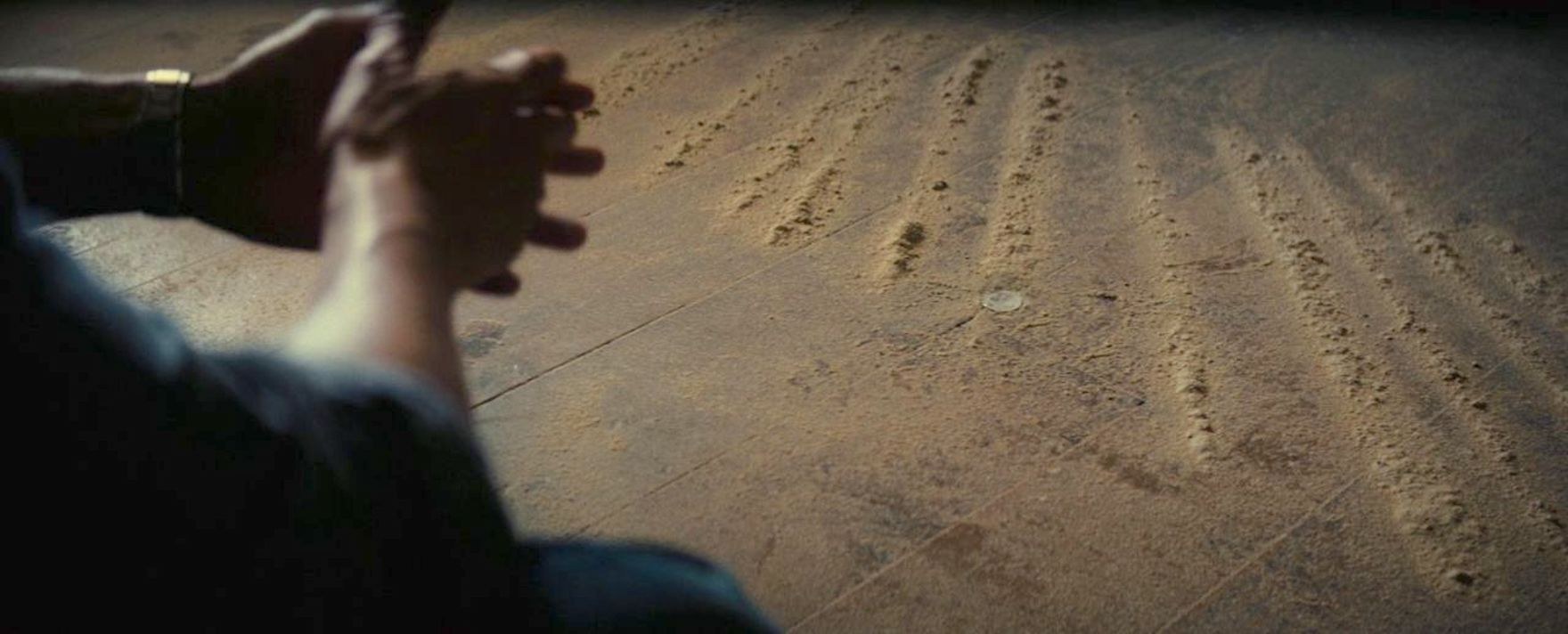
On Earth the light is softer and dirtier, and dust hangs in it. In the bedroom after the first storm, a low light rakes across the floorboards from the far side of the room and picks out every ridge in the lines of dust, while Cooper’s hands stay soft at the edge of frame. This is the Tarkovsky idea Nolan described, a hard world made beautiful by weather and light, with nobody pretending it is pleasant.
Front Projection
- Part 04/09
- Frame 08
- IMAX 1.43:1
- Double Negative
- Also projected on set
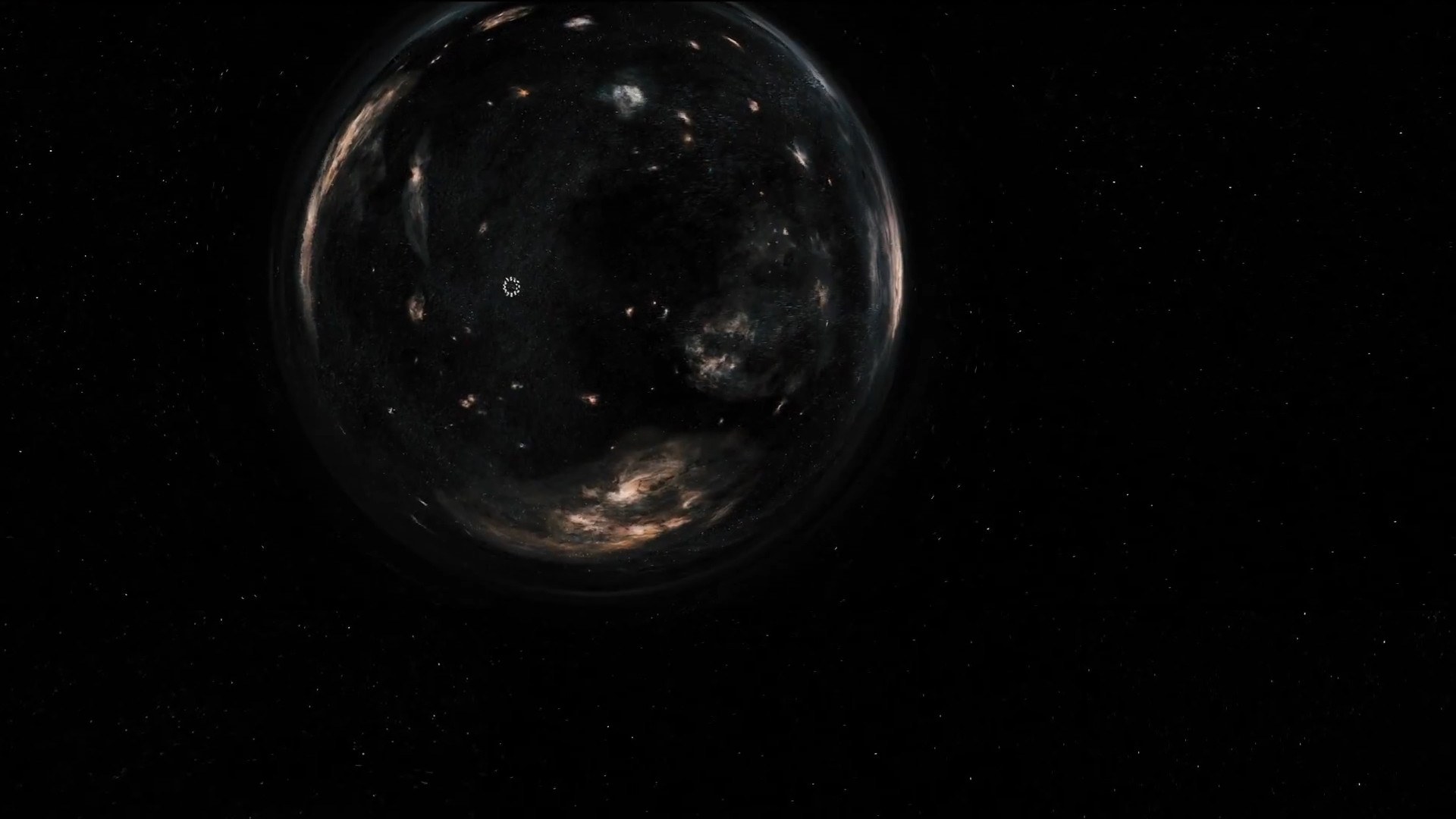
The wormhole above is a finished effects shot, with the Endurance a tiny ring just left of its centre. On set, the actors saw it too.
“We didn’t use a single green screen in any of the spacecraft sequences on this film,” Franklin has said. Double Negative’s images of space, its starfields, the wormhole and the black hole, were projected onto screens outside the windows of the spacecraft sets and photographed in camera along with the actors. Franklin put the screens at 300 feet long by 80 feet high. The projectors were Barco units of 40,000 lumens and about 600 pounds each, moved around the stage on a forklift, and two were often converged on the same patch of screen to gain about a stop of exposure.Franklin and the production notes describe screens hung outside the windows and lit from the front. Entertainment Weekly’s 2014 set report describes rear projection behind the small windows. They may be describing different rigs.
For the photography, this was the decision that mattered most. The projected image was bright enough to light the actors through the glass. Franklin said it gave enough light to expose the negative as if by raw daylight, and the production notes describe it reaching through the windows onto the actors’ faces. So when the crew looks out at the wormhole, its light is on their faces and in the curve of their helmets, and it changes when the view changes. A green screen gives an actor nothing to look at and gives the cinematographer green light spilling onto everything. Here the picture outside the window was also a source of light.
The visors are where the debt to The Right Stuff shows. They catch reflections of whatever the astronauts are looking at, and the camera is close enough to read them.
Because the view outside was live, the crew could move through the set with a handheld camera, and Nolan could change the imagery in real time. Franklin said the cast loved it, because they had something in front of them that they could imagine was real.
The projection crew expected a couple of days to move a projector, and the film’s crew got the resets down to about fifteen minutes. In the end about 150 shots were finished entirely in camera this way.Screen Daily counts about 170. The film has about 850 visual effects shots in all, delivered at 5600 by 4000 pixels.
Mounting the Camera
- Part 05/09
- Frame 14
- Scope 2.39:1
- Beneath a hull
- Hard light
- Black sky
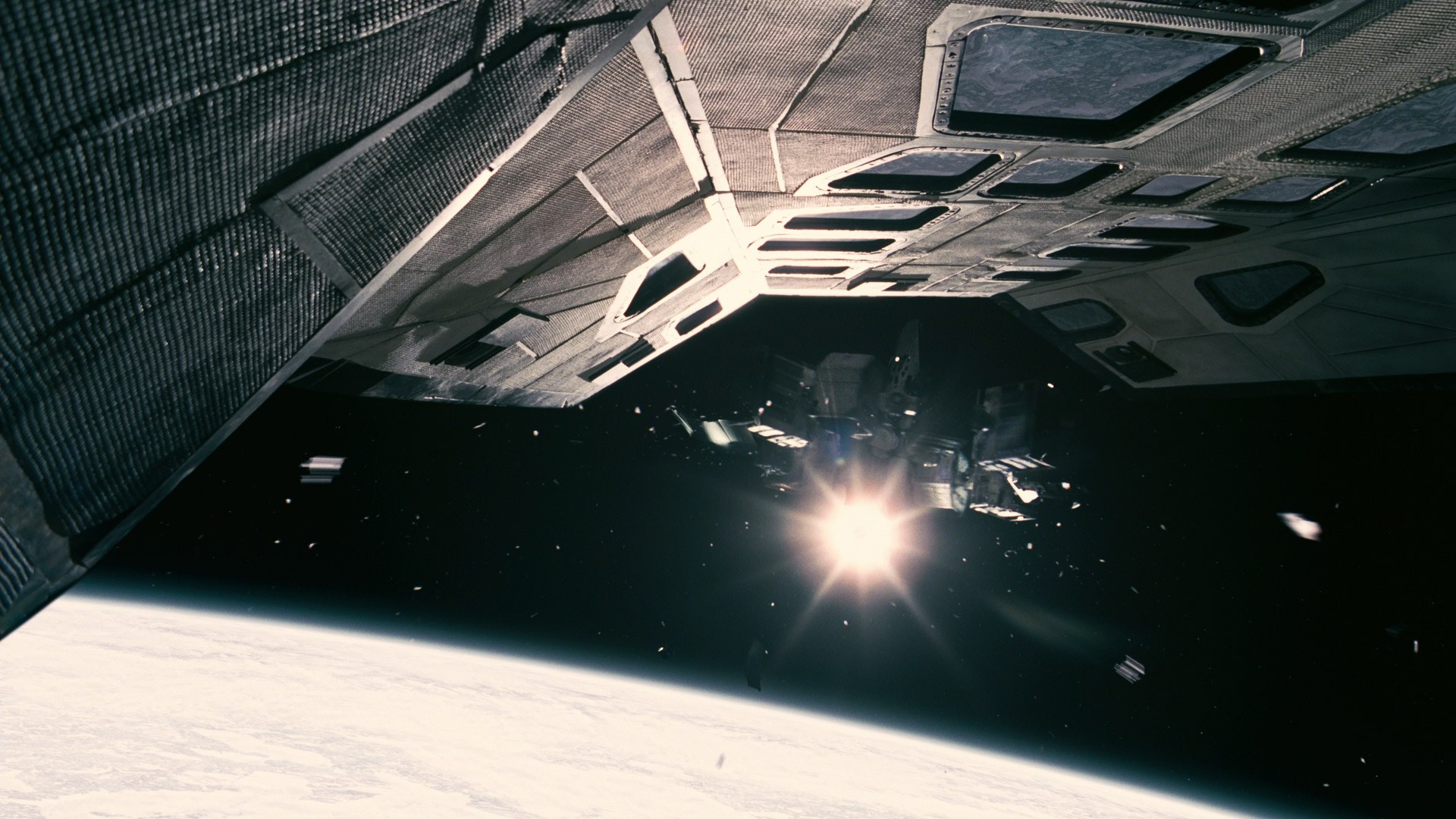
The explosion above is seen from just beneath the hull of a nearby craft. A flash at the docking ring throws a star-shaped flare, debris tumbles against black, and the edge of the white planet runs along the bottom of the frame. The camera is where a camera bolted to the ship would be, and that was the rule for the film’s spacecraft.
Nolan named the IMAX space documentaries as one of the main reasons he wanted to shoot in 70mm at all, and his team studied the shuttle-era IMAX films of Toni Myers as reference for spaceflight. Inspired by that footage, he and van Hoytema decided to hard-mount the IMAX camera to the ships themselves. The full-size Ranger, 46 feet long, and Lander, 50 feet long, were built and set on a six-axis gimbal driven by motion control, which the crew called the Waldo. When Empire visited the set, its reporter found an IMAX camera fixed to the Ranger’s upper port side, sticking out of the hull like a growth. Nolan said the result gave a feeling of being sealed inside a real moving vehicle, as if the sequence were playing out for real.
Inside, the camera went on people. Van Hoytema’s crew took parts off an IMAX camera, made it easier to hold and added a shoulder support, and he shot most of the IMAX material handheld. Nolan said they treated it like a GoPro, strapping it to heads, bodies and spacesuits. Van Hoytema built strange rigs, he said, so that the camera would seem to be witnessing something from a viewpoint you recognise from the real world. He didn’t want a camera floating above the action and seeing everything.
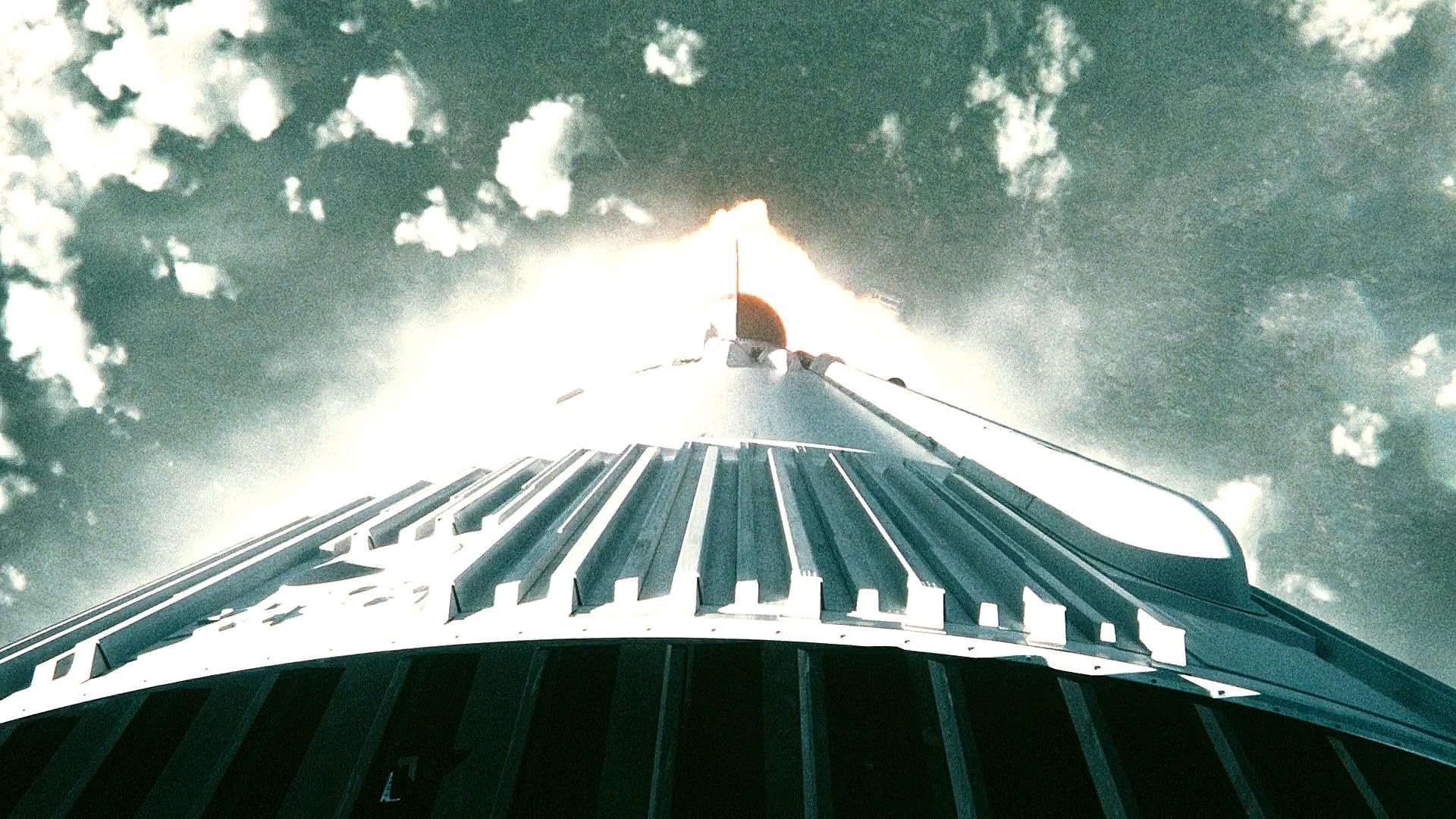
The launch borrows the same point of view. Its most memorable view looks down the rocket’s ribbed flank from a point on the vehicle itself, past the fire, to clouds already far below. It is grainy and harsh, closer to engineering footage than to anything composed.
The same rule went down to the miniatures. New Deal Studios built them so large that they were nicknamed maxatures, and they account for more than 90 per cent of the spacecraft shots, with digital models used mostly for the wide views. Nolan told New Deal’s Ian Hunter that the camera had to be physically attached to the model, as in the live-action space shots. The models were photographed with VistaVision motion-control cameras.The 1/15-scale Endurance was about 25 feet across according to the production notes, and about 14 feet according to fxguide. For the docking explosion, New Deal built a fifth-scale Ranger, put a VistaVision camera inside a Pelican case, which the crew called the Pelicam, fixed it to the model’s nose and tethered the whole rig to a crane. Hunter said the result looks very much like a film made by a documentary crew, and that is how it plays, as footage from a camera that happened to be bolted on when the ship went.
The docking that follows uses several of these methods at once. The damaged Endurance is spinning, and Cooper has to match it. For the exteriors, the Endurance miniature went on a spinning cruciform model mover under a locked key light, so the shadows wheel around the ring the way they would on a real rotating ship. Van Hoytema shot the full-size Lander on a motion base with spinning lights to sell the rotation, and to match him New Deal hung their miniature upside down and flipped the camera.
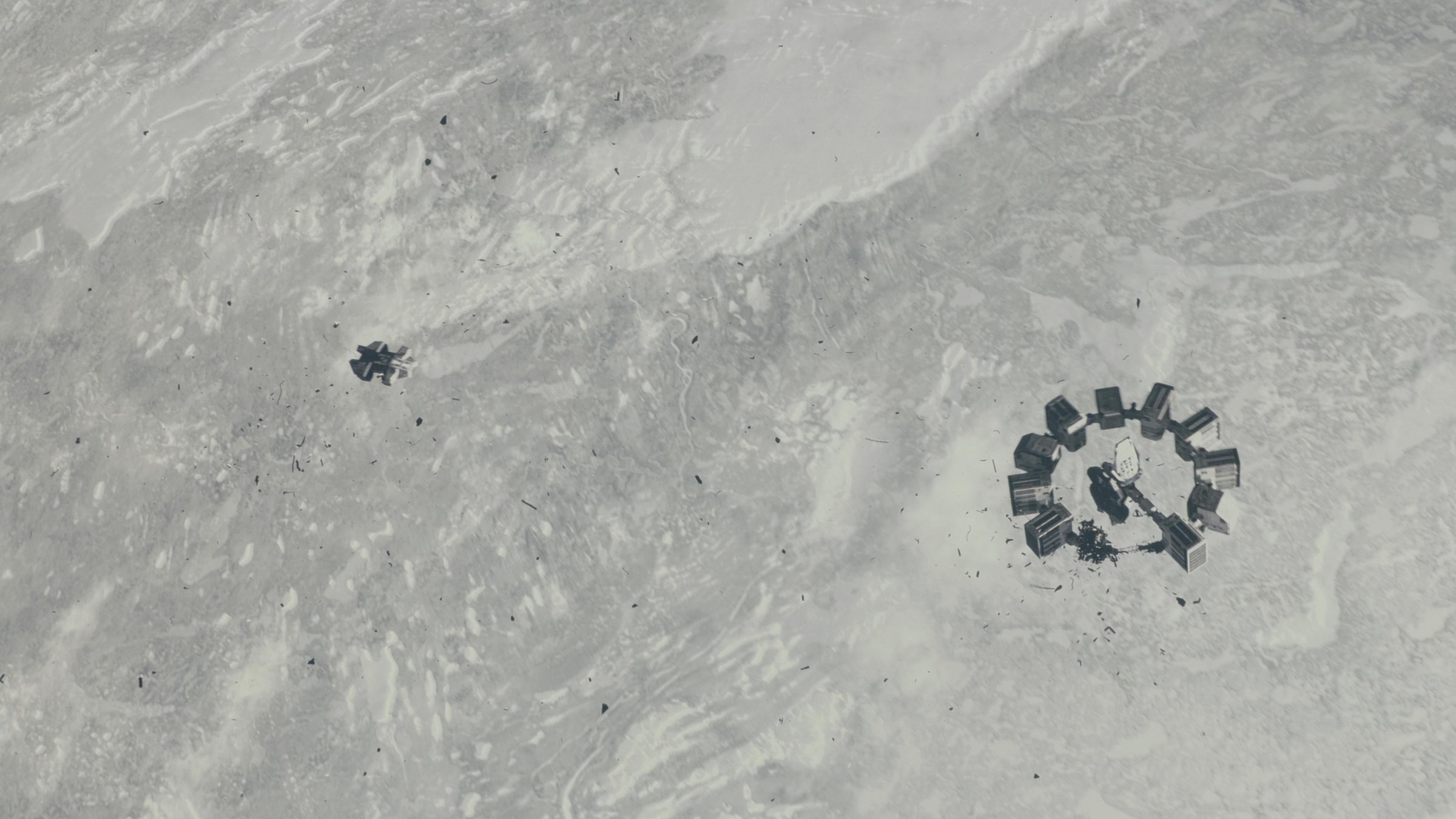
Even the aerial work had its own mount. For the flying shots the production put an IMAX camera in the nose of a modified Learjet, where most productions would have used a helicopter.Franklin posted photographs of the jet in November 2013 and then deleted them.
Locations
- Part 06/09
- Frame 02
- Scope 2.39:1
- Alberta
- Planted corn
- Aerial
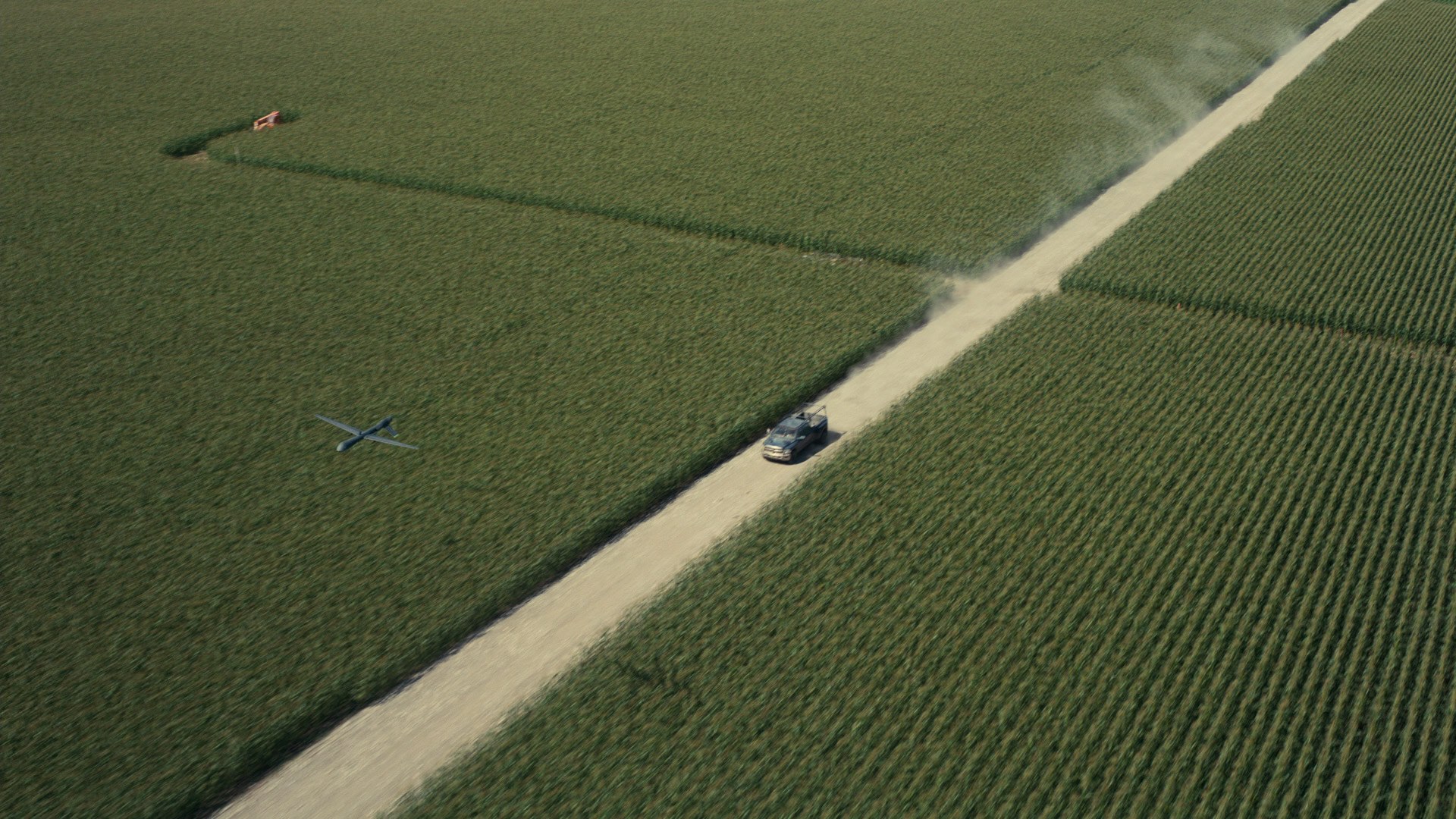
The drone chase is filmed from high above the field. A pickup runs down a pale dirt road, trailing dust, and the drone skims the corn to its left. To the right of the road the rows stand out as clean lines, so the frame reads almost like a plan of the farm. That corn is real. Nathan Crowley planted about 500 acres of it in Alberta. Corn takes about five months to reach six feet, and the production planted a back-up field elsewhere in Alberta as well.
Principal photography began on 6 August 2013 in Alberta, around Nanton, Longview, Fort Macleod and Okotoks, which stood in for the American Corn Belt. It then moved to Iceland, for ten days by one account and two weeks by another, and to Los Angeles for 54 days.
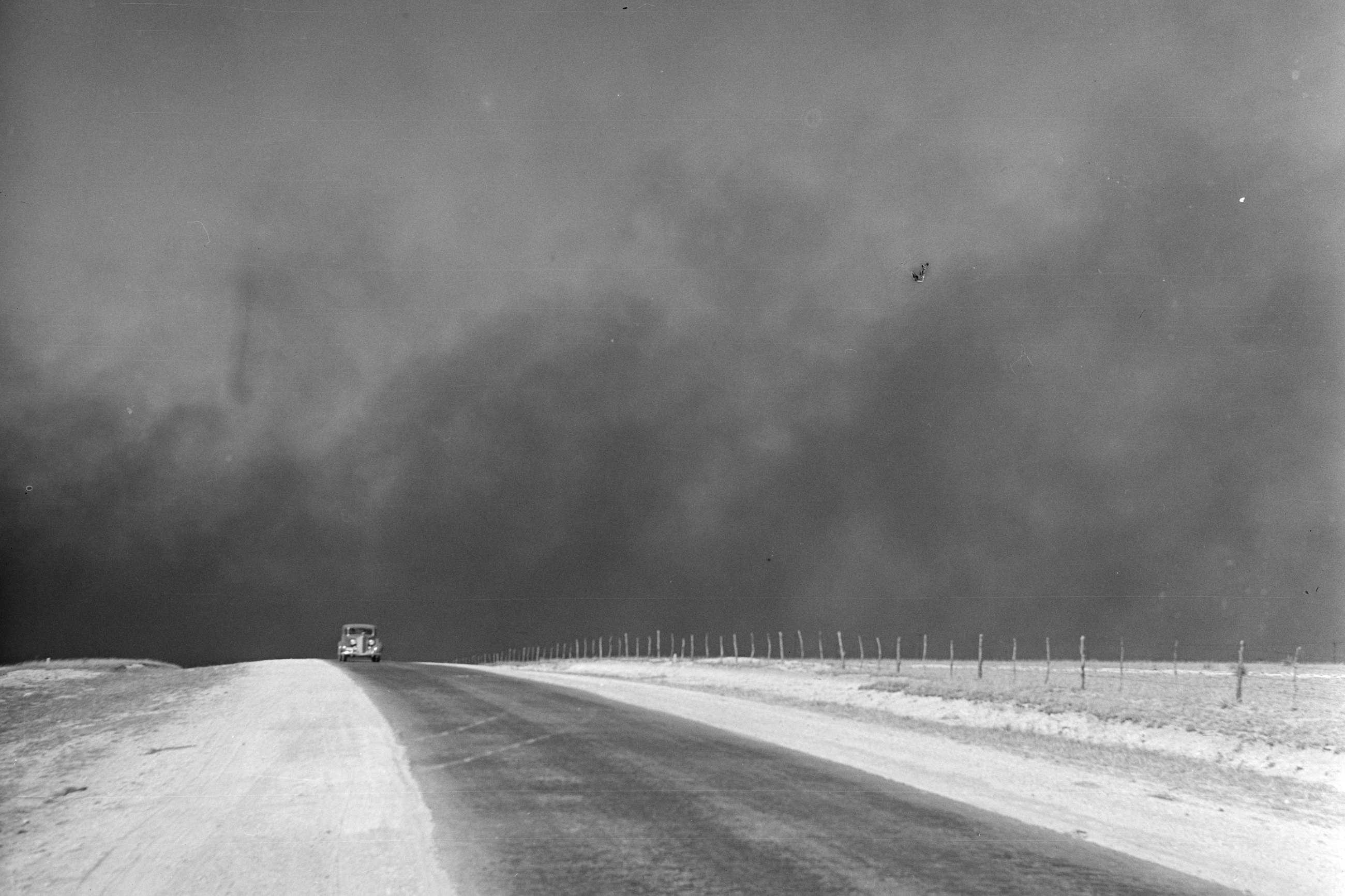
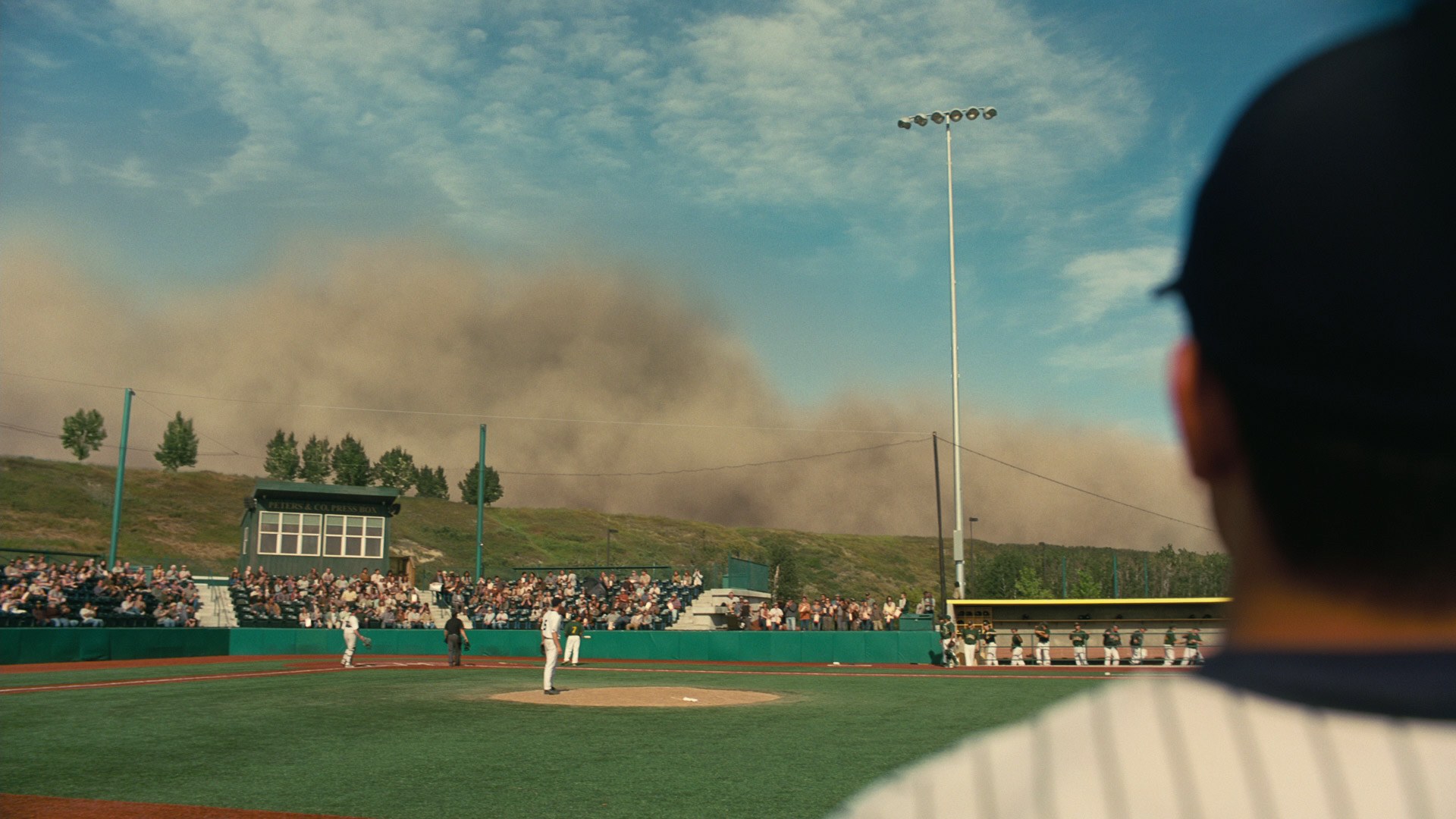
For the dust storms, large fans blew a biodegradable, cellulose-based dust called C90 through the air, including down Fort Macleod’s Main Street, and Nolan drew on Burns’s documentary for these sequences too. The storm at the ballpark is composed like a news photograph: the out-of-focus shoulder of a player in the foreground, the game still going on, and the wall of dust rising over the hill behind the stands under a blue sky.
Iceland gave the film two of its other worlds. The water planet was shot in water less than 30 centimetres deep near Kirkjubæjarklaustur, in the south of the island, after England’s tidal Morecambe Bay had been considered. Sagafilm, the local service company, said the site had the right depth and looked infinite.The production notes name the Brunasandur lagoon; other sources say Mafabot. Both are near Kirkjubæjarklaustur. The full-size Ranger and Lander went too, so that they could be photographed standing in the water and on the ice. From the air, the result is one white object on a sheet of rippled grey that runs to the edge of the frame, with a low sun turning the far side of the water to gold.
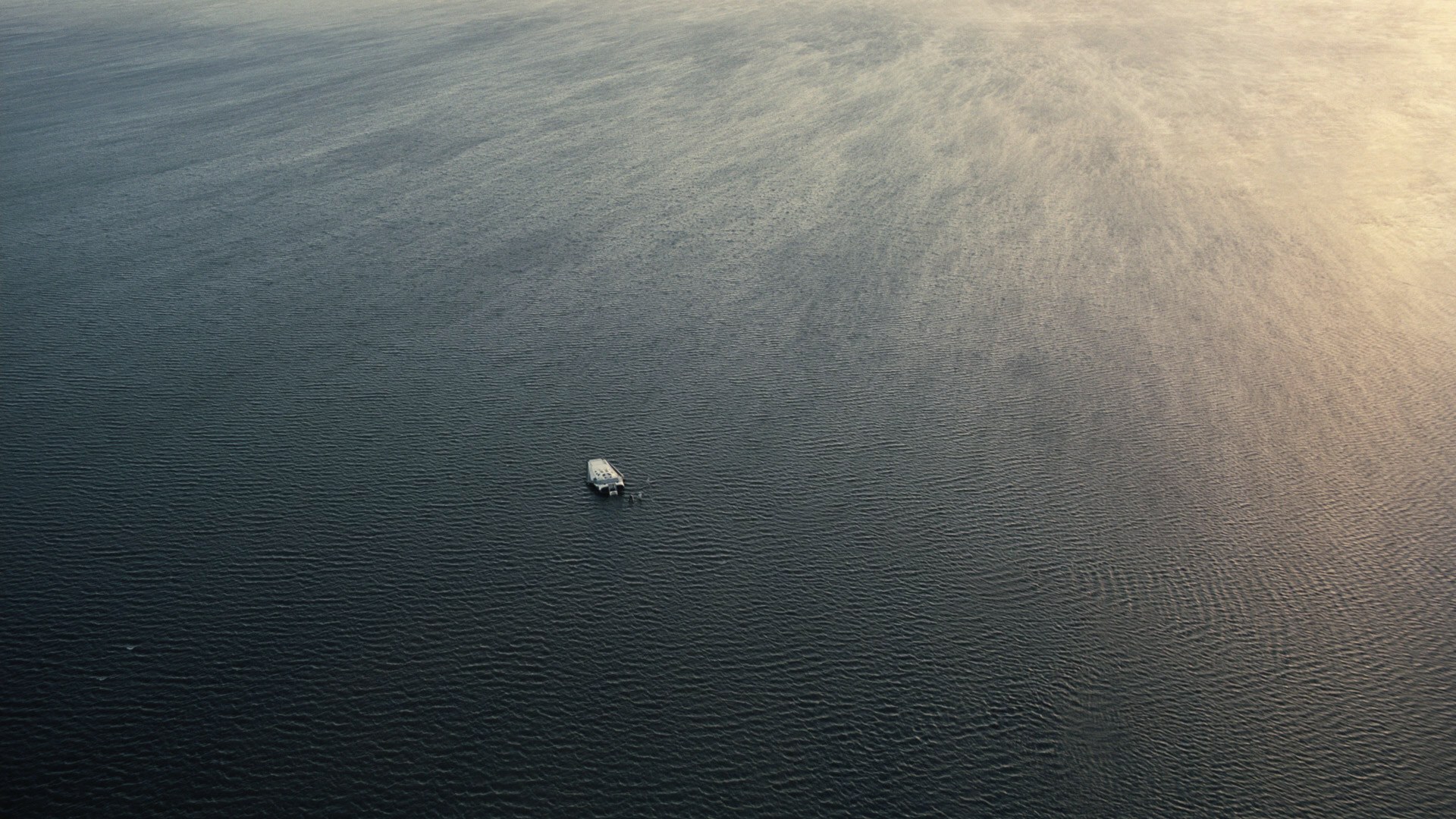
I think this is the best location work in the film. The water really does run to the horizon, and the actors are really wading through it. When the wave arrives it keeps the same flat, misty light, which is a large part of why I believe it.
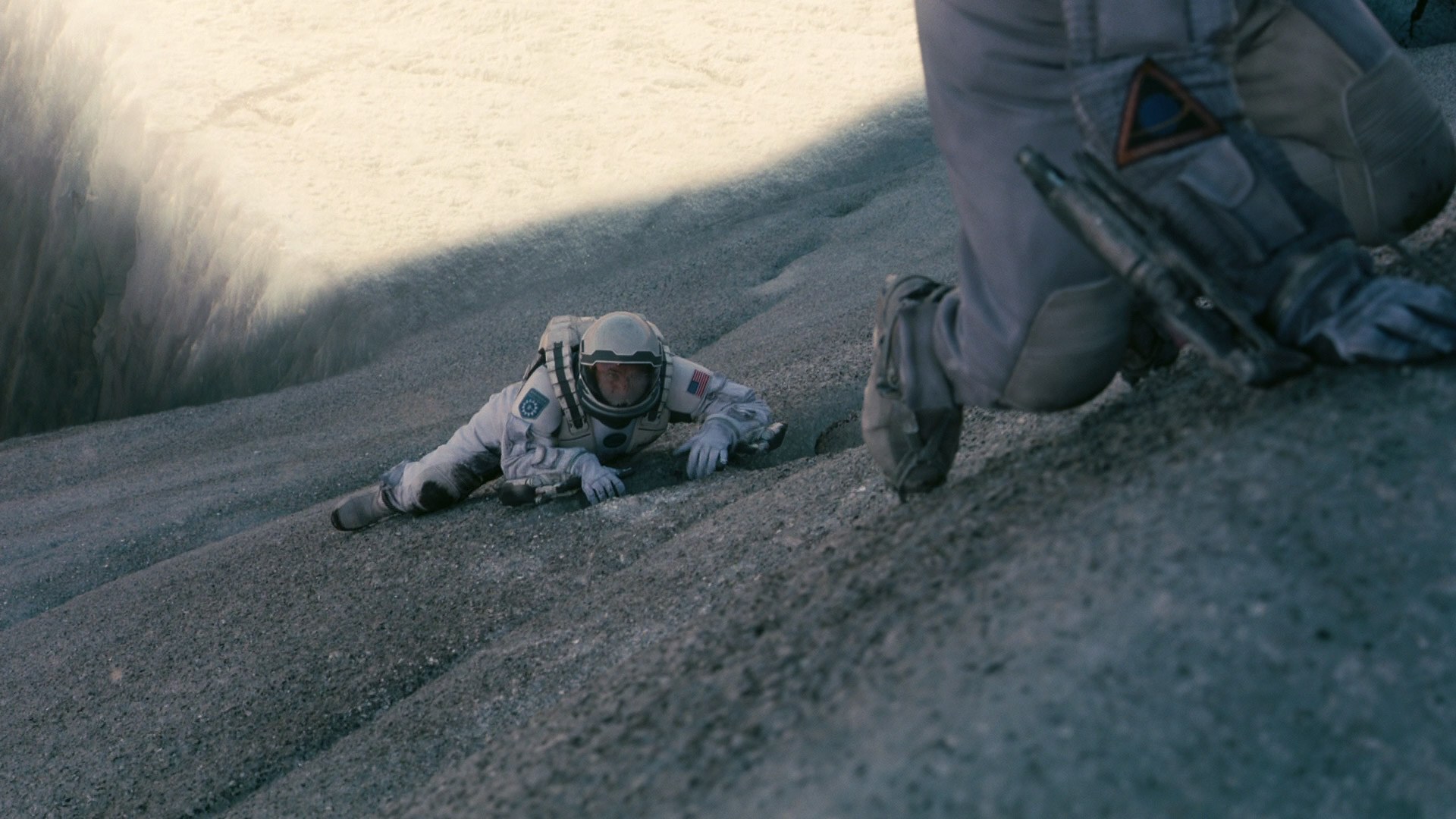
Mann’s planet was shot on Svínafellsjökull, an outlet glacier of the Vatnajökull ice cap, where Nolan had filmed part of Batman Begins. The light on the ice is hard, and in the frame below a shadow cuts a straight line across the slope. When a day on the glacier was cancelled, the close-ups of the fight were shot in a parking lot painted to match. I have looked for the join and never found it.
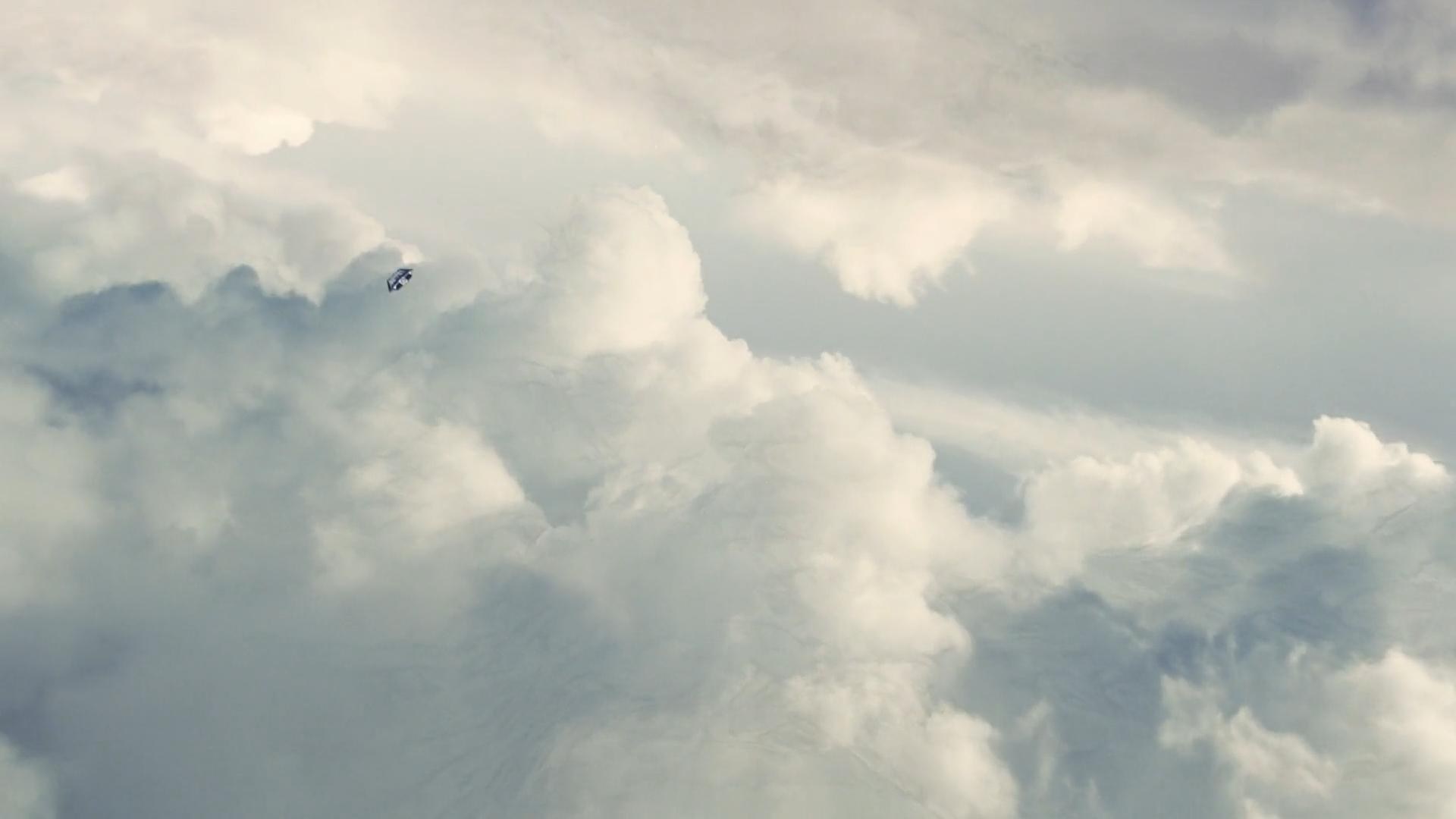
The descent to that planet is one of the softest images in the film. The Ranger is a dark speck at the upper left of a frame filled with white cloud, lit evenly from everywhere, with no hard source at all. After so much hard space light it is a relief to look at.
The Black Hole
- Part 07/09
- Frame 16
- IMAX 1.43:1
- DNGR
- Spin 0.6
- No colour shift
- 4,500 K disk
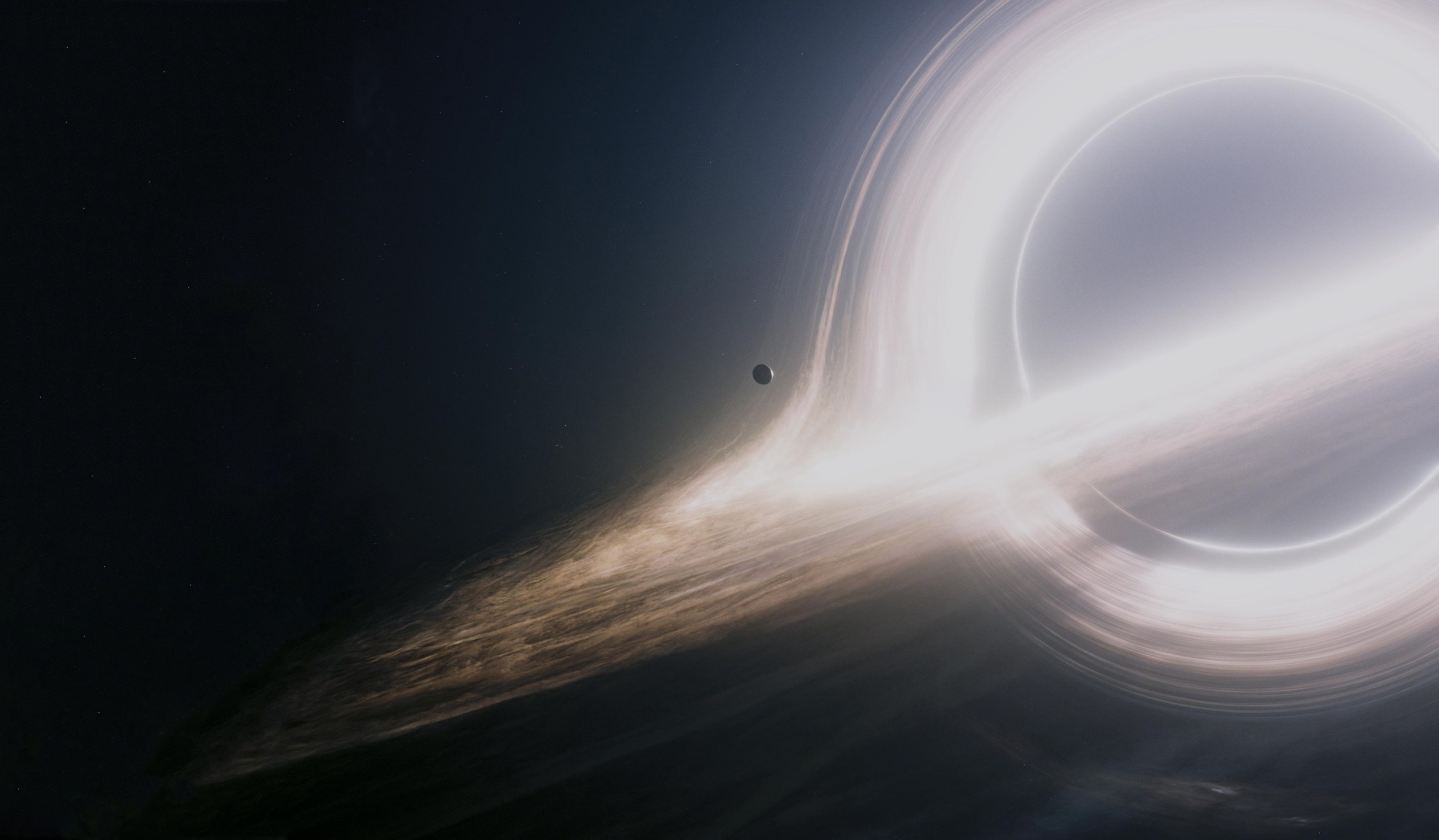
Nobody could photograph Gargantua, so the production made an image that behaves as if somebody had.
Double Negative built a new renderer for it, called DNGR.The team’s paper, published by James, von Tunzelmann, Franklin and Thorne in Classical and Quantum Gravity in February 2015, expands the name as Double Negative Gravitational Renderer, and adds that it can also be read as the Double Negative General Relativistic code. Franklin has called it Double Negative General Relativity. Kip Thorne supplied the equations, the company’s chief scientist, Oliver James, turned them into code, and Eugénie von Tunzelmann supervised the computer graphics.
The renderer’s central idea was a photographic one. Following a single ray of light per pixel made distant stars and nebulae flicker from frame to frame. An IMAX frame has about 23 million pixels, and the flicker had to go. So DNGR followed bundles of rays, narrow beams of light, through the curved space around a spinning black hole, and the paper credits this technique with giving the images the smoothness that IMAX demanded. A single IMAX frame typically took from half an hour to several hours on ten processor cores.In a 2019 interview with James, CERN Courier gives render times of up to 100 hours and almost 800 terabytes of data for the film.
Then they made it look as if it had passed through a camera. The team photographed a point of light through the full set of 35mm and 65mm lenses typically used on Nolan’s IMAX and anamorphic cameras, measured how each lens spread it, and convolved the renders with the result, so that the computer images would match the images shot by real cameras. The paper calls the soft glow this adds veiling flare, and says it is very characteristic of IMAX lenses. They worked out the motion blur for a 24-frame camera with a 1/48-second exposure, the standard 180-degree shutter, and calculated it analytically instead of by random sampling. Gargantua was given the lenses and the shutter of cameras that never went near it.
They also edited it, the way you would recompose a shot. A fully realistic disk, with the Doppler and gravitational colour shifts and the beaming that come with them, was badly lopsided, bright and blue on one side and dim and red on the other, and the paper rules it out as unacceptable. So the film’s disk has no colour shifts at all. It is thin and cooled to a uniform 4,500 kelvin, with some embellishments added. The story needs a black hole spinning at nearly its maximum rate, about 0.999 in the paper’s own figures, but Nolan and Franklin judged the image at that spin too confusing for a mass audience, so the pictures use 0.6.
Franklin described the problem in the terms a cinematographer would use. A black hole against black space would have been no more than a silhouette against the stars. What gives Gargantua a shape is the disk, lensed up over the top of the shadow and down under it, which he compared to a fiery version of the London Underground logo. In the frame above, Miller’s planet is the small dark disc to the left, and the disk wraps over and under the shadow, which in this frame reads as a pale grey.
The team had a more accurate image and chose the one an audience could read, then gave it the flare and blur of the production’s own cameras so that it could sit in the same film as the cornfield. I think that was the right call, and it is the call a cinematographer would make.
The Tesseract
- Part 08/09
- Frame 17
- Scope 2.39:1
- Partly a built set
- Projection
- Slit-scan look
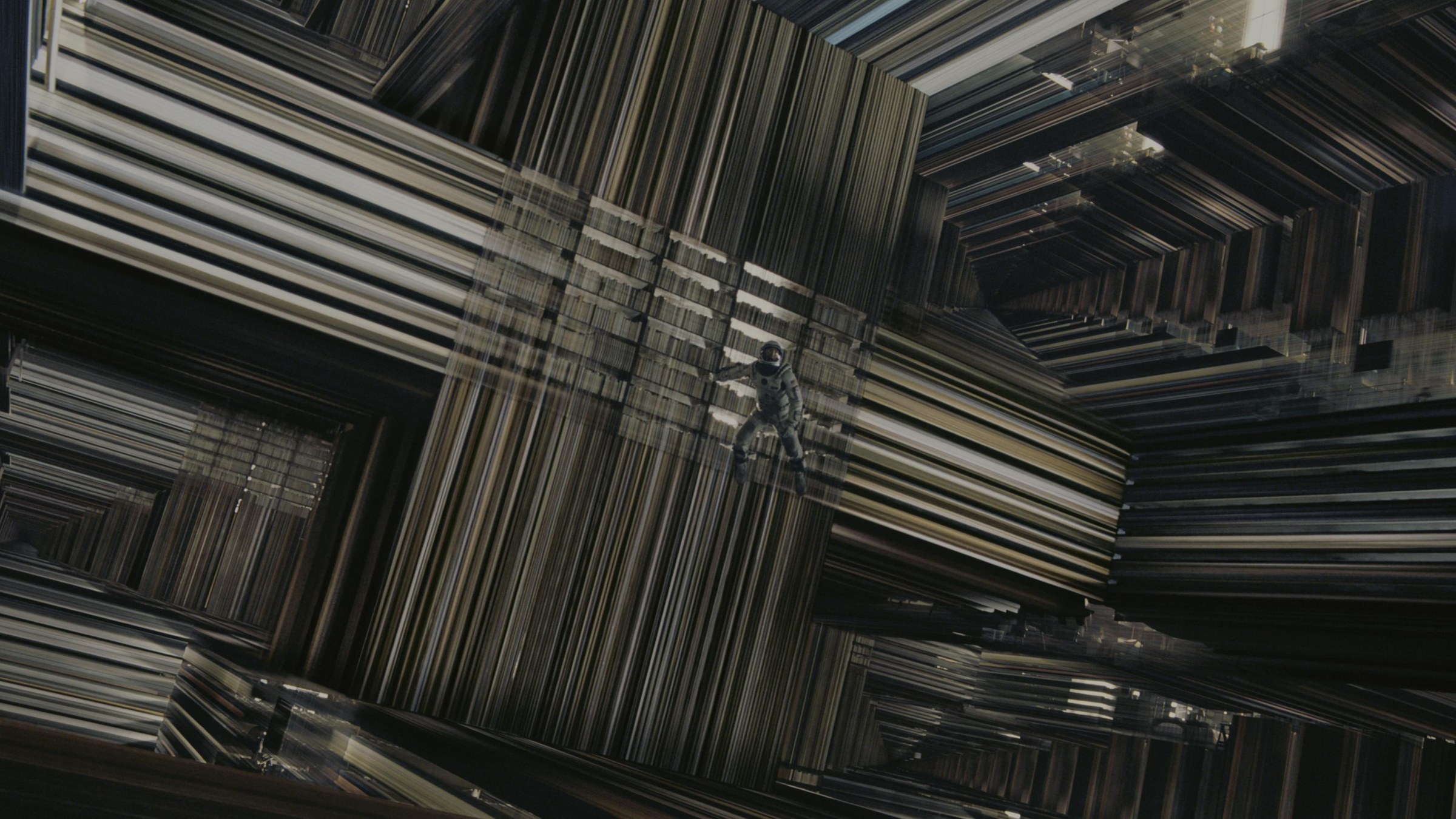
The tesseract is where the film’s two methods meet. It looks like the most digital place in Interstellar, and a good part of it was built.
According to Franklin, one section was built as a physical set with four rooms around it, and the rest was extended digitally without end. Screen Daily describes a glass floor. The look came from slit-scan photography, which, as Franklin explains it, captures a single place over a stretch of time. Before building anything, Nolan’s team made a small model, an infinity box, to try the idea out.
The set was lit by its own images. The crew projected the moving timelines onto the physical set, so the light from those stretched-out moments was in the room with the actor. Using projection instead of green screen made the set easier for van Hoytema to light, and front projection showed McConaughey what Cooper would be seeing. For the shots of Cooper travelling through the tesseract’s tunnels, beyond the built section, McConaughey played in front of a projection screen showing rough previsualisation, which was later replaced with the finished tesseract.
In the frame at the top of this section, Cooper hangs small in the middle of the lattice, and everything around him is made of stretched lines: shelves and books pulled out into long streaks until they read as texture. It is a bedroom seen across time. Then the film cuts back to the farmhouse, years later, and the photography changes completely. Murph sits in low light, warm on her face, with the shelves behind her almost lost in shadow.
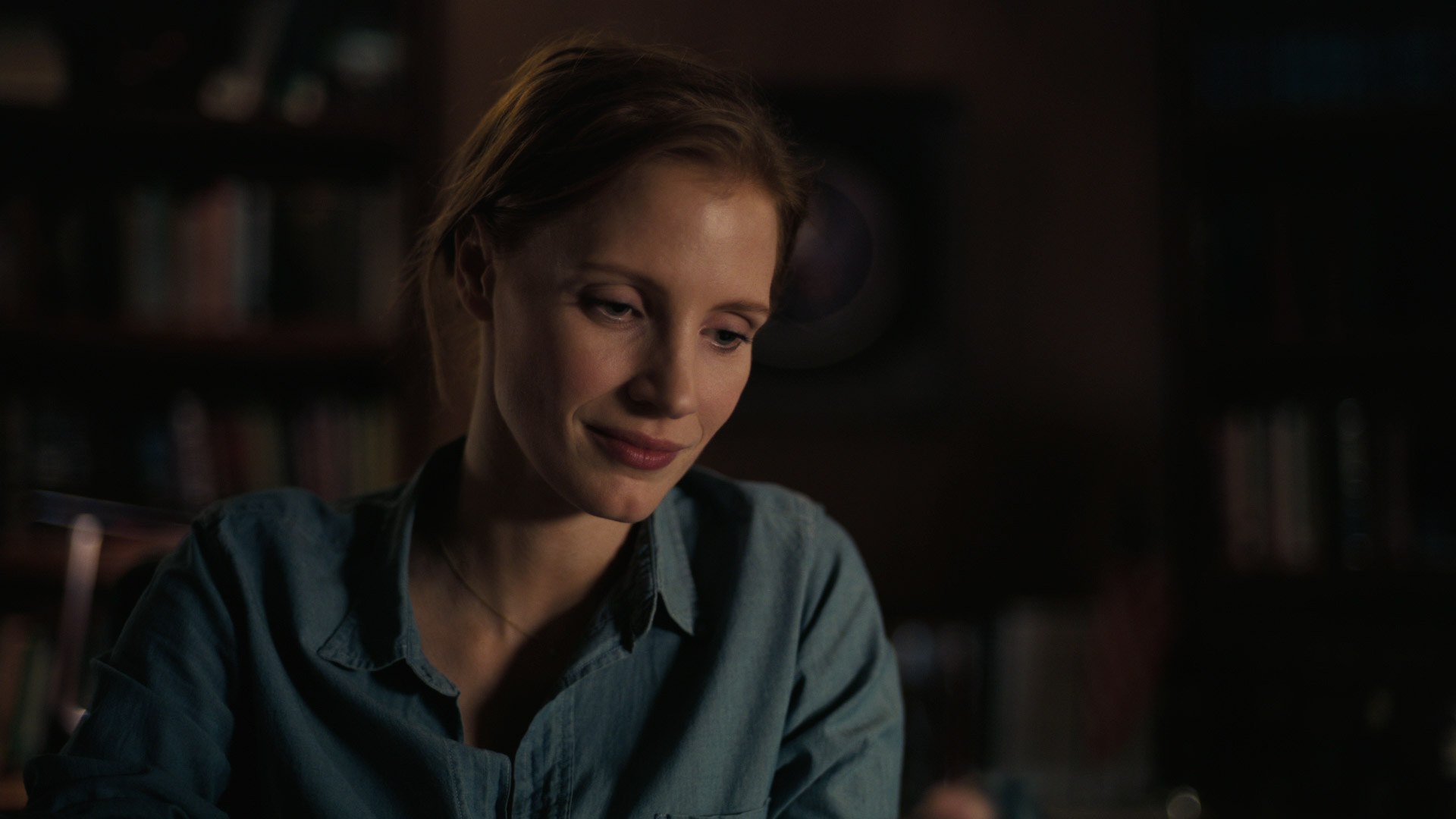
I love that cut because it joins two kinds of photography: a huge abstraction made partly from projected light, and a close shot of a face in a dark room. The film needs both, and it moves from one to the other without a bump.
The Finish
- Part 09/09
- Frame 20
- Scope 2.39:1
- Low sun
- Lens flare
- Photochemical grade
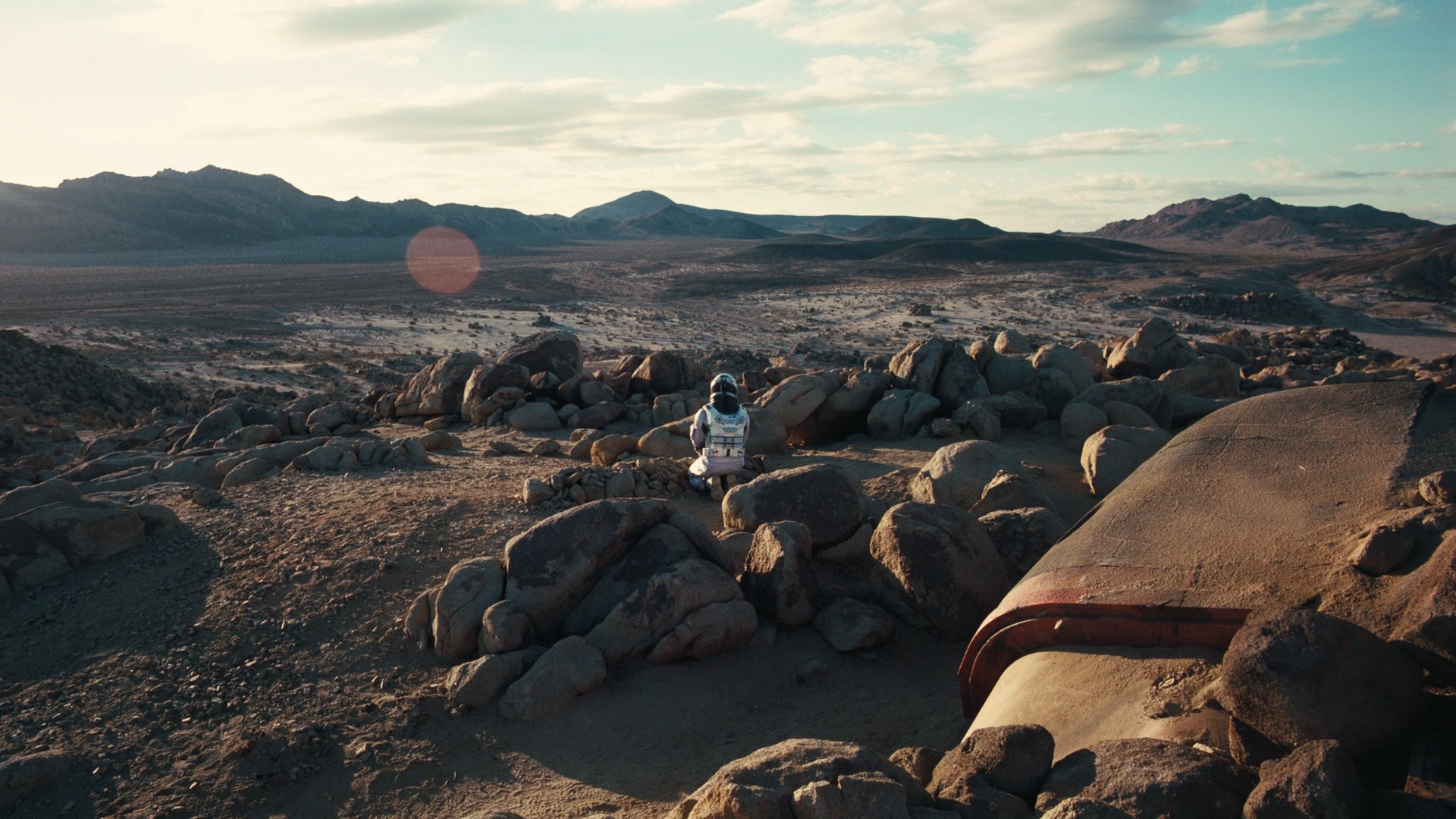
The film closes under a low sun. Brand kneels, small, among boulders, a wrecked capsule fills the right foreground, and the sun throws a round red flare into the frame at left. It is one of the warmest images in the film, and like the rest of it, its colour was set on film.
Interstellar was graded photochemically. At FotoKem, the film timer Mato Der Avanessian worked through it scene by scene with Nolan and van Hoytema. FotoKem processed the 65mm negative and the 35mm effects negative, cut both negatives, and made the answer prints, the intermediates and the domestic release prints. The last card of the end credits says the film was shot and finished on film.
The release prints were made several ways at once. In 15/70 IMAX prints the IMAX sequences were printed at full quality in their own format, and the 35mm sections were blown up to fill the screen with a 6K digital process. Standard 70mm prints reduced the IMAX footage and enlarged the 35mm optically, both photochemically, at 2.2:1. Even on the 35mm prints, which were struck photochemically, the IMAX sections came from new 4K negatives made from 8K scans of the IMAX footage. The digital versions were matched to the approved film prints by the colourist Walter Volpatto and the colour scientist Joseph Slomka, working with Der Avanessian. The film print was the master, and everything else was made to look like it.
You can see that grade in the whites. Near the end, old Murph lies in a bed on Cooper Station, framed tight on her face and a white pillow, lit softly from everywhere, with Cooper a dark, out-of-focus shape at the right. The whites are warm, close to cream, and her skin keeps all its texture.
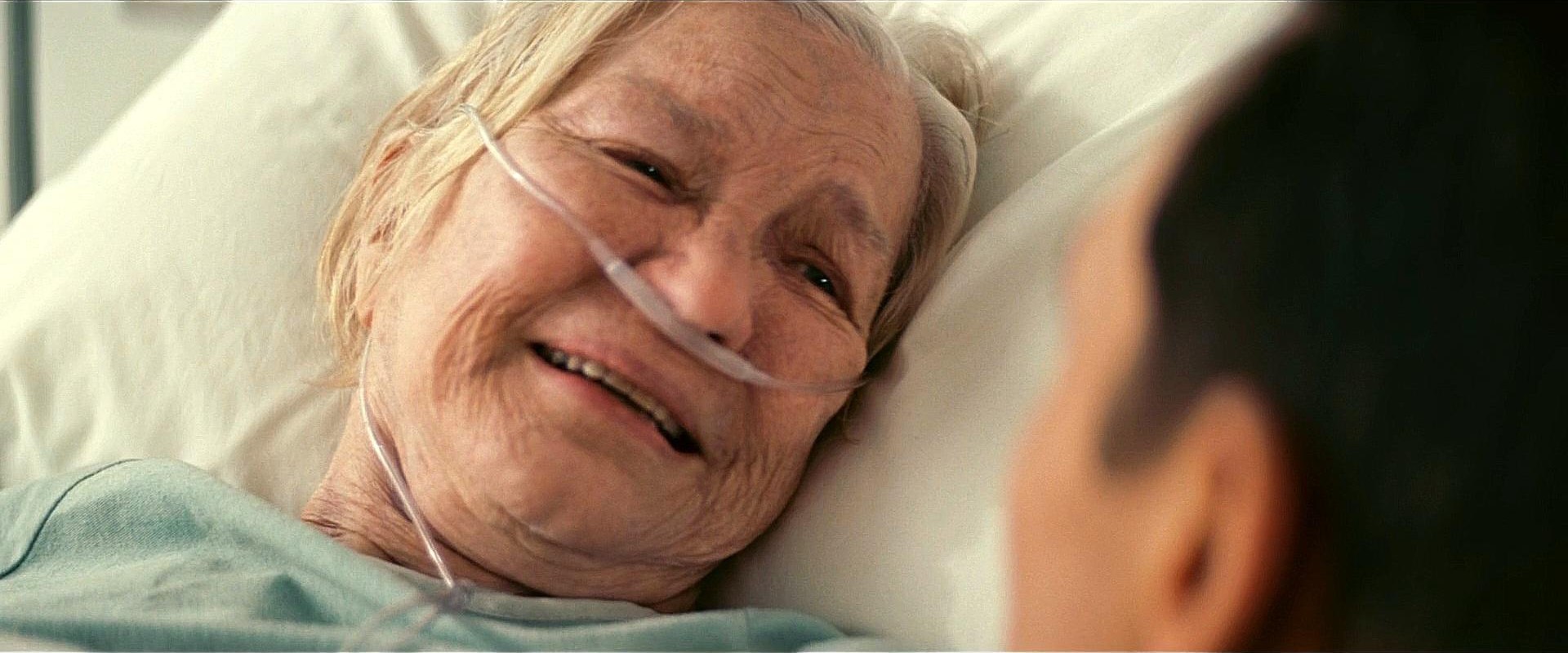
Paramount was moving to digital-only releases by then, and it made Interstellar an exception. Cinemas that could still project film got it two days before the wide release on 7 November 2014, about 250 screens, 41 or 42 of them IMAX 70mm. The IMAX print weighed about 600 pounds, its 49 reels wound onto a single reel, and it needed two projectionists. In July 2014, while the film was still in post-production, the studios agreed to buy set amounts of Kodak film to keep its plant running, a deal Nolan had lobbied for.
The cinematography was nominated for a BAFTA and not for an Oscar; Emmanuel Lubezki won that year for Birdman. Van Hoytema won later, for Oppenheimer. Interstellar began the large-format partnership that went on to Dunkirk, Tenet, Oppenheimer and, in 2026, The Odyssey, shot entirely on IMAX film.
When I think about Interstellar now, I think about where its light comes from. The light in the cockpits follows a projected picture of space, and the glow in the tesseract comes from the timelines themselves. Even the black hole carries the flare of lenses it never passed through. Over and over, the film makes its light come from the thing the characters are looking at, and puts the camera where someone could really have stood. Twelve years on, that is what still makes it feel real to me.
Written by Reza
The Shot List