Damien Chazelle, 2016
La La Land
How Linus Sandgren photographed Damien Chazelle’s musical on 35mm anamorphic at the old CinemaScope ratio of 2.55:1, in long single-camera takes under real twilight skies.
La La Land begins with a card announcing that the film is presented in CinemaScope. It appears in a narrow black-and-white frame, and then the frame stretches sideways to the full width of the screen and the card turns to colour. Before there is a single image of Los Angeles, Damien Chazelle and his cinematographer, Linus Sandgren, have told you what kind of picture this is going to be. It is going to be wide, and it is going to look like the studio musicals that used to follow a card like that.
The rest of the film keeps the promise the hard way. It was shot on 35mm film over 42 days from August 2015, mostly in real places around Los Angeles, with the musical numbers in long, unbroken takes on a single camera. The sky in its best-known dance is the real sky, and its traffic jam was staged on a working freeway interchange.
Sandgren is Swedish and grew up in Stockholm. He built a career in commercials after moving to Los Angeles, and before this film he had shot American Hustle and Joy for David O. Russell. Chazelle interviewed several cinematographers. When Sandgren came in, Chazelle played him the music, and by Sandgren’s account a meeting booked for an hour ran to two. He says he always shoots film, and he brought his own film crew, including the operator Ari Robbins and the gaffer Brad Hazen.
What he wanted was a Los Angeles that felt heightened and romantic: real locations, lit to feel magical instead of realistic. I have left the story alone apart from what each image needs, and organised what follows by craft, starting with the shape of the frame.
Format
- Frame 01
- Opening card
- Narrow to full width
- Black and white to colour
The first frame: a retro “Presented in CinemaScope” card, which opens out from a narrow black-and-white frame to the full width of the screen and turns to colour.
Chazelle wanted to make the film the way a 1950s studio would have made it. A filmmaker from that era, Sandgren said, would ask for “the best camera and the widest screen”. Chazelle also asked for a film that was “very anamorphic”, by which he meant both the wide frame and the way anamorphic lenses distort the out-of-focus parts of a picture.
Chazelle expected the standard scope frame of 2.39:1. Sandgren pushed for 2.55:1, the old CinemaScope ratio, and named George Cukor’s A Star Is Born (1954) and other films made before 2.40 became the standard. His reason was that the wider frame gives the audience more image. He also wanted to frame the dancing head to toe, for an epic feel.
2.55:1CinemaScope
The old CinemaScope ratio Sandgren pushed for, naming A Star Is Born (1954). The film is framed for it.
At the same height, a 2.55 frame is only about 7 per cent wider than a 2.39 one, a thin extra strip at each side. I notice it most in the two-shots, where it gives a couple room to drift apart and still share the picture.
What Sandgren shot was not the original CinemaScope process but Panavision anamorphic, framed to CinemaScope’s old ratio. The format was 35mm, four perforations to a frame, with a 2x anamorphic squeeze. According to American Cinematographer, the production had been budgeted for three-perf, and the team paid for the extra perforation by “rehearsing more and shooting less”. The magazine adds that across the full width of a four-perf frame a 2x squeeze gives a picture of about 2.66:1, which was cropped to 2.55.
1.28:1Squeezed 2×
A 2x anamorphic lens squeezes the picture to half its width on the 35mm negative; stretched back out, it fills the 2.55:1 frame.
Panavision cut new ground glasses marked for 2.55:1 and modified lenses to cover the wider picture. Some still did not quite cover it, and Sandgren has said they kept the slight vignetting instead of correcting it.
The camera was a Panavision Panaflex Millennium XL2, with Panavision’s C Series anamorphic primes and some from the E Series. Sandgren told Panavision the C Series “maintained a classic Hollywood feeling”. According to American Cinematographer, he avoided the 30mm and 35mm because they distorted too much, used the 40mm as his main lens with some use of the 50mm and 75mm, and generally shot at T2.8 with no filters other than neutral density. There were zooms on the job too, he told MovieMaker, but Chazelle wanted to catch a lot of scenes in single takes.
Film Stock
- Frame 04
- Kodak 500T 5219
- Rated EI 200
- Pull-processed
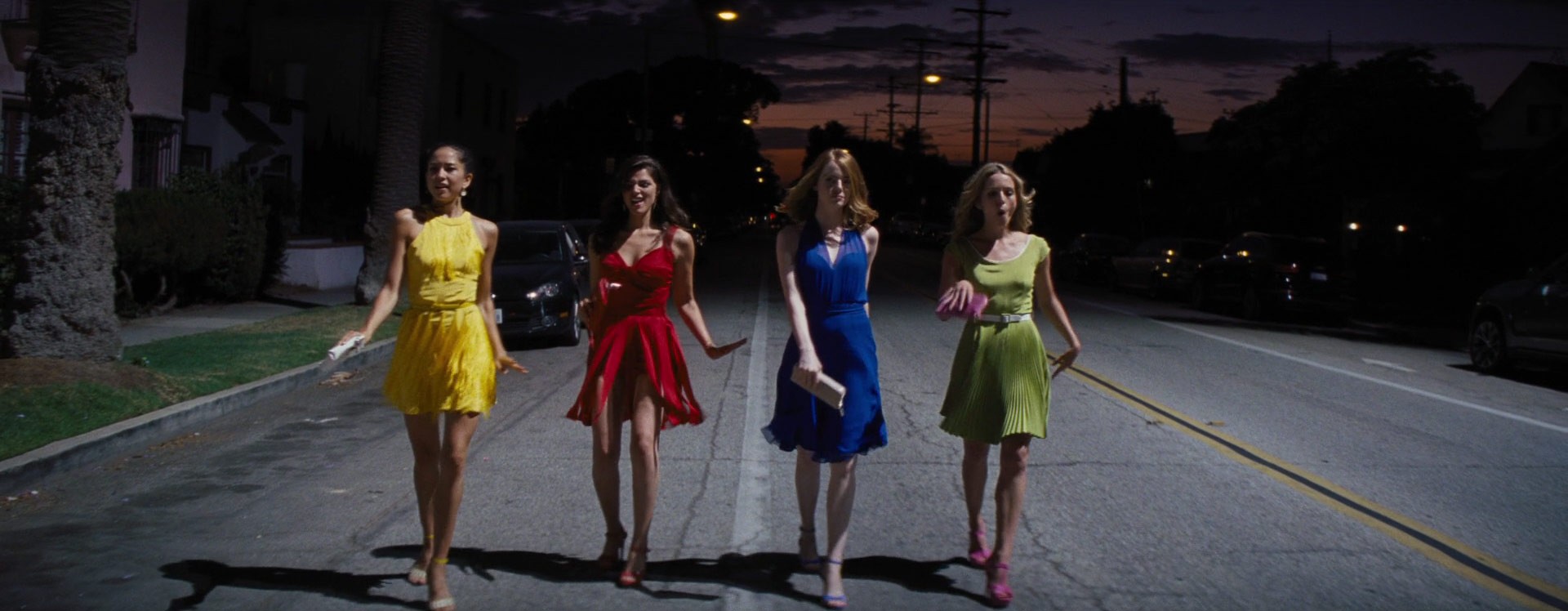
“Someone in the Crowd”: the four roommates walk down a street at dusk in yellow, red, royal blue (Mia) and green. On overexposed, pull-processed 500T, the colour was held on the negative and left at a normal level in the grade.
Sandgren and Chazelle both wanted the richest image they could get, and Sandgren’s argument for film was about colour. Film, he said, “exaggerates” it, especially the greens and blues of Los Angeles street lights and skies, which digital barely registers. He told MovieMaker the film “was supposed to look much more magical than realistic”.
Most of the film, the interiors by day and night and the dusk and night exteriors, was shot on Kodak Vision3 500T 5219, and the daytime exteriors on Vision3 250D 5207. Both were overexposed. The 500T was rated at EI 200 and the 250D at EI 100, which American Cinematographer puts at a stop and a third over, and FotoKem in Los Angeles then pull-processed the negative by a stop. The point was finer grain, softer contrast and a slightly muted, held saturation, baked into the negative. Push processing, Sandgren said, would have made the colours feel “too electric” and the image grainier.
Three departments put those colours in front of the lens, working from one plan: David Wasco’s production design, Sandy Reynolds-Wasco’s set decoration and Mary Zophres’s costumes, with gelled light on top. Zophres has said she and the production designer “almost choreographed where we would use color and how”. Her “Technicolor palette” was royal blue, yellow and red, matched to Pantone by the art department. She kept one rule: if Emma Stone wore a colour, nobody else in the frame did, though it might echo in a background prop such as a flowerpot.
The frame above, from “Someone in the Crowd”, shows the rule at work. Mia is in royal blue, and her three roommates wear yellow, red and green, colours chosen to set hers off without competing with it. Zophres says a planned pink for one of them was dropped because a location the team had found was already pink.
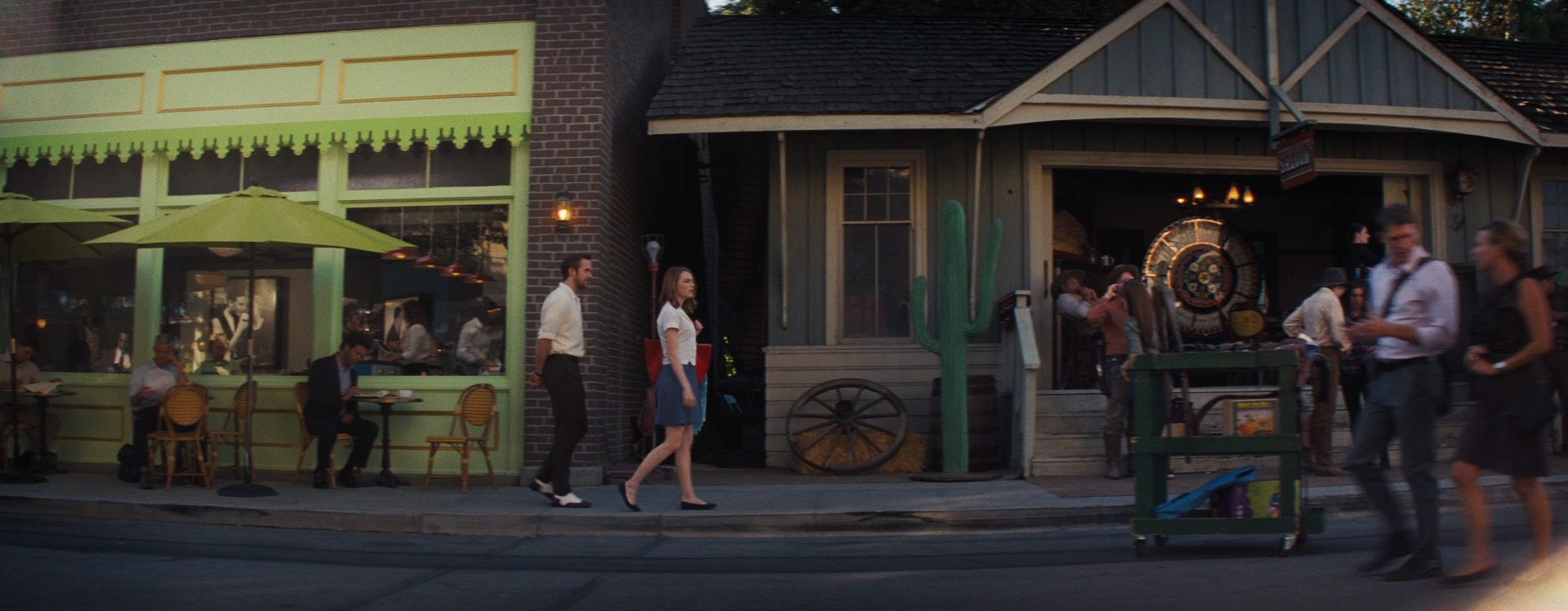
Wasco has said the template was the Jacques Demy films of the 1960s, and American Cinematographer names The Umbrellas of Cherbourg and The Young Girls of Rochefort. Wasco also quotes Chazelle’s brief to the designers: make “the real locations look fake and make the sets look overly real”. The Warner Bros. backlot seems made for that brief. Mia’s coffee shop sits on the lot’s French street, and in his commentary Chazelle points out that the window from Rick’s Café in Casablanca is on the same lot.
The finish was digital. American Cinematographer reports that at EFilm the negative was scanned at 6K on an Arri scanner, downsampled to 4K and filmed out at 2K, and that the colourist, Natasha Leonnet, added blue in the blacks “to emulate the original Technicolor process”. Sandgren told Kodak that the saturation was otherwise left at a normal level, because the separation between colours was already on the negative. The colour in this film was made in front of the lens, and the grade mostly leaves it alone.
Moving the Camera
- Frame 08
- Lighthouse Café
- Hard spot on the band
- Softer light on the tables
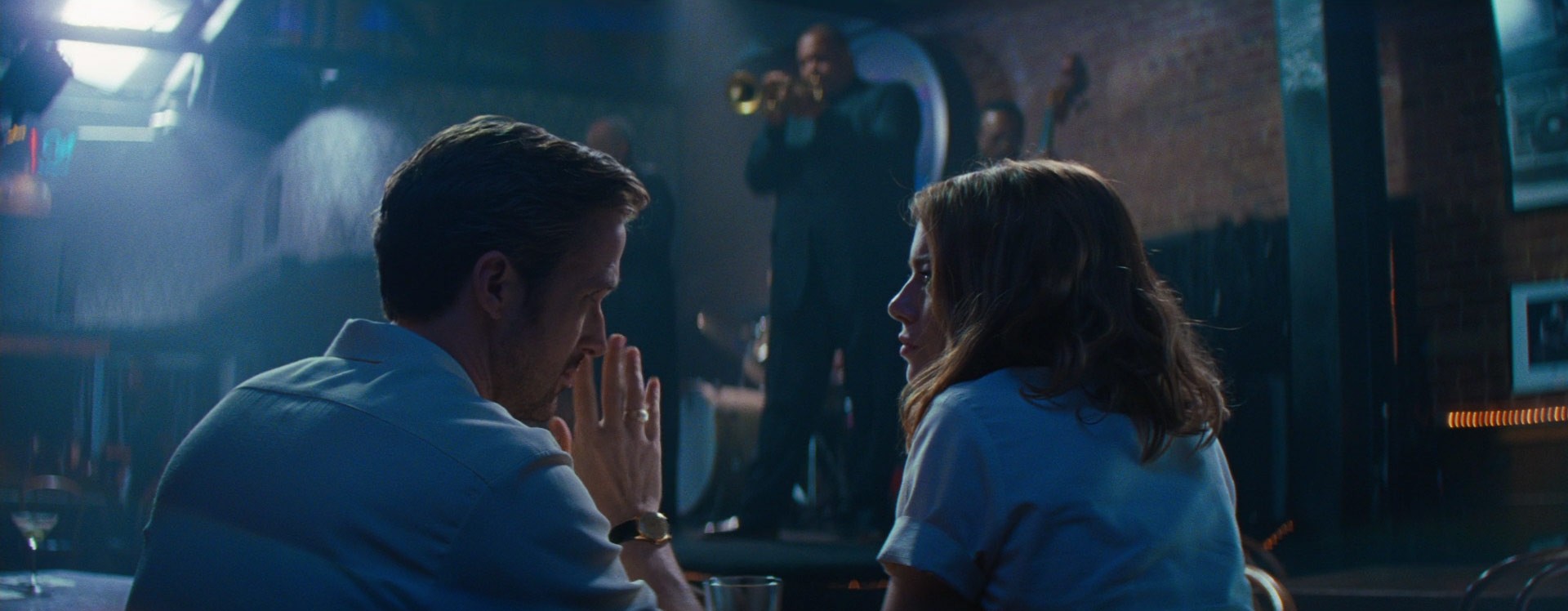
The Lighthouse Café in Hermosa Beach: the trumpeter plays under a hard spot on the stage while Sebastian and Mia talk at their table in softer light. Sandgren lit the band with small, hard Par-can spots and the audience from above with softer sources.
Chazelle wanted the musical numbers caught head to toe in single takes, with the camera moving in depth as well as from side to side, instead of breaking them into coverage. Sandgren told Panavision that the unbroken takes were meant to “seduce the viewer into emotional involvement”, and that cranes and Steadicam let the camera be “more three-dimensional” in the space.
The numbers were shot with one camera, so that you can see Ryan Gosling really playing the piano and Stone really singing. Dialogue-heavy scenes usually had two. In his commentary Chazelle says the dinner argument between Mia and Sebastian was the only sequence he covered fully, and you can feel it: for those few minutes the film cuts like an ordinary film.
One camera and long takes made a lens problem. A standard anamorphic lens focuses no closer than about three feet, so a single moving shot struggles to start on a dancer’s whole body and end on a face. Panavision’s Dan Sasaki built a custom 40mm 2x anamorphic that focuses down to 19 inches. With it, one take could travel from a head-to-toe wide into a close-up.
The moves were worked out in rehearsal. Scenes were rehearsed for weeks, often filmed on an iPhone, to fix the camera marks, and Chazelle’s iPhone rehearsal of the opening number was later released.
The fastest camera in the film is in a jazz club, in a scene with Sebastian at the piano and Mia in the crowd. The camera whips back and forth between them, and behind-the-scenes footage shows Chazelle tapping the operator’s shoulder to cue each whip. Sandgren told Kodak the pans tilt as well as swing, and that the operator makes the stops with his own body position, so Robbins practised the musical flow and they shot many takes. The light was built for the whips too. Sandgren told Kodak he lit the band with hard, small Par-can spots and the audience with softer top light, and kept the camera on the shadow side, so that each whip lands on contrast.
What I like about all this is that the long take is never a stunt. The camera stays close enough to see faces, and it keeps moving because the scene is a dance, even when nobody is dancing. The biggest of these moves, and the one that needed the most machinery, is the first thing in the film.
The Opening Number
- Frame 03
- Steadicam to crane
- Natural sun
- Main title
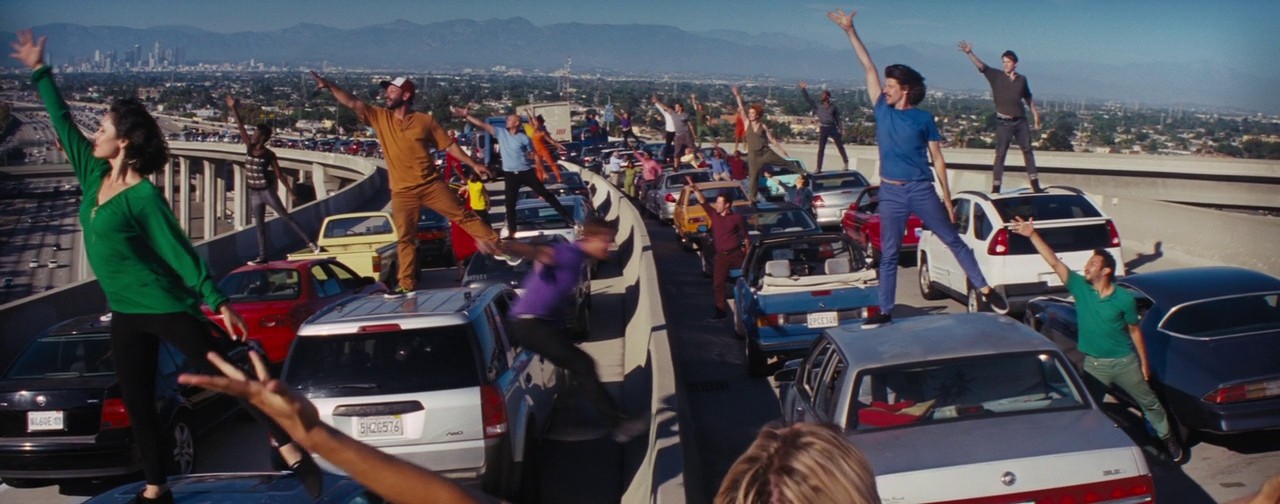
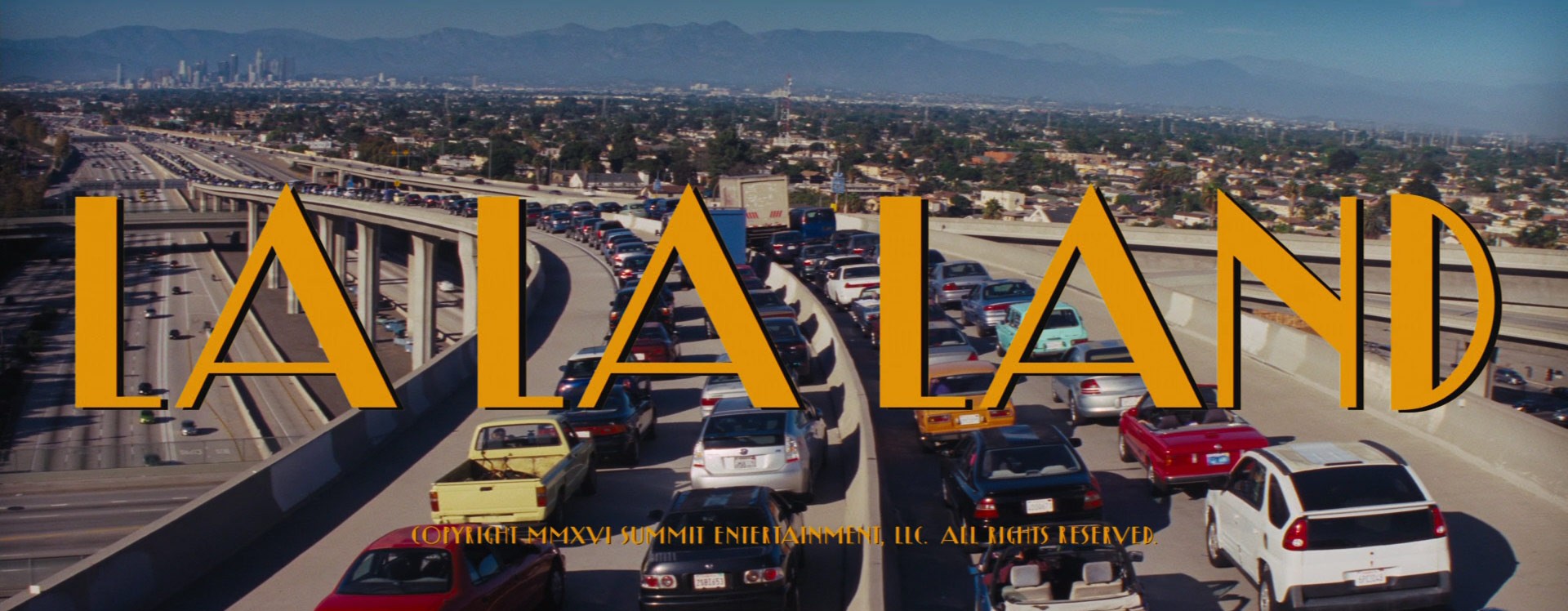
The end of the opening number: the last of its three shots begins on Steadicam, and the operator steps onto a crane that rises high over the jammed ramp as the title comes up.
Chazelle has said the idea for the opening came from Love Me Tonight (1932), which begins with Paris waking up. His version is a Los Angeles traffic jam, shot on the elevated carpool connector ramp between the 105 and 110 freeways at the Judge Harry Pregerson Interchange. The supervising location manager, Robert Foulkes, picked it for its view of the downtown skyline, which, as Wasco tells it, struck Chazelle as looking “like the City of Oz”. The other lanes stayed open, so the traffic moving behind the dancers is real.
After rehearsals in a studio parking lot, the ramp was closed twice, once for a rehearsal and then for a weekend of shooting. The Daily Beast reported about 30 dancers, 100 extras and at least 60 cars.Other reports, LAist’s among them, say 100 dancers. The Daily Beast’s split is the more specific. Both days were among the hottest of the year, about 108 to 110°F as the designers remember it, and Wasco’s main worry was a knee-high parapet with a drop of about 100 feet beyond it.
On screen it plays as one take of nearly six minutes. It is three shots joined by two hidden cuts, and both cuts fall inside whip pans, at about 3:00 and 4:45. The plan was to shoot it all on Steadicam, but a four-foot-high median was in the way. The answer, for two of the three shots, was a MovieBird 45 telescoping crane on Allan Padelford’s Biscuit Jr., a drivable camera trailer.Sandgren called it a Technocrane in two interviews. American Cinematographer and AwardsDaily name the MovieBird 45. As Chazelle put it, “because we needed the camera to glide over cars, we had to use cranes.”
The light is the sun. American Cinematographer reports negative fill from the key grip, Anthony Cady, to cut the sun back, and Sandgren told Kodak of a single 12-by-12 bounce for the reveal of the band in the truck. The hard part was the crane’s own shadow. The number was split into three pieces, each shot in its own narrow window of the day so that the crane would not throw a visible shadow on the dancers. American Cinematographer says the first two were shot in the morning and the last in the afternoon.Sandgren told AwardsDaily it was the other way round, two in the afternoon and one in the morning. The first day was cloudy, which is awkward for a song about sunshine, so they chased the sun through the clouds. Sandgren told Kodak he exposed the backlit shots about a stop under the shadow reading, and rode the exposure through the moves with a Preston remote iris.
The last of the three shots starts on Steadicam, and the operator steps onto a crane, which lifts the camera over the dancers before the title comes up. The Steadicam stretch alone took about 25 takes. Zophres says the number was first planned in earth tones, close to monochrome, and it ended as greys and browns with pops of colour for the dancers who had parts, so the strong colours stand out against cars and concrete.
Knowing that the traffic at the back of the frame is real changes how I watch it. Every car beyond the dancers is somebody actually trying to get somewhere.
Magic Hour
- Frame 06
- Real twilight sky
- One crane take
- 27 marks
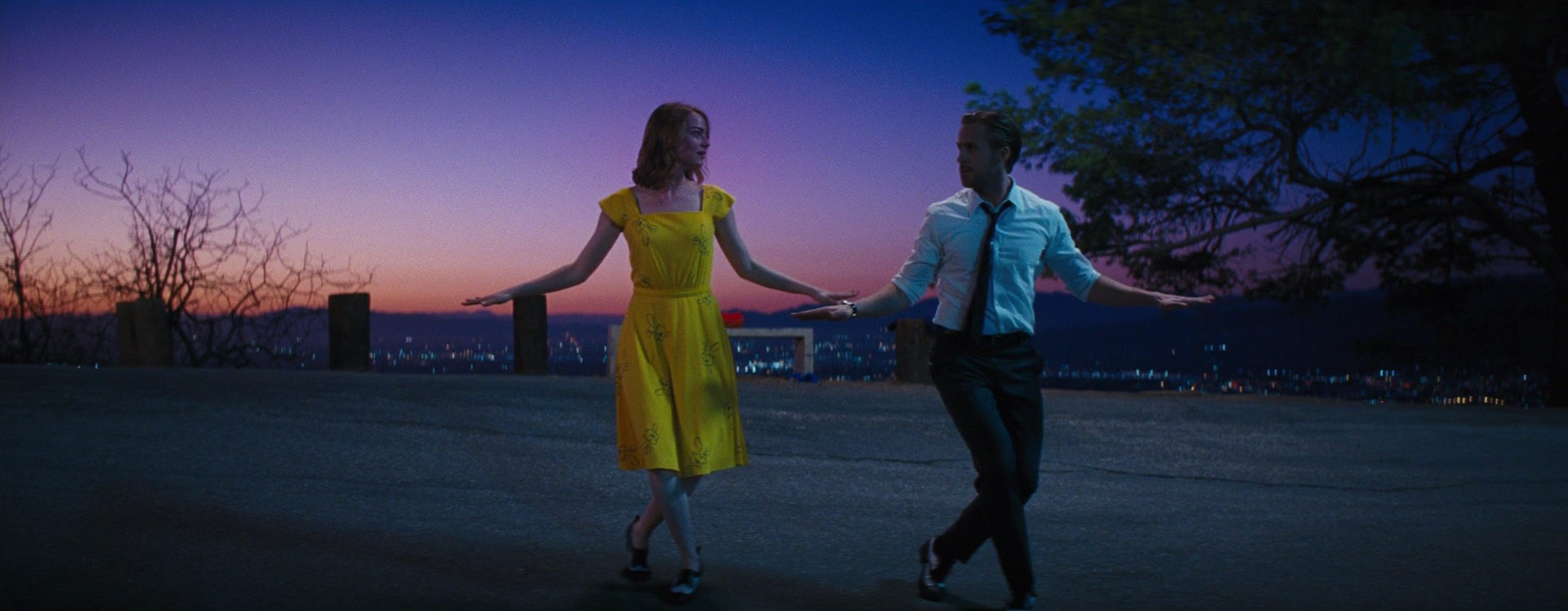
“A Lovely Night” at Cathy’s Corner in Griffith Park: a real, unreplaced twilight sky, caught in one crane take between about 7:00 and 7:45 p.m., with the yellow dress against it.
The rule of the production was to catch things in the camera instead of adding them afterwards. Chazelle chose not to shoot at night and put a sky in later, and not to move the numbers onto a stage. The pink magic-hour skies and blue twilight skies behind the dances were caught for real and not replaced.
“A Lovely Night” is the test of that rule. It was shot at Cathy’s Corner, a turnout on Mount Hollywood Drive in Griffith Park that looks out over the San Fernando Valley. It plays as a single unbroken take, and the crane move had 27 marks. They rehearsed it all day, from about seven in the morning to seven in the evening, and rolled only in the twilight window, roughly 7:00 to 7:45 p.m. Then they came back the next evening and did it again.
Sandgren says they got five takes each evening, ten in all, and that on the first evening only takes three and four had the light right. The film uses one.Chazelle’s commentary puts it at about three takes a night. Sandgren gave five in three separate interviews. Sandgren told MovieMaker there was no coverage, so a failed evening meant another evening on the hill. As the light dropped, according to American Cinematographer, Hazen filled the actors from two condors with LED units along the slope and, down the hill, a 90K Bebee, a cluster of fifteen 6K lamps.
The sky in the frame above is real. Sandgren himself says it “looks surreal”, and it does: a pink and blue dusk that most films would now make in a computer, here because a crew stood on a hill and waited for it. Against it is Stone’s canary-yellow dress. Sandgren says he worked with the costume department on its colour and on its fabric, for the way the material reflected the light.
Sebastian’s “City of Stars” on Hermosa Beach Pier was handled the same way. It was shot just before or after sunset, with the camera set and the crew waiting for a soft light that matched the look. Sandgren has said they had about 30 minutes and got 15 Steadicam takes, holding the horizon level, with the light the main thing that changed between them.
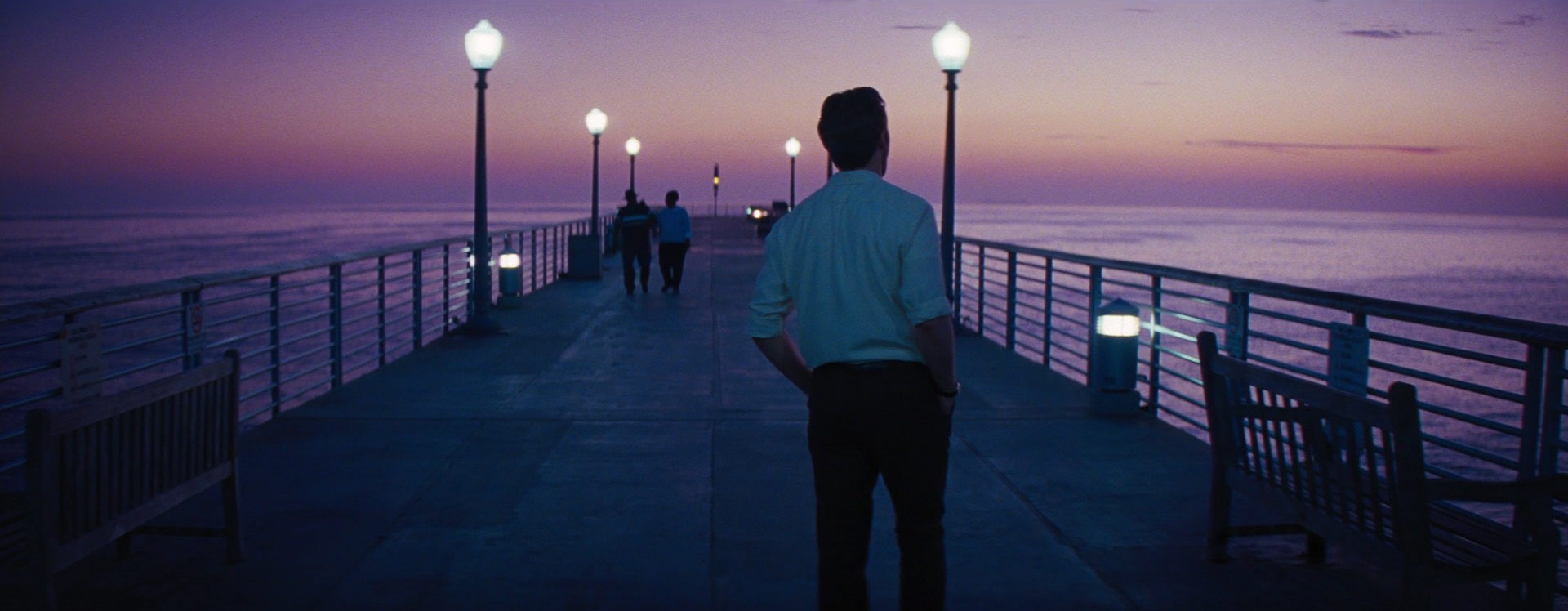
The old gas-lamp-style street lights on the pier were dressed in for the film. Sandy Reynolds-Wasco has said they “rented 12 streetlights and brought them everywhere”, partly because of the budget. It is one of my favourite details in the film. Once you know about those twelve lamps you start spotting them, a travelling set of period street furniture that gives the real city an older face.
Colour at Night
- Frame 12
- Fern Green gel
- After Vertigo
- Mia in purple
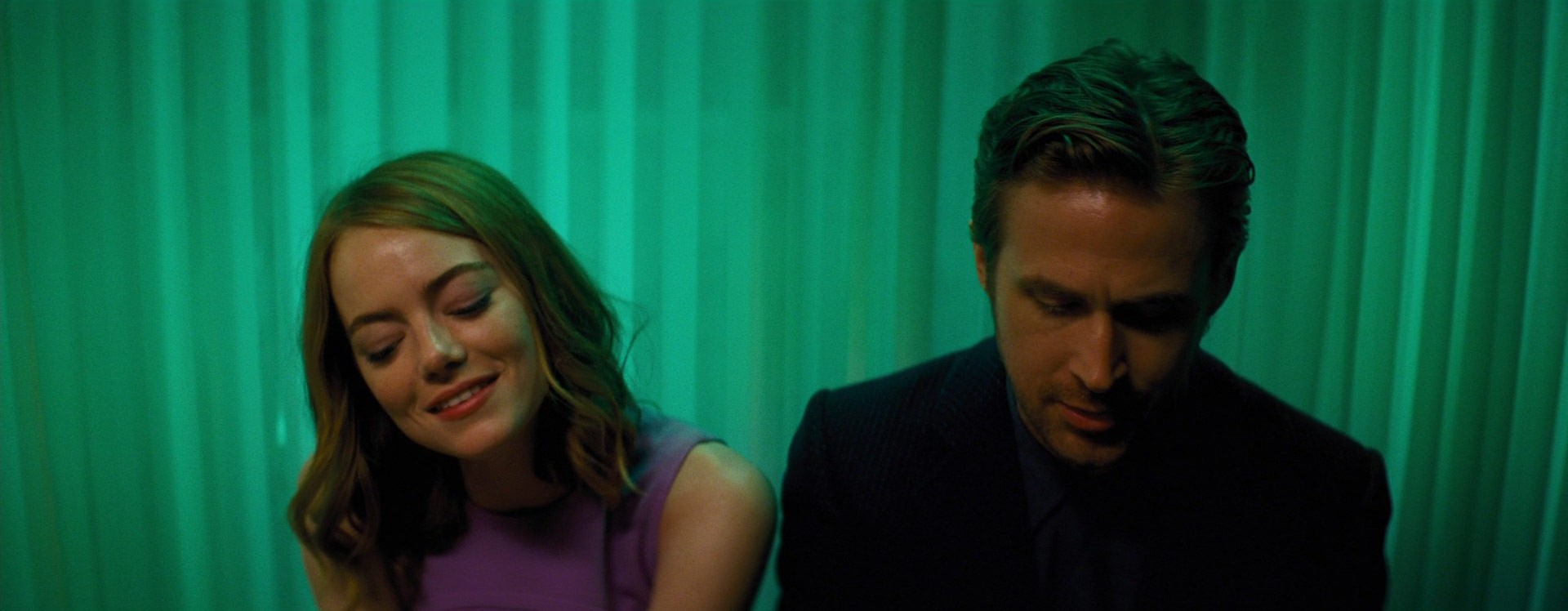
The “City of Stars” duet in Sebastian’s apartment: Fern Green-gelled Kino Flos and LED tubes outside the window glow through the curtains like a neon sign, after Vertigo, with Mia in purple.
At night, Sandgren changed the city’s light. Los Angeles, he told Filmmaker, has a lot of orange sodium-vapour street lights, “but we didn’t want them to exist in our Los Angeles”. In the film the night street light is mostly cool white and blue-green, like mercury vapour. This is where his argument for film pays off, since the greens and blues of street lights are exactly what he said film exaggerates.
Orange is kept back for one purpose. Sandgren told Kodak that the orange street lights “were the reality”, the place Mia goes when she visits her parents near the end.
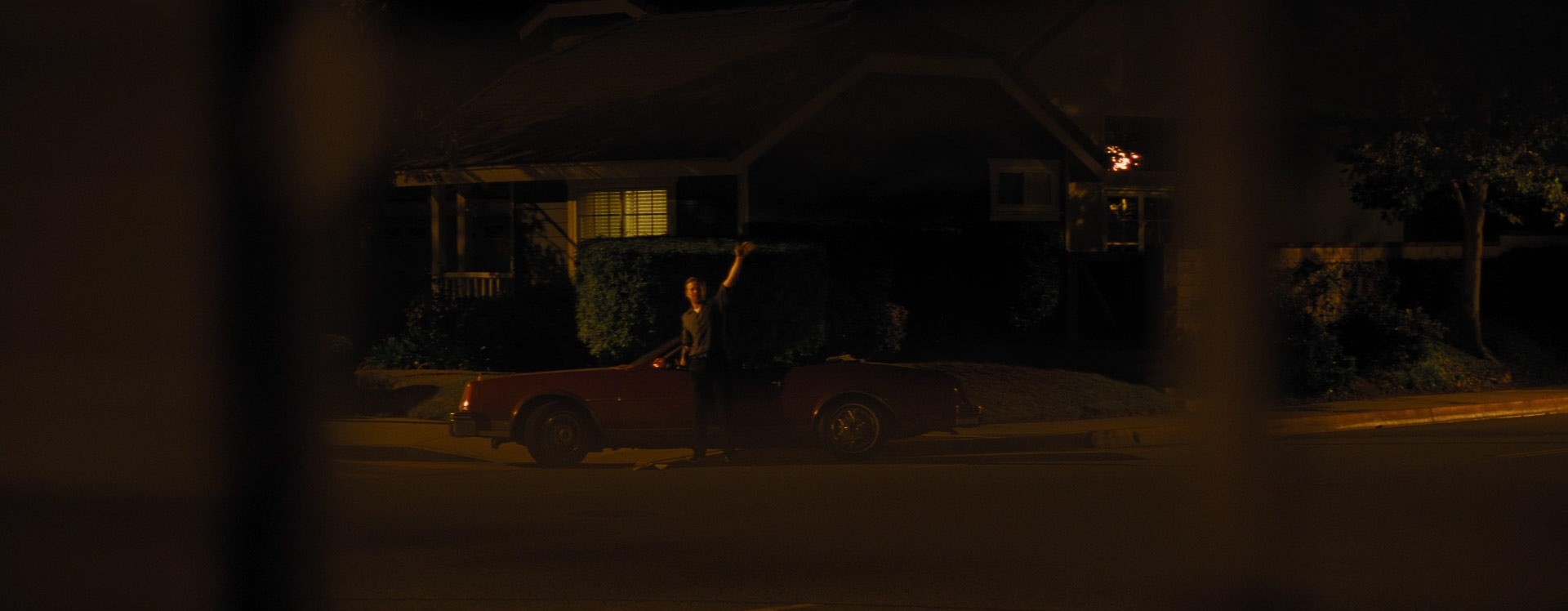
The strongest colour at night is indoors. For the “City of Stars” duet at Sebastian’s piano, Hazen put daylight Kino Flos and dimmable LED tubes outside the window, gelled Fern Green, to look like a neon sign, after the green neon in Kim Novak’s hotel room in Vertigo. Chazelle says the green light was a late addition, and that Stone’s dress was changed to purple that morning to match Novak’s. The flares are deliberate. According to a No Film School breakdown, Sandgren marked the camera position for one moment in the song and placed LEDs outside the window to flare the lens there.
Outside Mia’s theatre, American Cinematographer describes extra pink fluorescent light at the centre of the frame, added “as if it was the ‘heart’”, while Sebastian stands in a hard, cool pool from a 6K HMI with Plus Green. None of these nights is how Los Angeles really looks after dark. Their colours of light came from gels and lamps in front of the camera, not from the grade, so they fall on faces and walls the way real light does.
The Spotlight
- Frame 05
- Smoke House, Burbank
- Room gone dark
- Single spotlight
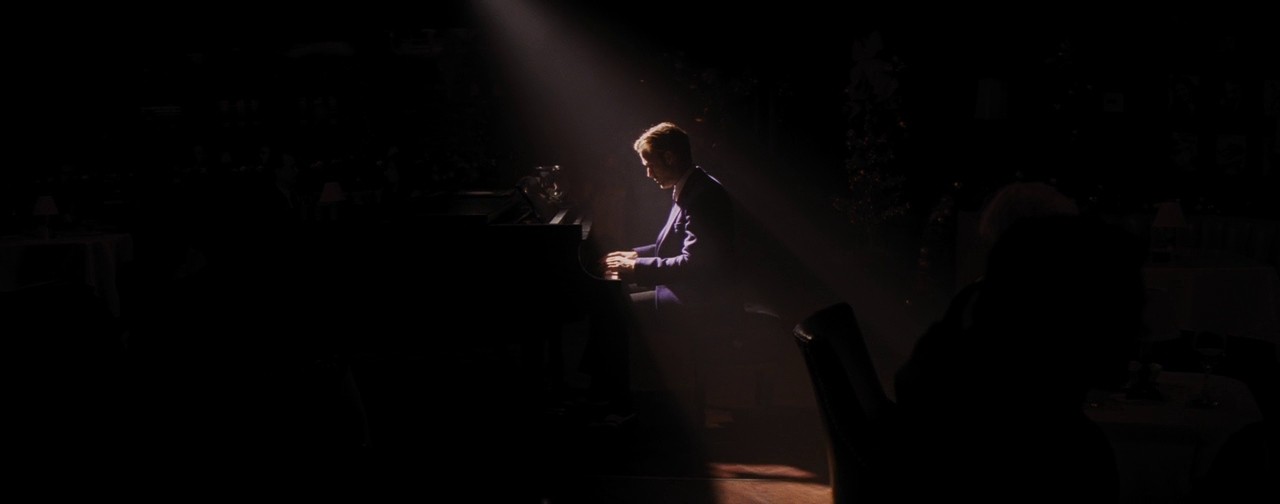
The restaurant, shot at the Smoke House in Burbank: the room light has faded, and a single slanting spotlight holds Sebastian at the piano while the diners sink into shadow.
Sandgren has a device that he uses more than once in La La Land. Inside a take, the realistic light in a room fades away and a single spotlight comes up on one character. He ties it to the characters’ dreams of being in the spotlight, and says that dimming the room also draws the camera, and the viewer, closer to the person left in the light, which he calls “emotional contact”. It is the plainest case of something he did all through the film, letting the light answer what a character feels as well as the lamps in the room.
The clearest early case is in a restaurant, shot at the Smoke House in Burbank. Sebastian abandons the holiday set list he has been told to play and starts his own piece. The rest of the room goes dark and he plays in a spotlight. When the piece ends the room comes back up to normal. The cue reads as Mia’s point of view. For the length of the piece she sees only him, and so do we.
The audition near the end is the same device at full strength. As Mia begins to sing, the room light fades out and a single spotlight comes up on her. “It’s not a fancy move,” Sandgren has said, “but it’s very intimate.” The camera pushes in slowly and circles her. Chazelle filmed the casting directors too, but he says he never cut away from Stone, who sang it live in a single take, with Justin Hurwitz playing piano in another room and feeding it to her through an earpiece. Once the room has gone dark, the only colour left in the frame is Mia’s lavender sweater.
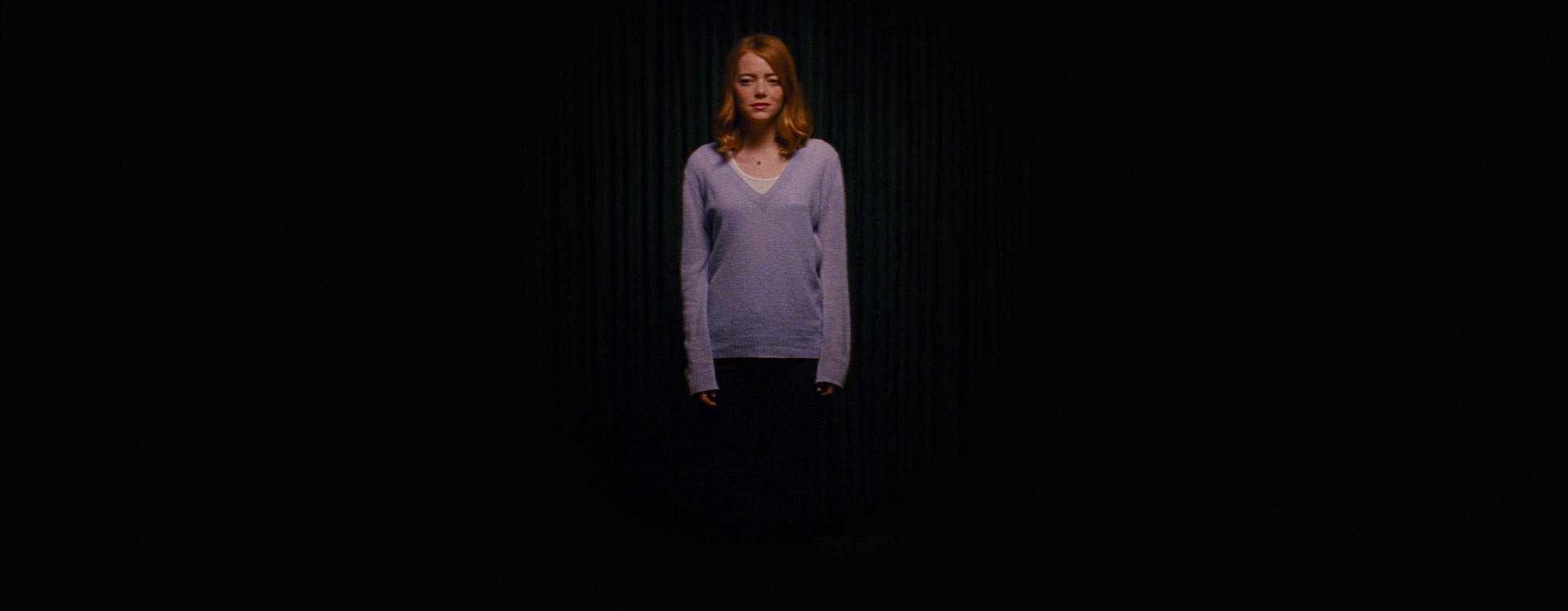
I think the audition is the best-photographed scene in the film, and it is also the simplest: a single performer in a single light, with a camera that keeps moving slowly toward her. The fading room does what a cut would usually do, taking everyone else away. Because it happens inside the take, you watch the room disappear.
As I see it, the device returns at the very end. In Sebastian’s club, as he plays their theme, the room seems to fall away, and the epilogue opens out of that.
The Observatory
- Frame 11
- Stage replica
- Actors on wires
- 24 RGBA LED Pars
- Stars added in CG
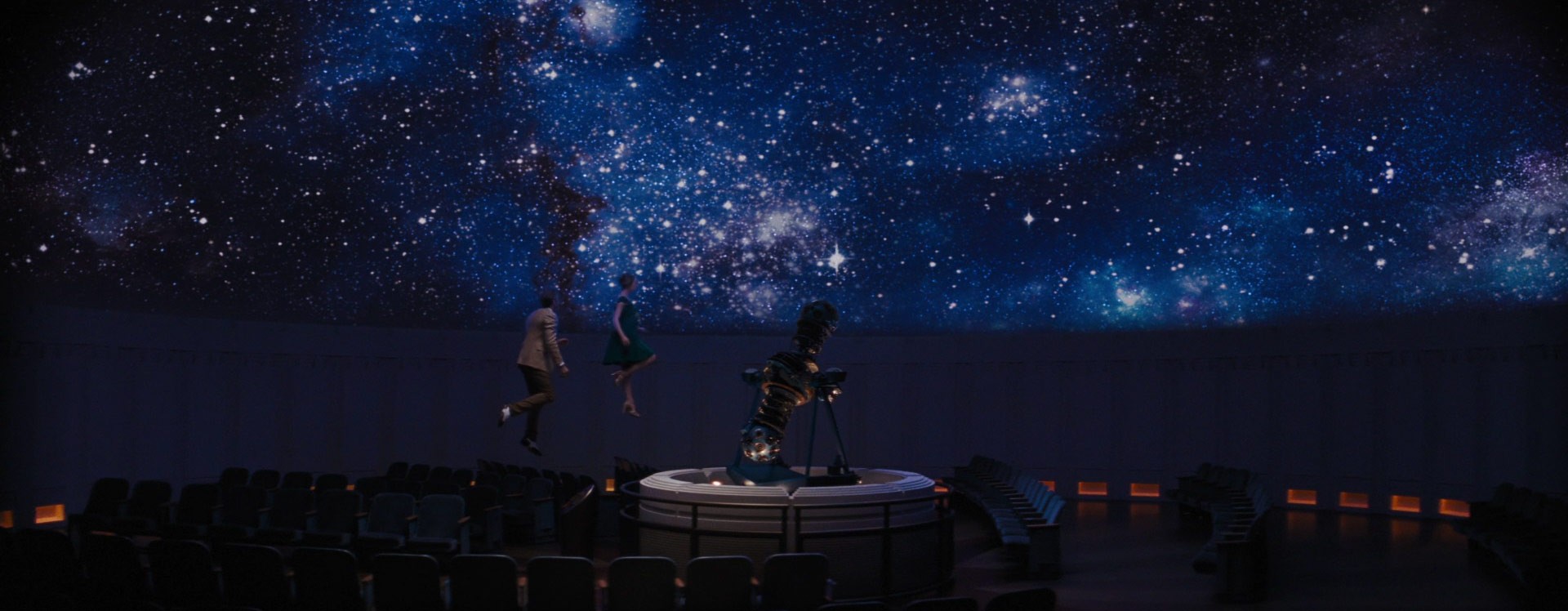
The planetarium, a stage replica of the room seen in Rebel Without a Cause: Mia and Sebastian lifted above the seats beside the star projector. They flew on wires under a bluescreen ceiling, lit by LED Pars driven by star imagery, and the stars were added later in CG.
The date that leads to the observatory begins in a cinema. They watch Rebel Without a Cause at the Rialto Theatre in South Pasadena, a real cinema that had been closed since 2007 and was partly renovated for the shoot. The light on their faces is projector light, playing across them in the dark, and a No Film School breakdown points out a subtle flare from the projector. Sandgren picked the scene out to Kodak as a favourite.
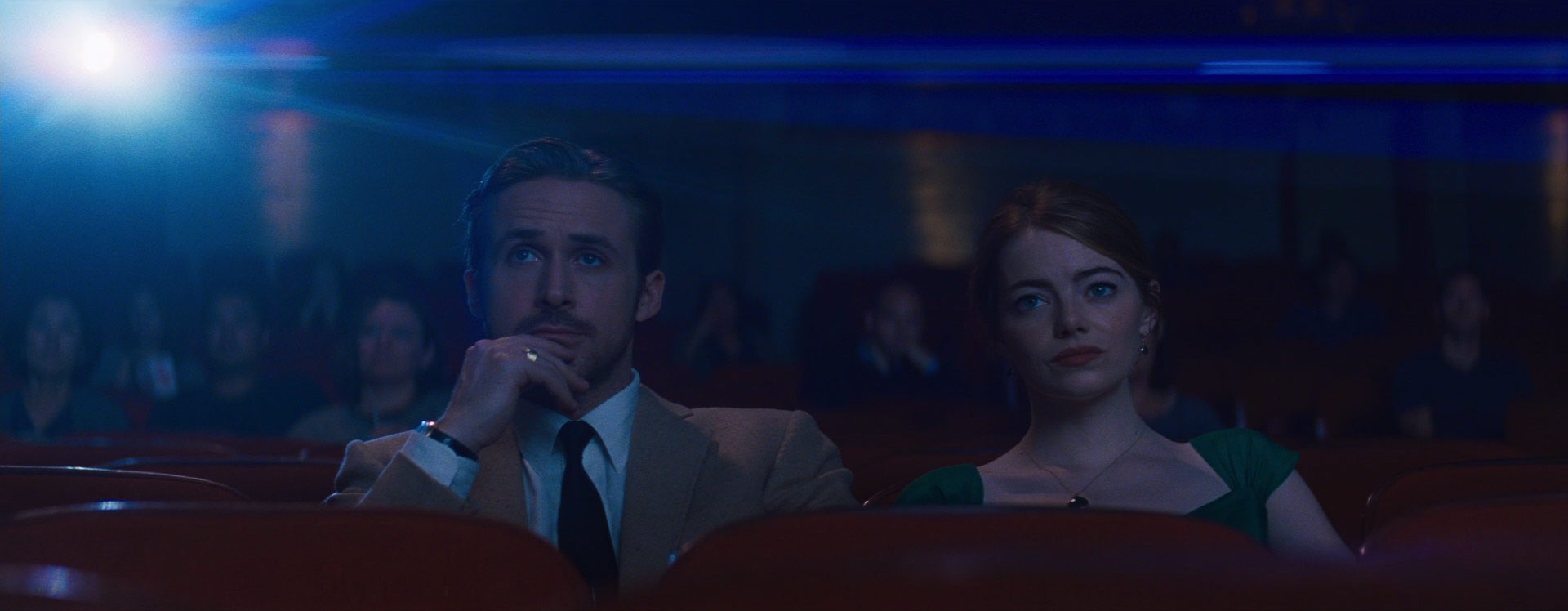
Rebel has a planetarium in it, and that is where they go next. The exteriors, the lobby and the walls were shot at the real Griffith Observatory, which, American Cinematographer says, gave the production one day for interiors and exteriors. Inside, the magazine lists HMI Pars and Kino Flos gelled with Plus Green, Pars with half CTB, and dimmable 75-watt household bulbs in the wall fixtures. Even in a public building, the light leans green and blue.
The planetarium itself was off limits. The crew could not shoot inside the real one or rig wires there, so it was rebuilt on a stage. The Hollywood Reporter describes the replica, at Hollywood Center Studios, as the earlier art-deco planetarium seen in Rebel, with a period projector, copies of the doors and a terrazzo floor redone “more art deco”.
The ceiling of the set was a bluescreen, lit by Kino Flo Image 85s with super-blue tubes. Overhead, behind Light Grid Cloth, were 24 Chauvet Colorado RGBA LED Pars. Images of the stars that would be added later were projected onto the cloth, and the lighting programmer, Christopher Ferguson, used them as a guide, adjusting the colour and brightness of the LEDs to match the shifting light of the CG sky. The stars you see were added in CG, but the light on the actors came from those Pars, so it moves across them with the sky they are meant to be flying through. Stone and Gosling were flown on wires and shot with crane and Steadicam. For the back half of the waltz, American Cinematographer says, professional dancers in silhouette took over on a 40-foot bluescreen platform.
Zophres has said that Chazelle gave the departments a graph of the film’s emotion, and that it peaks at the planetarium. It is also the plainest exception to the rule about catching things in the camera, and I like the way it bends. The stars are digital, but the light from them was on the stage, moving over two people on wires. It is a bluescreen shot lit like a location.
The Epilogue
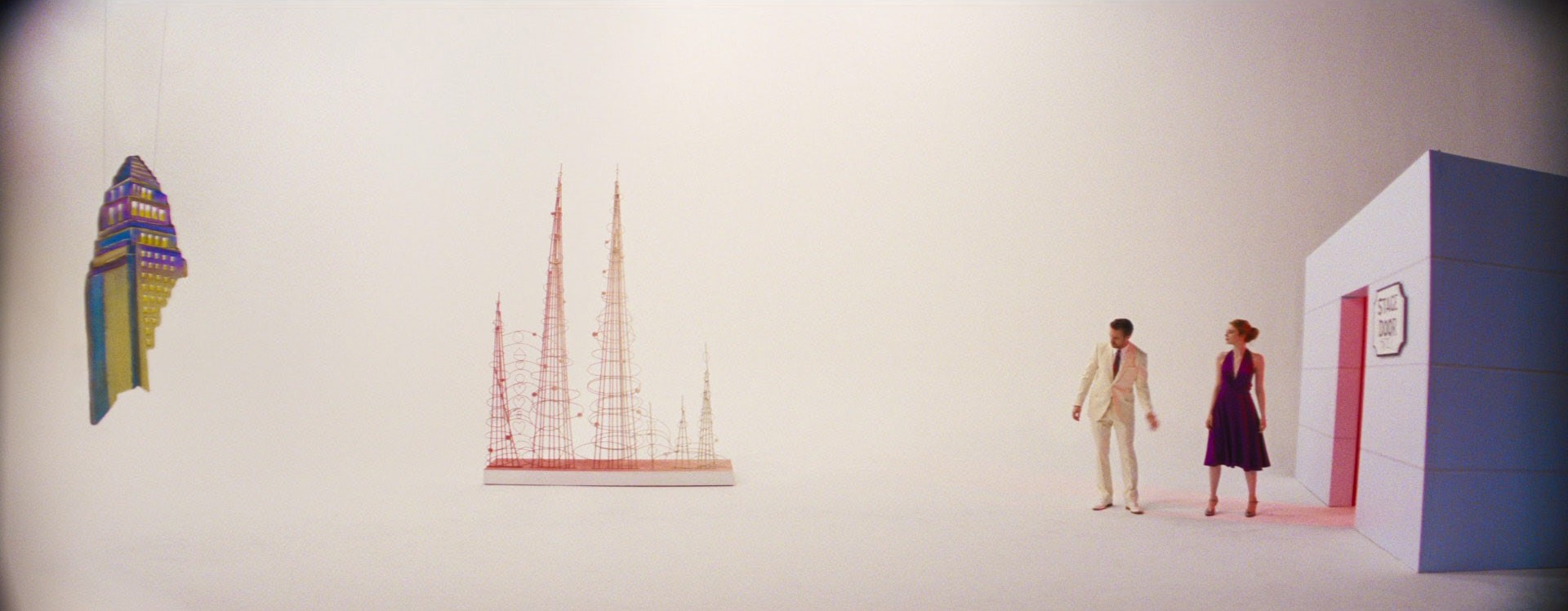
- Frame 15
- Soundstage
- White set
- Models and cut-outs
In the epilogue, on a soundstage: Sebastian and Mia by a stage door on a white set, with a red wire model of the Watts Towers and a hanging painted cut-out of a building.
Tom Cross, the editor, says Chazelle wanted the old optical techniques, irises and fades and wipes and dissolves, to express how the characters see their world. The epilogue is where those techniques take over, and where the film leaves its real locations for sets.
Much of the fantasy was shot on a soundstage. Partway through, the real world gives way to a white set with sketched Los Angeles landmarks, and then to cut-out orange trees. The production notes cite the painters Ed Ruscha and David Hockney as references for the film’s Los Angeles, and this is the sequence where you can see it. Sandgren told MovieMaker that he worked closely with the on-set painter on these theatrical sets, down to repainting the floor on the day, because he would rather get the colour in camera than add it in post.
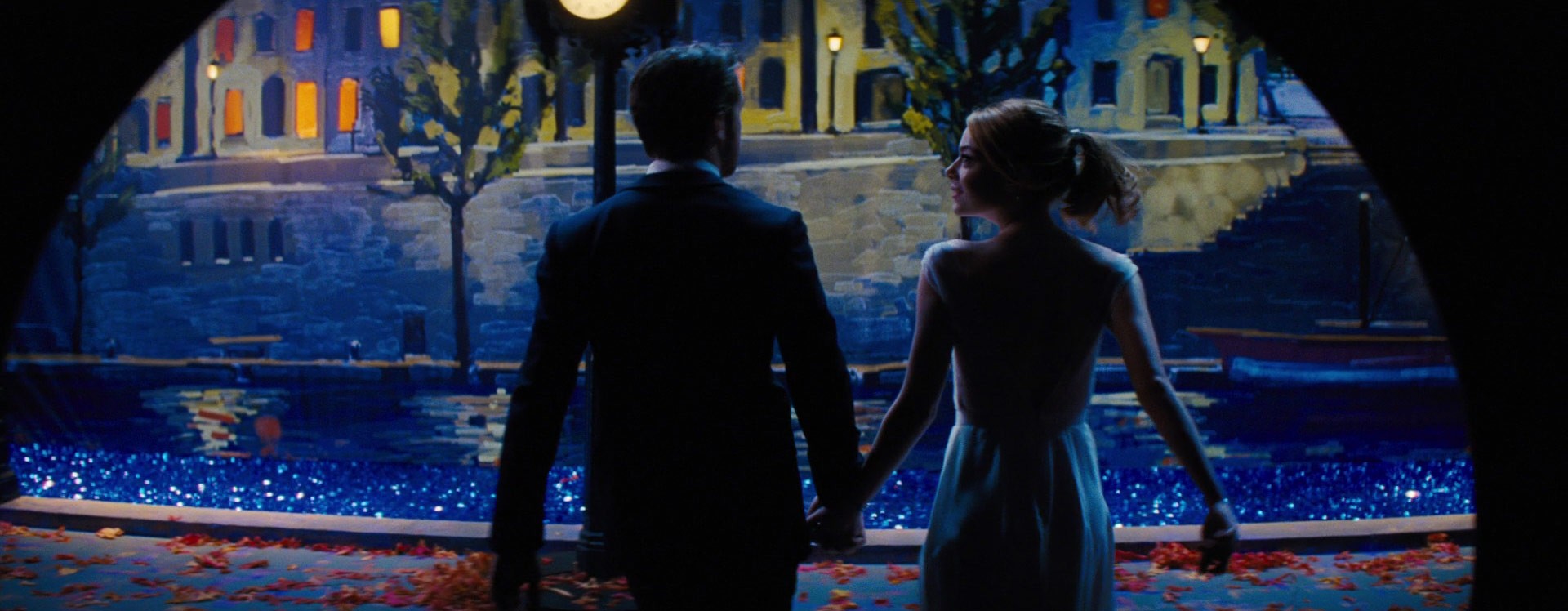
Then the film moves to a stylised Paris of painted backdrops. In one shot a circle of black, like an old iris, frames the couple from behind as they walk onto a painted Paris street by the river at night. Sandgren also mentions the scene “when they come into Paris through the black tunnel”, where the light was adjusted on the day with the painter.
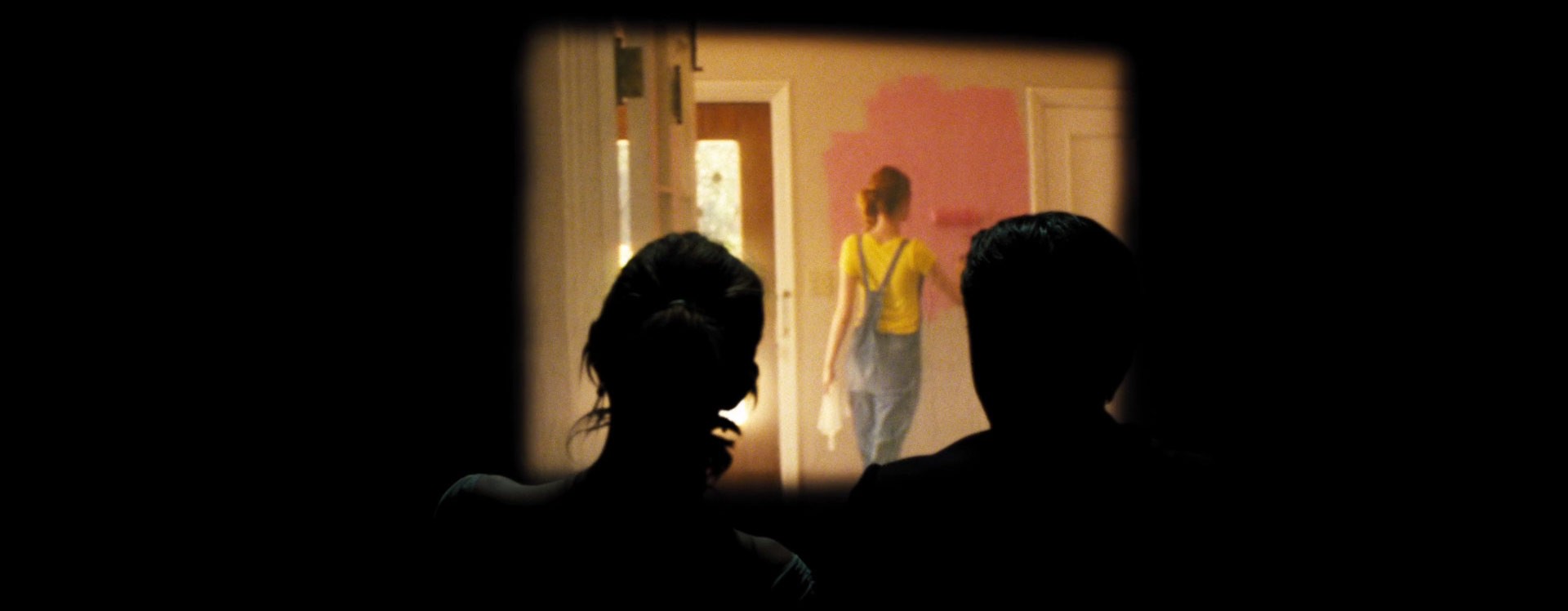
The format changes too. The imagined family home movies were shot on 16mm with an Aaton A-Minima, through a lens Panavision and Sasaki built for the job, an 18mm 2x anamorphic at T2.8, which Panavision describes as giving a “grittier, degraded look”.The sources disagree on the 16mm stock. Kodak’s interview gives Vision3 250D 7207 and American Cinematographer gives 500T 7219. So even the home movie is anamorphic. At one point the picture jumps a little. Sandgren told Kodak the camera really jammed, and Chazelle kept it. I love that the most dreamlike part of the film carries an accident from a real camera.
The fantasy gives way, and the film is back in the club. In his commentary Chazelle says an earlier cut ended with Mia driving into the dawn. They chose to end instead on the two of them looking at each other across the room.
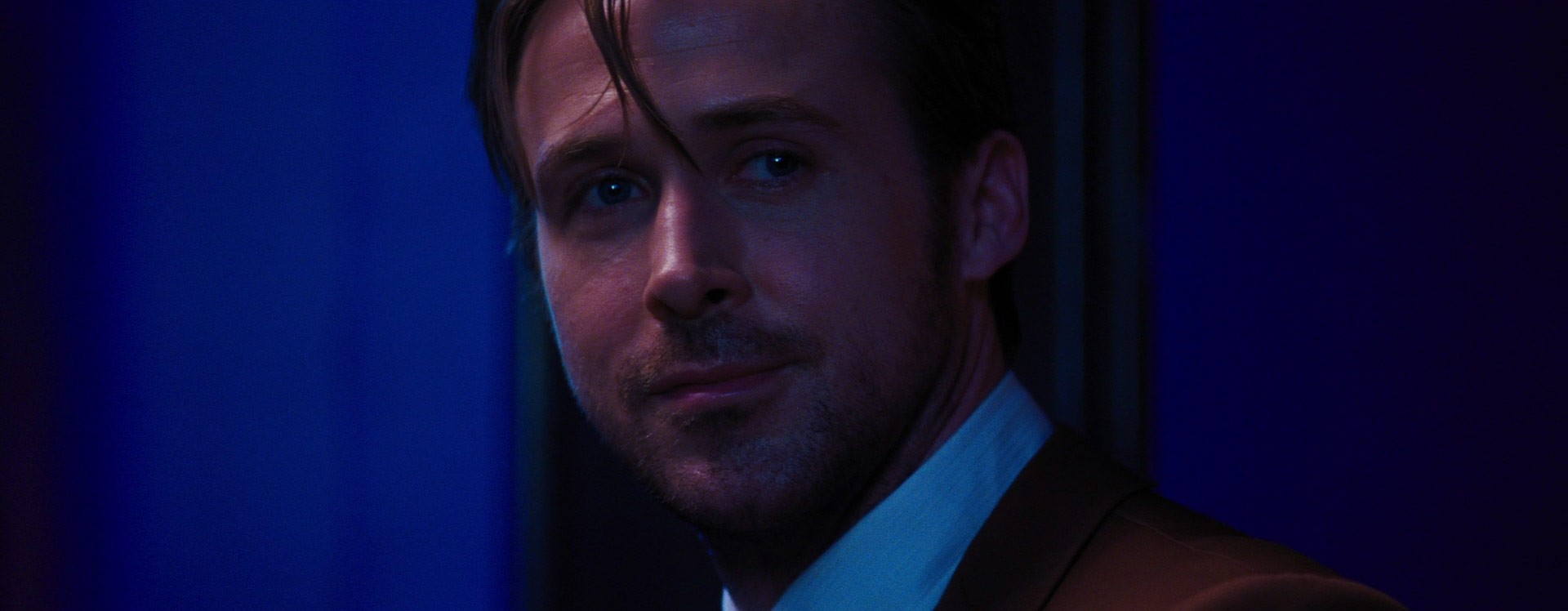
After that comes an MGM-style “The End” card. The film began with a card for a format, and it ends with a card from the studio era that format belonged to.
Sandgren won the Academy Award for Best Cinematography on 26 February 2017, his first nomination. He won the BAFTA as well, though at the ASC Awards earlier that month he lost to Greig Fraser for Lion.
When I think about La La Land now, I think about the waiting. Most of its famous images depended on light that would not last, and the crew waited for it: two evenings on a hill for three-quarters of an hour of twilight each time, a pier until the light went soft. The images that look most artificial, the pink sky over the hill and the green light in Sebastian’s window, were made with real light, and the sets were lit as if they were places. I can’t think of another recent film that is so openly a fantasy and so stubborn about photographing it for real.
The Shot List