Mad Max: Fury Road
George Miller, 2015
How John Seale photographed George Miller’s chase on his first digital feature, with tethered Alexas in the War Rig’s cab, a crane on a racing truck, the subject held in the centre of every frame and night shot in full sun.
Mad Max: Fury Road is one long chase, and an extraordinary amount of it was really out there in the desert. More than 150 vehicles were built for it, and some of them were wrecked for real. The story fits in two sentences. Furiosa (Charlize Theron) drives a fuel tanker, the War Rig, out of the Citadel with the five women Immortan Joe keeps as wives, and Max (Tom Hardy), a prisoner kept alive as a blood bag, is dragged after them chained to the front of a War Boy’s car. They drive out across the desert, and then they drive back.
What I keep going back to is the photography. John Seale shot it in the Namib Desert, on his first digital feature, for a director who had drawn the whole film in storyboards before there was a conventional script. Under all the noise it is a very disciplined piece of work. Miller asked for the subject in the centre of every frame, so that a film of about 2,700 cuts could still be read at speed. The night scenes were shot in full sun. The colours were pushed until they glow, and by Seale’s estimate half the film or more doesn’t run at normal speed.
This essay is about how those images were made, organised by craft, starting with the cinematographer who took one night to say yes.
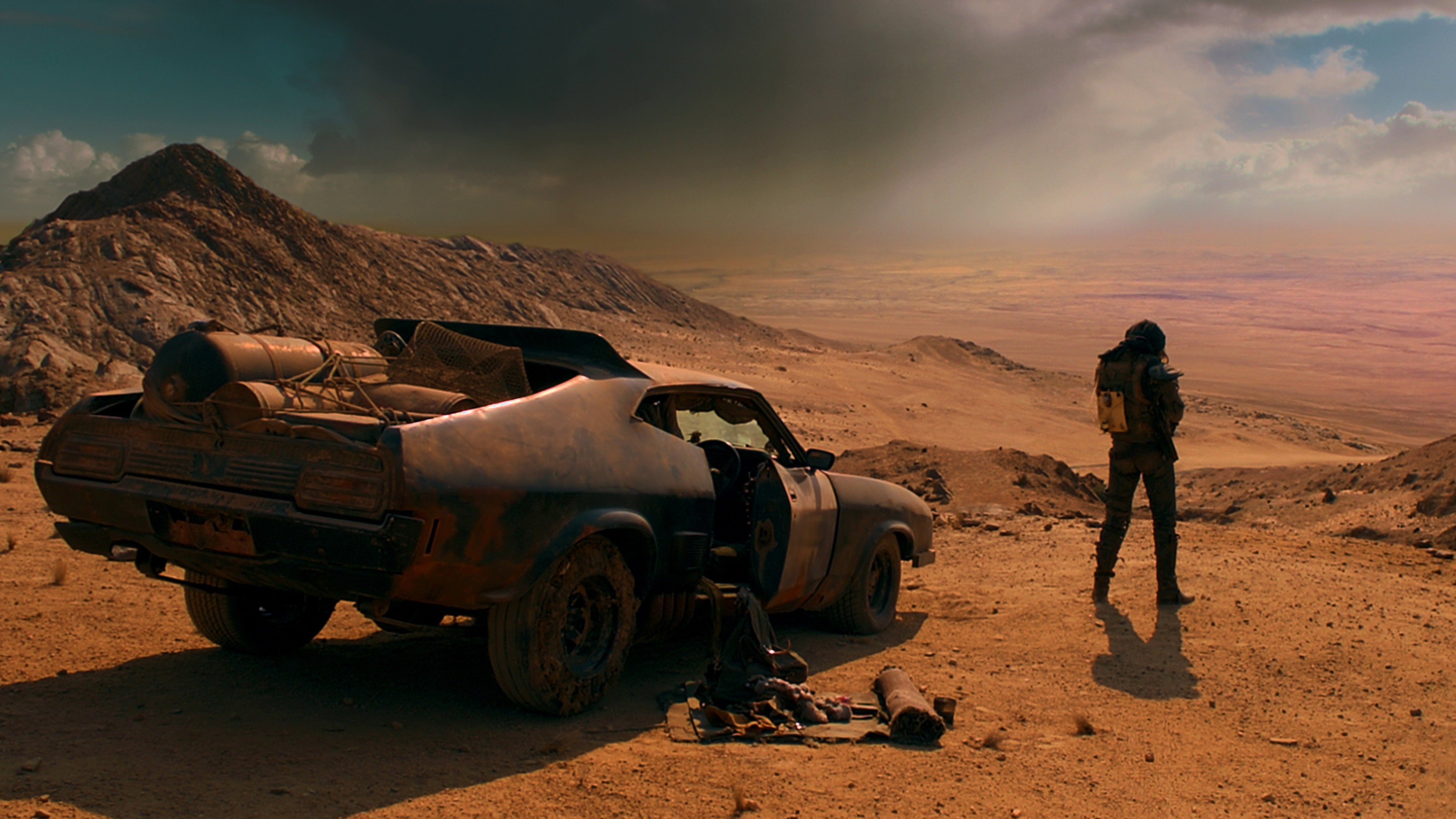
01about 1 min The opening: the Interceptor parked on a ridge, with Max off to the right, back to us, looking out over the orange wasteland under a storm cloud and patches of teal sky. The film’s two colours are there from the first frame.
The film opens on a ridge above the wasteland. Max’s car, the Interceptor, fills the left of the frame, and Max stands off to the right with his back to us, small against the plain. The ground is orange, a storm cloud hangs overhead, and the sky shows teal through the gaps. The rest of the film keeps coming back to those two colours.
Seale wasn’t meant to shoot it. Dean Semler, who had photographed Mad Max 2 for Miller, left shortly before shooting; the trade reports said for personal reasons. Variety Australia reports that Miller had considered Seale for that one too. This time the producer Doug Mitchell phoned him on Miller’s behalf, and by HitFix’s account he took a night to decide. He and Miller had made Lorenzo’s Oil together in 1992. Seale calls the story that Fury Road brought him out of retirement a running joke, because he says he had retired after earlier films too, and No Film School notes that he turned 70 during the shoot.
What he joined was a film designed as pictures. There was no conventional script at the start. Miller and the artist Brendan McCarthy had laid it out in about 3,500 storyboard panels, and Seale shot from the boards. I think that explains a lot about how the film looks. Every shot had been drawn before anyone pointed a lens at it, so the question on set was usually how to get the drawing.
It was also his first digital feature. When he arrived, the plan was 3D. Miller had spent years developing custom 3D cameras, built above all for shooting inside the cab of a truck. Then came the tests. According to Neil Oseman’s summary of a talk Seale gave to the Australian Cinematographers Society, the 3D sensor held only about five stops of dynamic range. Each stop is a doubling of light, so five stops is a span of only 32 to 1. A shaded face in a cab and the sunlit desert through its windscreen sit much further apart than that, and one of them would always be lost.
So the production switched to 2D, within a weekend by HitFix’s account, and the 3D release was converted in post.SHOOTonline places the switch some weeks after Seale joined.
The new cameras came from Panavision: ARRI Alexa Plus bodies and four Alexa Ms. The Alexa M is the small-head model, its sensor block tethered to the body by a cable, so only the head has to fit into a tight space. Roger Deakins had just used it on Skyfall.Sources differ on the number of Alexa Plus bodies: six according to Neil Oseman and British Cinematographer, ten according to SHOOTonline. Everything was recorded as ARRIRAW, the camera’s uncompressed sensor data, on eleven Codex Onboard recorders, because Seale says Codex was the only recorder that could handle ARRIRAW reliably. Radio links sent the pictures to a command vehicle, where Miller watched and cut on the move to see what coverage he still needed.
Around them went small cameras used as crash cams: about ten Canon 5Ds, a few Olympus cameras and some Blackmagics. Oseman notes that many of the Canon shots needed a new sky to hide banding, the visible steps that appear in a smooth gradient when a camera records too few shades of it.
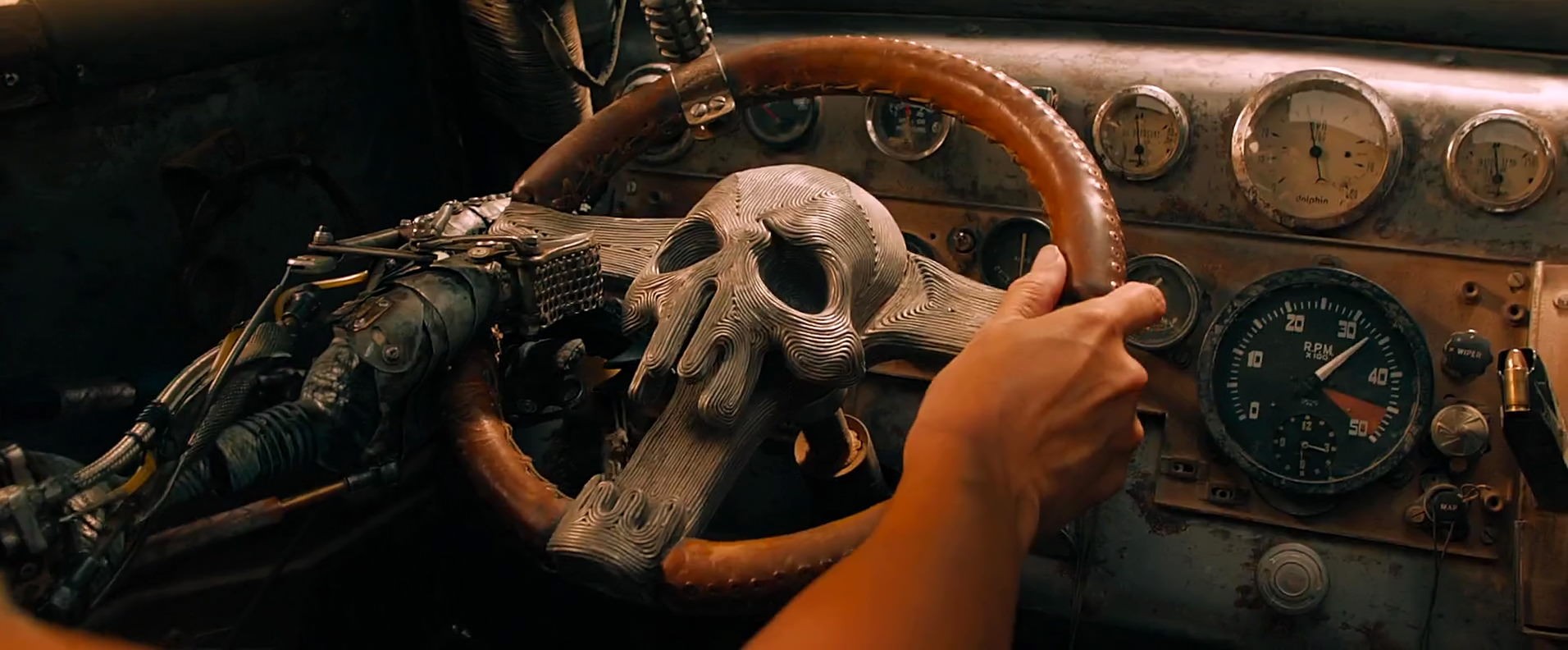
05about 10 min Close on the War Rig’s wheel and its skull boss: Furiosa’s own hand on the rim, her mechanical arm reaching in from the left, and the gauges sharp behind. In the cab, Seale used tiny 15mm and 16mm primes set at hyperfocal, so everything from about 0 to 9 feet stayed sharp.
Inside the War Rig’s cab, the camera sits close on the wheel: a skull for a boss, Furiosa’s own hand on the rim, her mechanical arm reaching in from the left and the gauges sharp behind. The cab is the one place where Seale gave up his usual lenses.
Fury Road was shot almost entirely on zooms, and British Cinematographer listed 17 Panavision-mounted zooms in the package. A zoom lets you reframe without stopping to change lenses, which counts for a lot when the shot is a truck going past at speed and you won’t get it twice.
The cab was the exception. There Seale used two tiny wide primes, a 16mm and a 15mm, set at their hyperfocal distance so that everything from about 0 to 9 feet was sharp. Every lens has a zone in front of it where things look acceptably in focus, and the zone gets deeper as the lens gets wider and the aperture smaller. Focus a very wide lens at its hyperfocal point and the zone covers everything that matters in a space that size, so nobody had to pull focus while the truck bucked around.
Oseman’s summary fills in the light. The cab scenes were shot at about T5.6, with LED strips on the ceiling and pillars lighting the actors. A T-stop is an aperture measured by the light that actually gets through the lens, and T5.6 is a fairly small opening, which helps keep the focus zone deep. In a cab in the Namib, plenty of light was already pouring through the windscreen, and I read the LEDs as there to lift the faces toward the desert outside.
Oseman also writes that after the DIT, Marc Jason Maier, flagged early footage on his meters, Seale rated the Alexa at 400 ASA instead of 800. Rating a digital camera lower means giving it more light for the same picture. You get cleaner shadows and give up some room above the highlights.
Outside the cab, Seale let go of something cinematographers usually guard closely, which is light continuity. The order was simply to shoot, and takes in overcast weather were intercut with takes in full sun, because the film would be cut fast and reworked in the grade. On a lot of films a passing cloud means waiting; here the grade matched it later. Seale told SHOOTonline that they also added grain and contrast to make the image feel less electronic, and that Miller pushed it further in post.
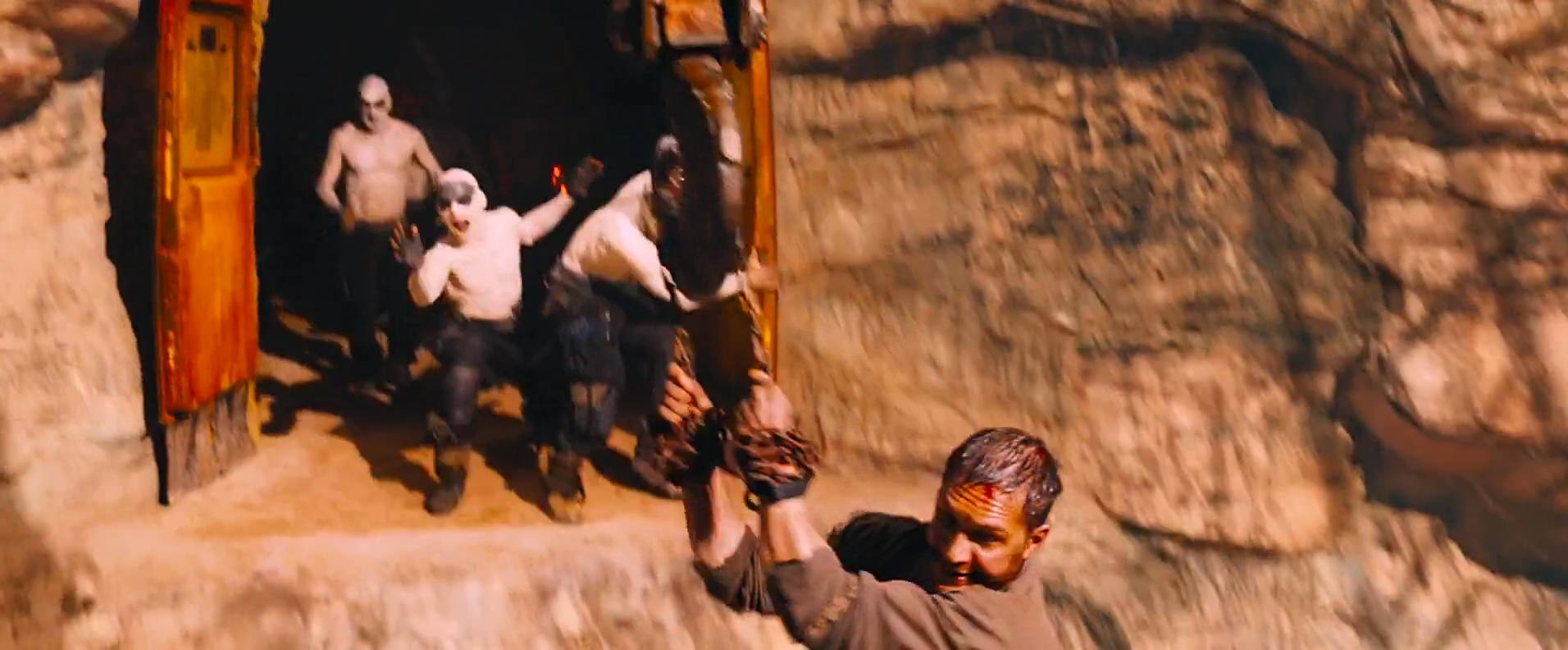
03about 5 min Max, still in chains, breaks out through the Citadel with War Boys bursting through a doorway behind him, the rock wall smeared by the moving camera. Neil Oseman’s summary of Seale’s talk says close-ups of the escape were shot on a Blackmagic camera with an 11-16mm zoom on a Movi gimbal.
Max breaks loose in the Citadel and runs, still in chains, as War Boys burst through a doorway behind him. The camera swings with him so hard that the rock wall smears. Oseman’s summary says the close-ups of the escape were shot on a Blackmagic Cinema Camera with a Tokina 11-16mm zoom on a Movi, a handheld gimbal that keeps the camera level while its operator runs.
Miller came in wanting single-camera coverage, even for the big stunts. Seale pushed for four to six cameras and won him over, and by Seale’s account the extra angles proved their worth in the cut. When a stunt happens once, every extra camera is an angle you’d otherwise never have. David Burr was DP for the second unit and the action unit, and Margaret Sixel, the editor, told ProVideo Coalition that the production generated up to 20 hours of footage a day.
The camera everyone remembers is the Edge. It was a gyro-stabilised crane on the roof of a supercharged V8 off-road racing truck, and it could swing all the way round and reach out about 20 feet,The Location Guide and Seale give the reach as over 20 feet; The Drive says the crane was 24 feet. so the lens could fly in among the vehicles at full speed. There were two, one on a Toyota Tundra. By Top Gear’s account, four people rode inside: a stunt driver, a crane operator on toggle switches, a camera operator, and Miller in the back with his monitors, directing from the middle of the convoy. British Cinematographer reported that the Edges were used in more than 40 per cent of the action sequences.
The strangest part is that many of the chase shots weren’t moving at all. Seale says that for a lot of the chase scenes the vehicles were standing still. The old studio name for this is the poor man’s process, where a parked car is rocked while lights and actors sell the speed. Seale calls the Fury Road version sim-trav, for simulated travel. fxguide describes the effects crew building sim-trav bases of airbags, fast pneumatic valves and hydraulic rams for the War Rig, the Gigahorse, the Doof Wagon and others, with Miller calling the bounces and swerves over a loudspeaker.
Some of the motion was added afterwards. Miller picked shots whose camera shake he liked and had that shake applied digitally to others. Sixel told NPR that shake was first added during the grade, to a gunshot in the fight between Max and Furiosa, and that they liked it enough to put it all through the film.
Then there is the speed itself. Seale estimates that 50 or 60 per cent of the film isn’t running at 24 frames a second. Miller’s rule was about reading. If he couldn’t read a shot, he slowed it down until he could, and if it read too easily, he shortened it or sped it back toward 24. As the filmmakers describe it, all of this happened in post. None of the accounts I found talks about undercranking, the old trick of running the camera slower than 24 so that action plays fast on screen; Sixel describes increasing speed ramps and shaving off frames. I feel it most in the tunnel escape, where the motion lurches and catches, then lets a moment land at a speed you can follow.
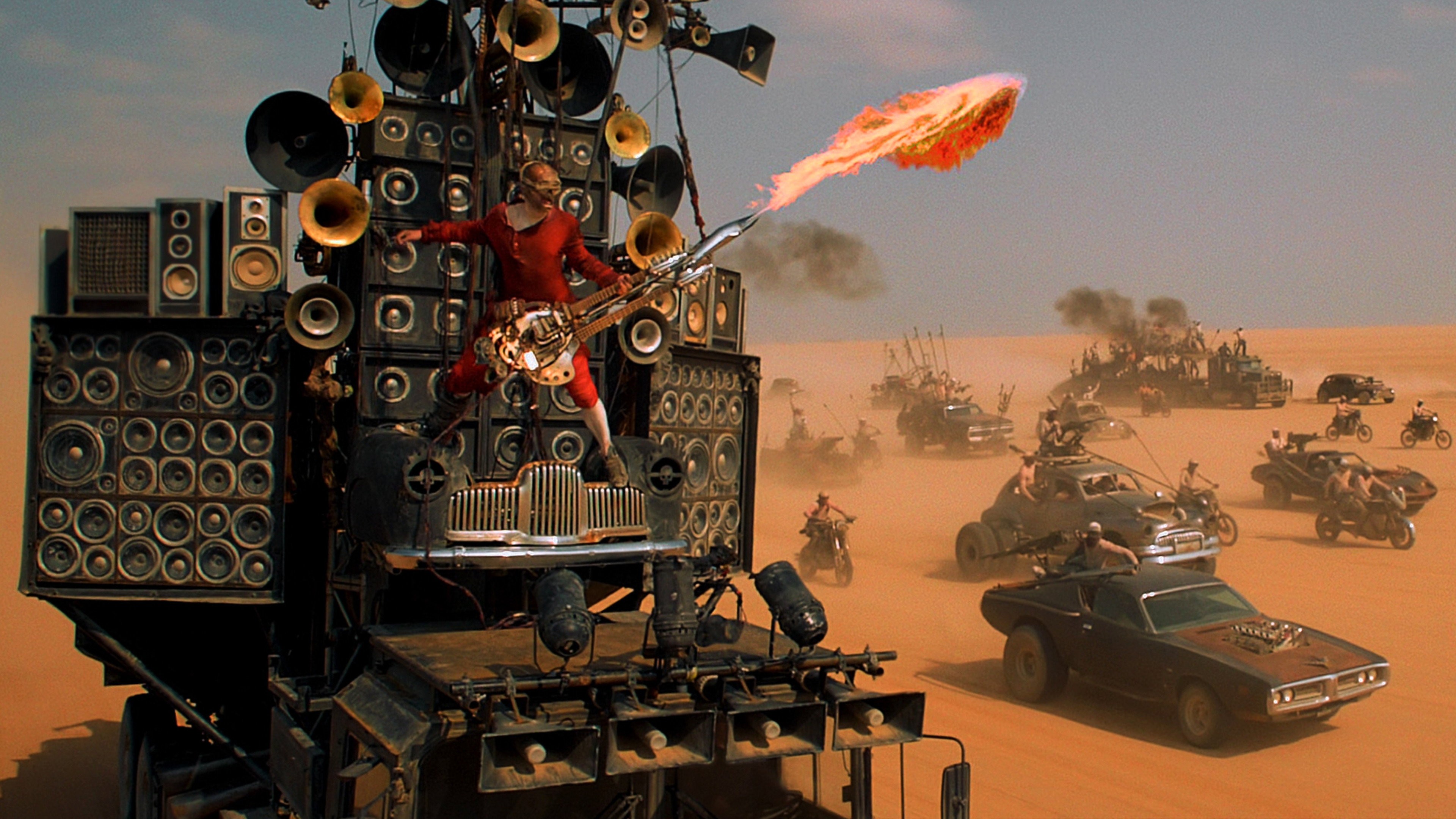
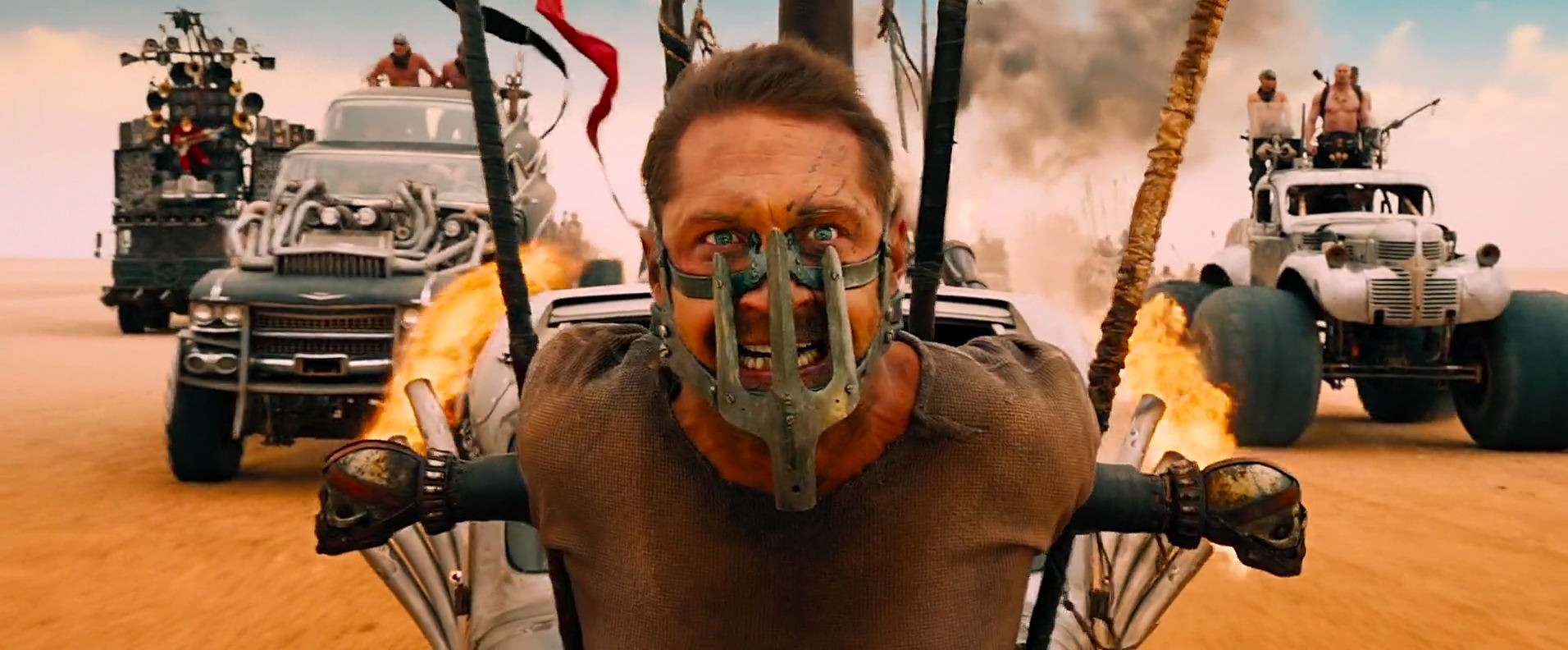
08about 17 min The Doof Warrior on the front of the Doof Wagon, his guitar firing a jet of flame, with the War Boys’ cars and bikes racing across the sand at right. The guitar worked, flames included.
The Doof Warrior stands at the front of his wagon against a wall of speakers, a jet of flame firing from his guitar over the War Boys’ cars. The guitar worked, flames included, because, as the production designer Colin Gibson tells it, Miller doesn’t like props that don’t work. He sits in the left half of this wide, but the flame is the brightest thing on screen and the eye goes straight to it. Most of the film is stricter.
Miller asked that the point of interest sit at the centre of the frame in every shot, close-up or wide, so that the eye never has to hunt for it after a cut. That is an odd instruction to give a cinematographer, who is usually taught to put a subject off centre, on a third or against an edge, because a centred subject can feel static. Miller’s reason was the editing.
The finished film has about 2,700 cuts. Miller says Mad Max 2 had 1,200, and that Fury Road isn’t much longer. Its average shot, by Miller’s count, runs 2 seconds and 9 frames. That is 57 frames at 24 a second, or 2.375 seconds; Seale was told about 2.3.
Miller told Den of Geek that centring matters most in the shortest shots, the ones of three to eight frames. Three frames is an eighth of a second. Nobody can search a picture for its subject in an eighth of a second, so the subject has to be where you’re already looking. In the slower scenes, he said, he can compose however he likes.
On the big, wide screen you can predict where the eye will be going a lot of the time.
The editor Vashi Nedomansky calls this eye trace, or crosshair framing. Those are his labels, not the production’s, but they fit. Across a cut, the thing you are meant to look at stays under the same crosshair, so your eye barely moves even when everything else changes. The demo below lets you compare centred and composed cuts.
Sixel had about 480 hours of footage, and she told NPR they reckoned it would take three months just to watch it before any real cutting could start. She says she deliberately traced the main characters through the cut, Furiosa above all, so that they wouldn’t disappear inside the stunts. I don’t think she could have done that at this speed without the centre rule.
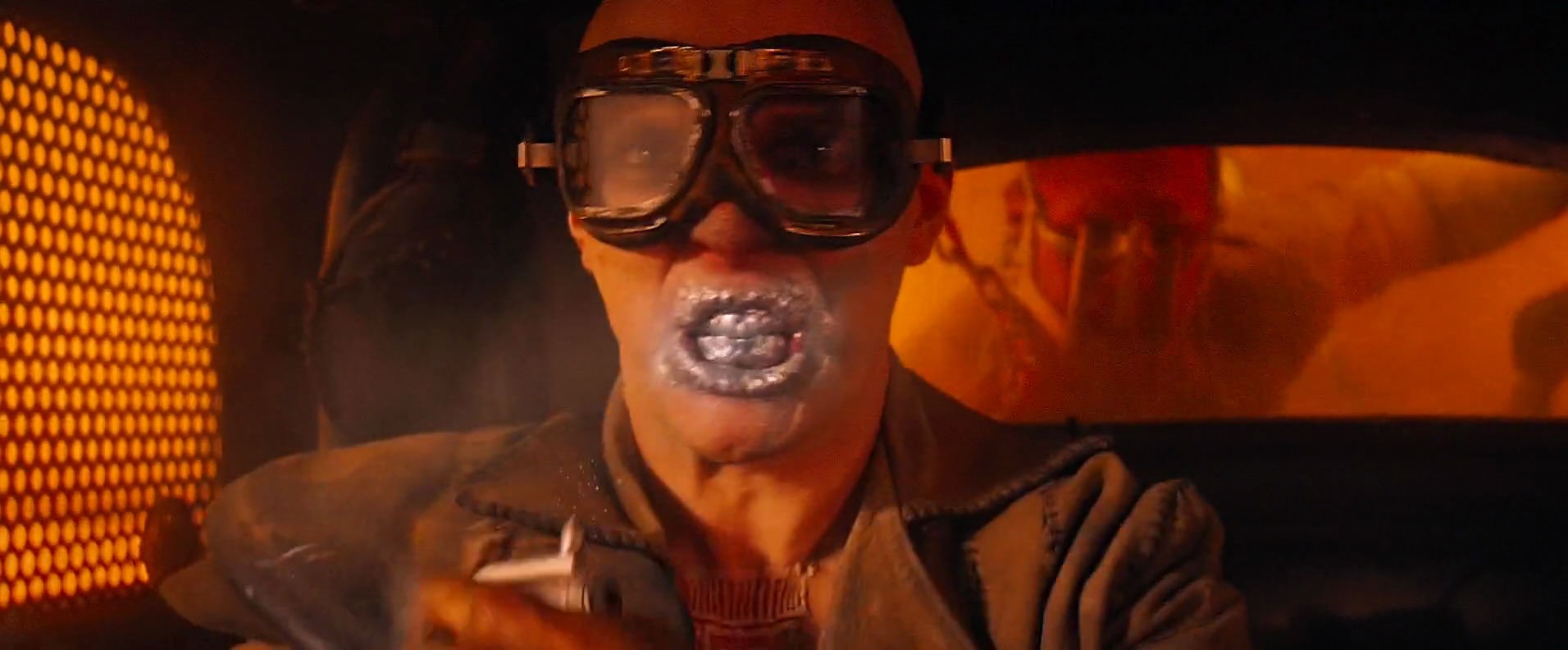
When the shooting didn’t put the subject in the centre, post did. Andrew Jackson, the VFX supervisor, describes shots being blown up, re-racked and repositioned in the frame to keep the action where the eye would be.
The colourist, Eric Whipp, worked the same way at the scale of a face. He says he rotoscoped essentially every eyeball in the film, tracing each eye by hand so he could give it more contrast and sharpness. His own case study adds that his vignettes and shading were steering the eye as well, with level changes across the cuts that the audience isn’t meant to notice. In a frame full of sand and steel, I find the sharpest thing is very often an eye.
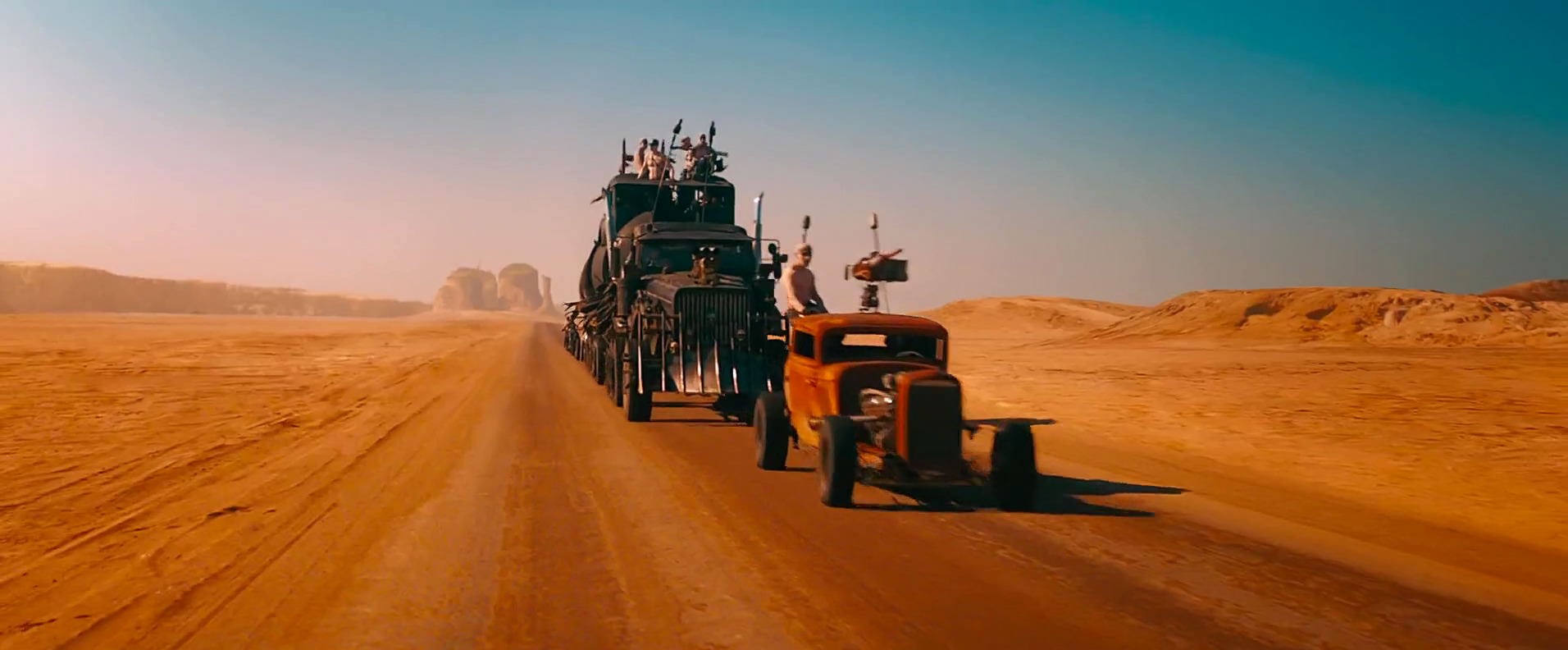
06about 11 min The War Rig heads out down a dirt track with an orange hot rod beside it and War Boys riding on top, rock towers on the horizon behind. Orange ground and teal sky: the two colours Whipp built the grade from.
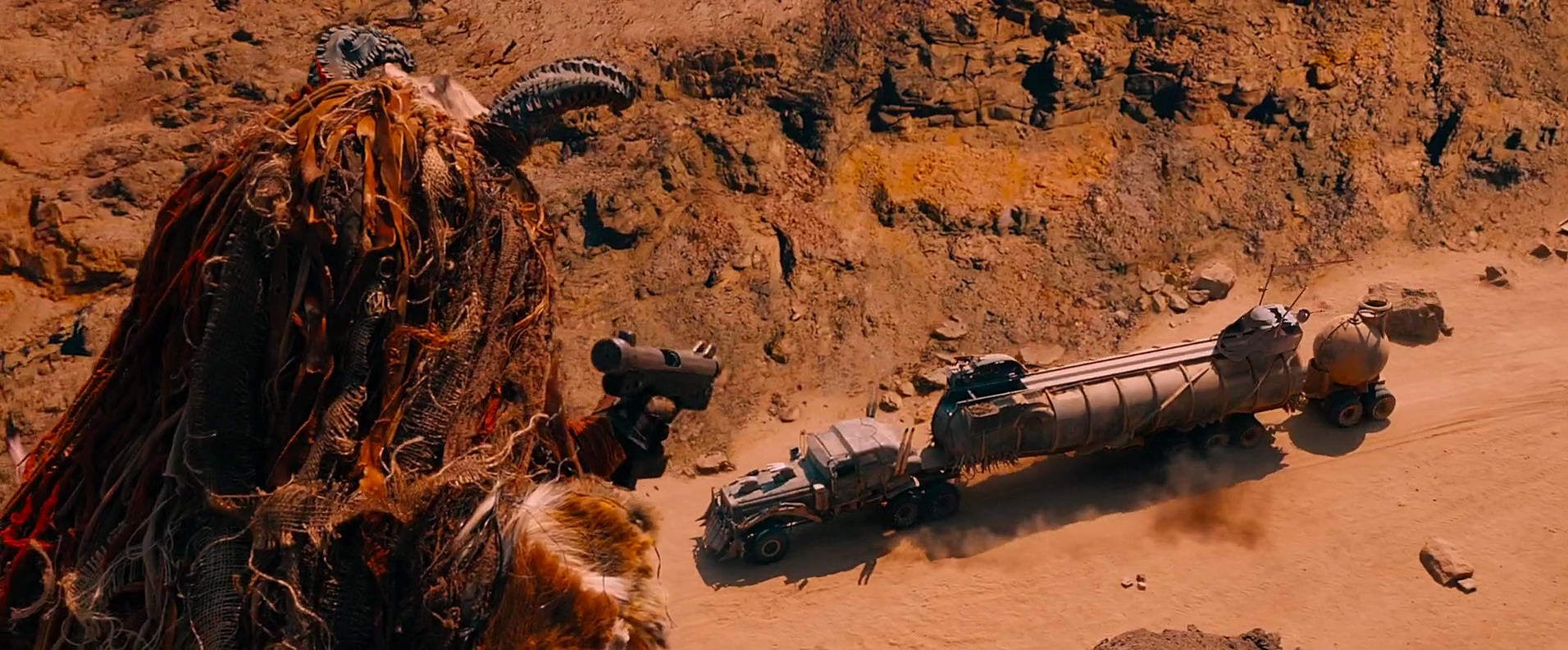
The War Rig leaves the Citadel and comes toward the camera down a dirt track, War Boys riding on top and an orange hot rod running beside it, with rock towers on the horizon behind. The ground is orange and the sky is teal. This desert wasn’t the original plan.
The film was meant to be shot around Broken Hill, in New South Wales. Years of heavy rain made that desert bloom with wildflowers, which is no use for a wasteland, and the shoot moved to Namibia.
Swakopmund. Skeleton Coast.
The base was Swakopmund, on the Skeleton Coast, and much of the filming was in the Namib Desert, in what is now Dorob National Park. Principal photography ran from July to December 2012, with about 120 days on location. Interiors and green-screen work went onto stages in Sydney and Cape Town, with pick-ups in Sydney from November 2013. Oseman mentions a detail I love: on moving shots, leaf blowers fed through flexible pipes kept sand off the lenses.
What the desert gave the colourist was two colours. The art direction was deliberately neutral, so Whipp built the look from the sand and the sky, a sandy beige and a blue. Miller’s brief was for a saturated, graphic picture. He had no interest in the bleached, desaturated look post-apocalyptic films had worn for decades. Miller’s own account is that teal and orange were the colours they had to work with, sky and desert, and the only choice was whether to drain them or crank them up. He cranked them.
Orange and teal is usually a grading habit, warm skin set against a cool background. In Fury Road the two colours are the place itself, pushed until they almost hum against each other, and I think that is why it never looks like a filter to me.
Whipp graded on FilmLight’s Baselight at his company, Alter Ego, in Toronto. He started setting looks on early cuts in Sydney in February 2014, and the grade ran for about eight months alongside the edit. He sharpened each shot on its own to give it grit, and he did hundreds of sky replacements, which makes sense for a shoot that refused to wait for the weather.
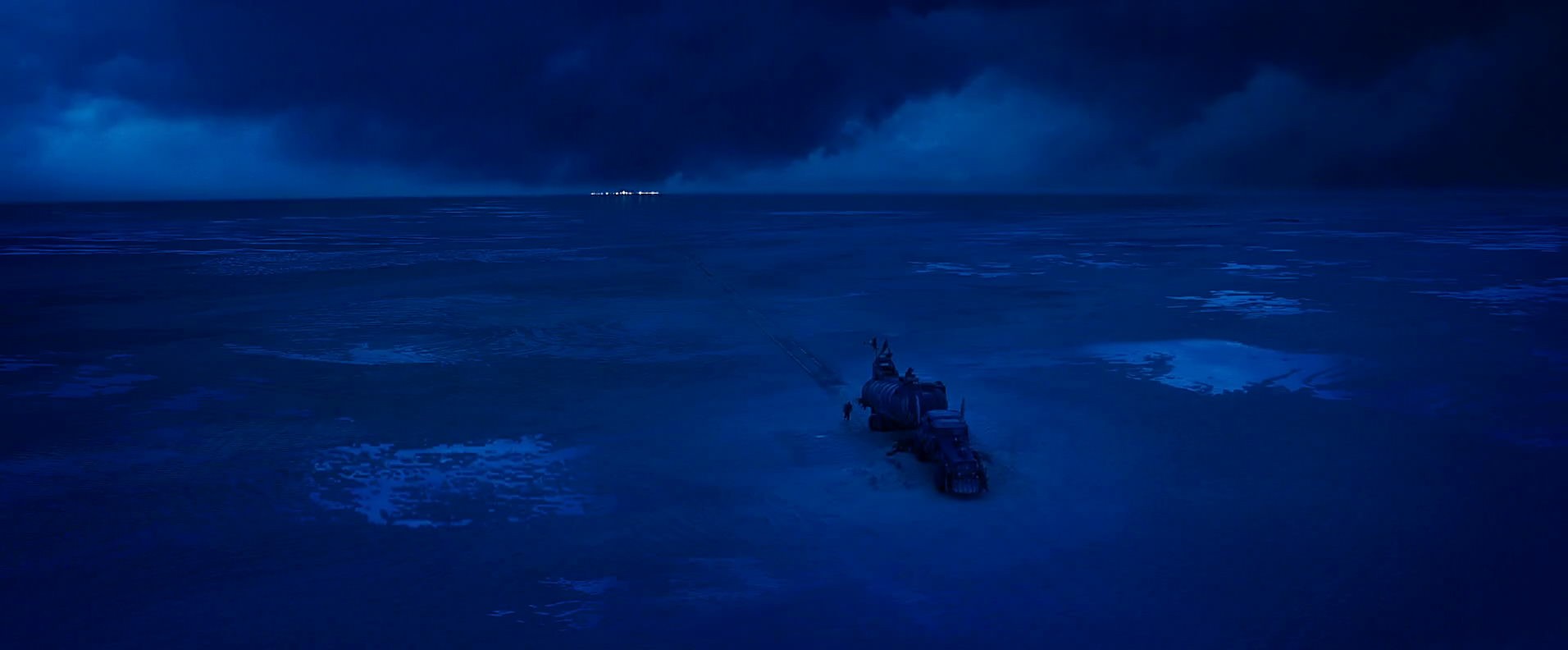
13about 58 min Night in the bog, from high above: the War Rig small in the mud and a line of headlights on the horizon as the Bullet Farmer closes in. The night scenes were shot in full Namibian daylight, about two stops over, and graded down to deep blue.
Night in the bog. Seen from high above, the War Rig sits small in the mud, and a line of headlights glows on the horizon under heavy cloud as the Bullet Farmer closes in. The sequence was shot in full Namibian daylight, and fxguide says Whipp added glowing clouds behind the Bullet Farmer in the grade, as a backlight.
Day for night is an old technique: shoot in the sun, then make it look like moonlight. The traditional way is to underexpose, so the picture comes out dark from the start. It works, but the shadows turn to mud and there is nothing left in them to recover.
Fury Road went the other way. The night scenes were overexposed by about two stops,FilmLight’s account says two to three stops, and fxguide says two stops or more. four times the light a normal exposure would get. On a digital sensor the noise lives in the shadows, so overexposing fills them with clean detail, and the only real danger is pushing the highlights past the point where they clip to white. The method came out of Andrew Jackson’s tests, in which he proposed testing as far as four stops over, and Seale then tended to expose a little higher, watching for clipping. Seale says logistics and a schedule change forced day for night in the first place. By FilmLight’s account, about half an hour of the film was made this way.
Then the grade brought it down. Miller’s brief was that the night scenes should be blue. Whipp tried silvery and photo-real night looks before settling on what he calls a graphic rich blue. In his own case study he puts the result at about 95 per cent blue, keeping roughly 5 per cent of the original colour, which he pushed only for story points like blood or a green plant. Almost every day-for-night shot was also rotoscoped and given a new sky, and that was done in the grade, not as a visual effect, so the skies could keep changing as the look developed.
Exposure scale from -3 to +4 stops. The usual way is to underexpose. Fury Road exposed about +2 stops, and tests went up to +4.
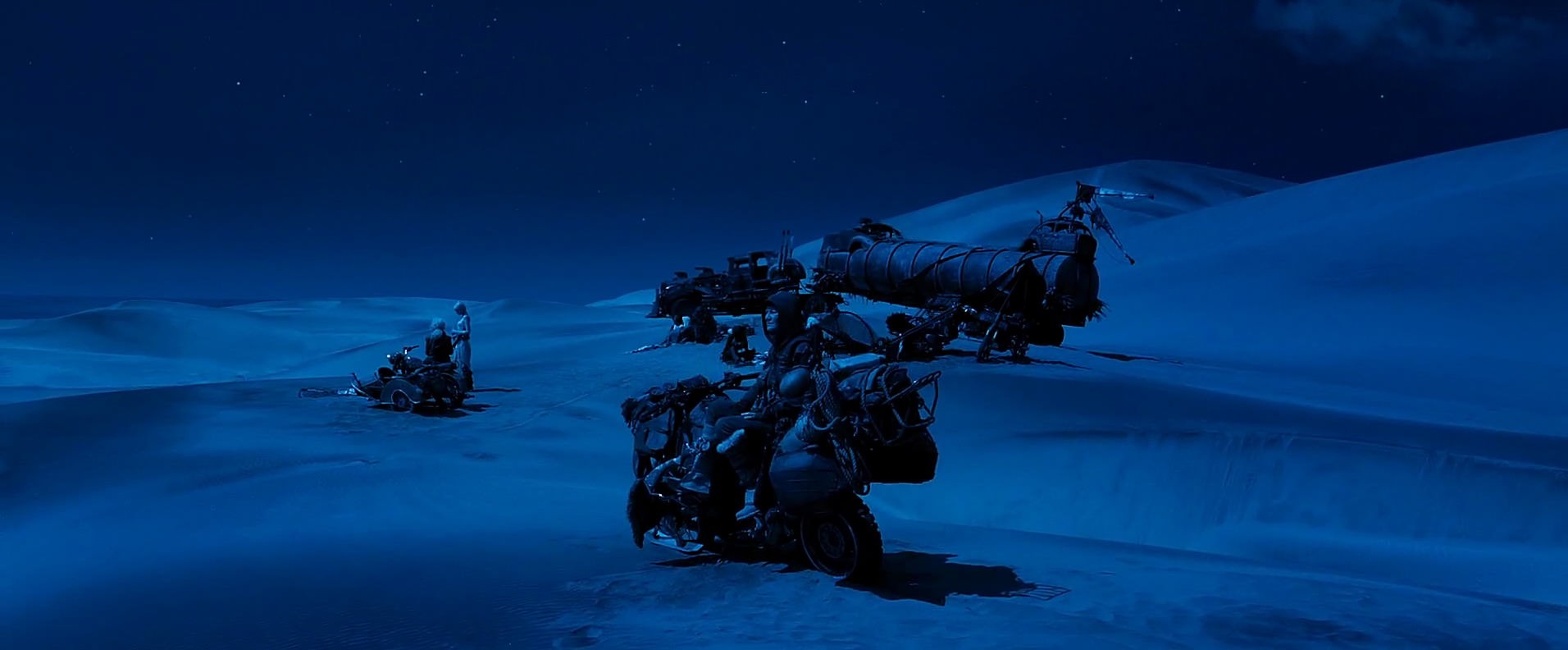
The camp above has a sky full of stars, and a hard shadow under the nearest bike that only the sun could cast. What I like about this night is that it makes no attempt to be real. Real desert night would be close to black, and nobody could follow a chase through it. This is a blue photograph with every detail kept, and the colour and the new skies tell you the time.
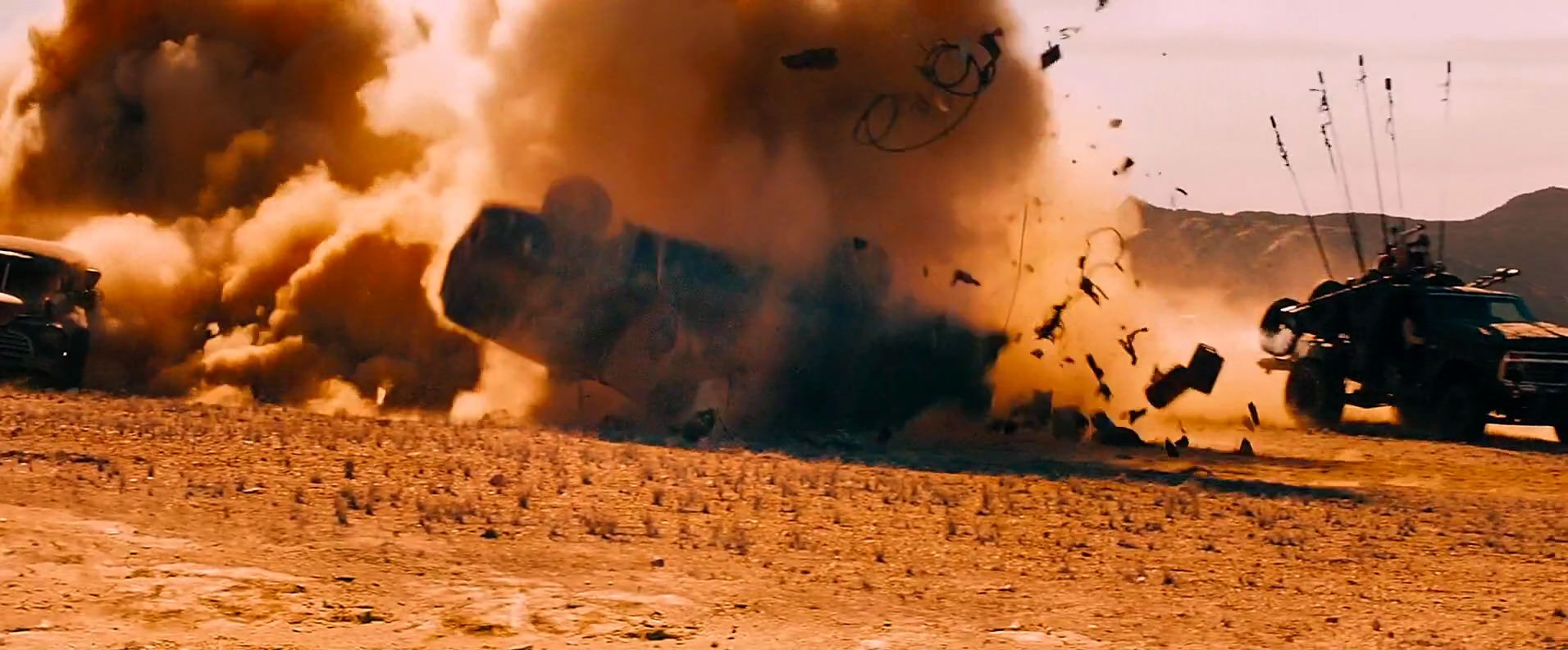
02about 3 min The Interceptor upside down mid-flip, inside its own dust, at the end of the opening chase. It was rolled for real by the Flicker, an arm driven into the ground by a nitrogen ram, with Guy Norris at the wheel.
Early in the film the War Boys run Max down, and his Interceptor goes end over end across the sand, caught here upside down inside its own cloud of dust and debris. It was rolled by a device the crew called the Flicker, an arm driven into the ground by a nitrogen ram, with Guy Norris, the stunt coordinator and second unit director, at the wheel. fxguide says it went over five and a half times on the day.The same account has seven and a half rolls in rehearsal. The Drive says eight and a half in testing.
A great deal of what happens to the film’s vehicles on screen happened in front of a camera. That changes the photography. Dust from a real roll hangs and drifts the way real dust does, and the car’s weight is in every bounce.
The pole cats are my favourite example. Miller expected to shoot them separately and composite them into the chase. The stunt team made them work for real instead, on poles about 30 feet long counterweighted with car engines, with performers riding the tops. Norris told Rolling Stone Australia that the riders trained in Chinese pole work for eight weeks under a friend who had worked for Cirque du Soleil. The rigging crew had flown performers at the Sydney and Beijing Olympic ceremonies.
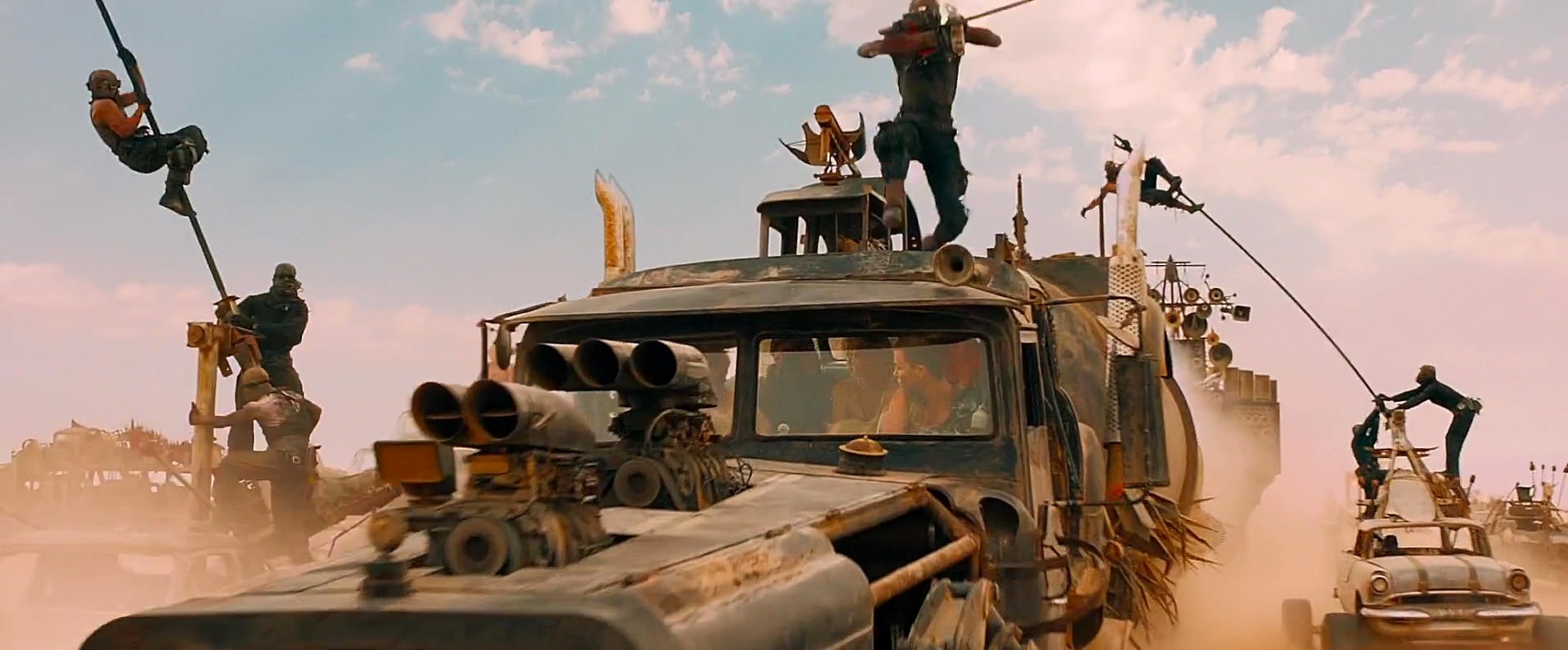
Because they were real, the pole cats could be photographed like everything else in the chase, with real sky behind them and real sunlight on their bodies. Nothing about the light on them is guessed, and I think that’s why they still look frightening.
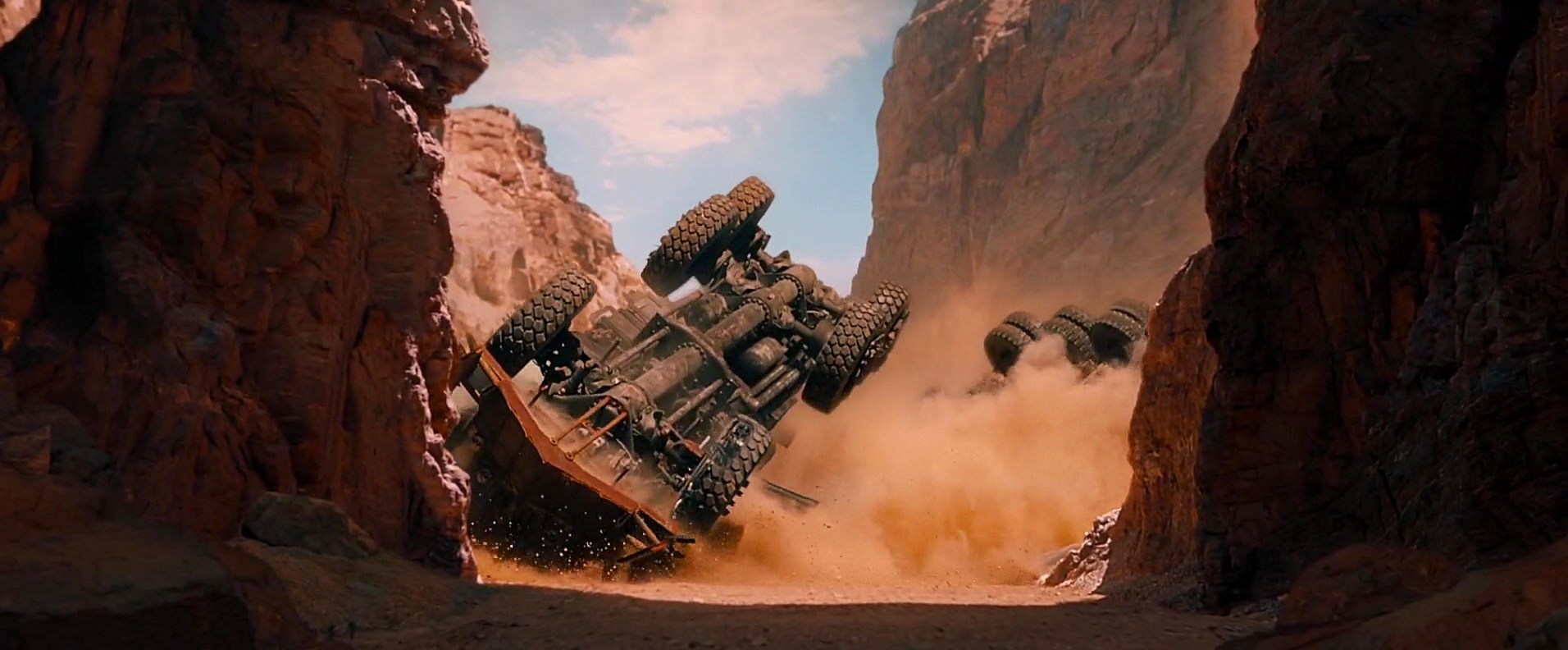
The War Rig itself was rolled near the end, in the neck of the canyon. Miller told Top Gear there was no way to put a person inside it for that, and that doing it in CG made no sense, so it was rolled for real. It is the climax of the chase, and it has the weight of a real truck coming apart.
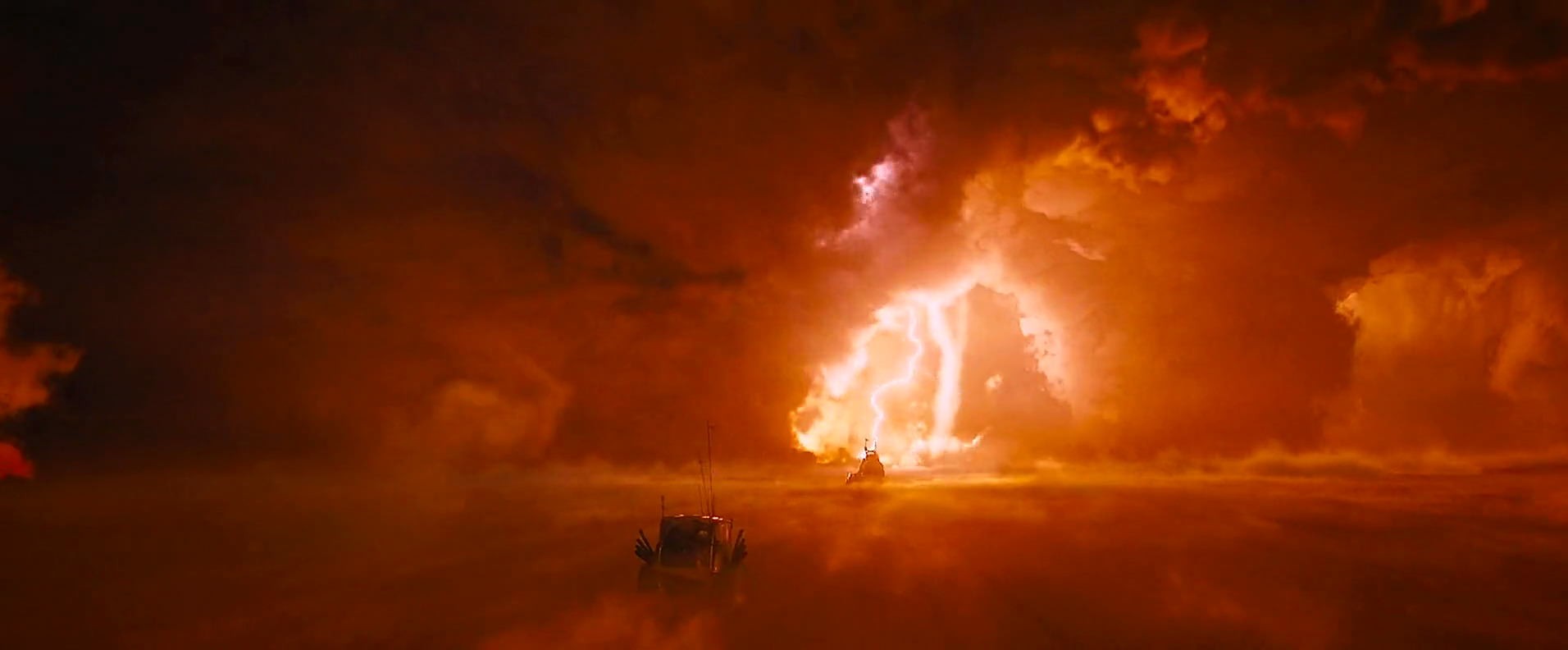
10about 23 min Inside the toxic storm, the film’s main CG sequence: a pursuit car runs toward a burst of forked lightning that lights the whole frame. The vehicles were shot in Namibia, and Iloura built the storm around them.
Inside the toxic storm, a pursuit car runs on toward a burst of forked lightning, the whole frame burning orange. Sixel calls the storm the film’s big CG sequence, and even here the starting point was real. The vehicles were shot in Namibia, and Iloura added CG car takeovers, digital doubles and the storm itself around them.
The storm lights itself. fxguide reports that Miller described it to the team as a super-cell, and that the lightning strikes were added as light sources for the shots. That is a cinematographer’s way to think about an effect, with the light on the rig coming from something you can see. Sixel says she played with the frame rates on the last War Rig shot of the storm.
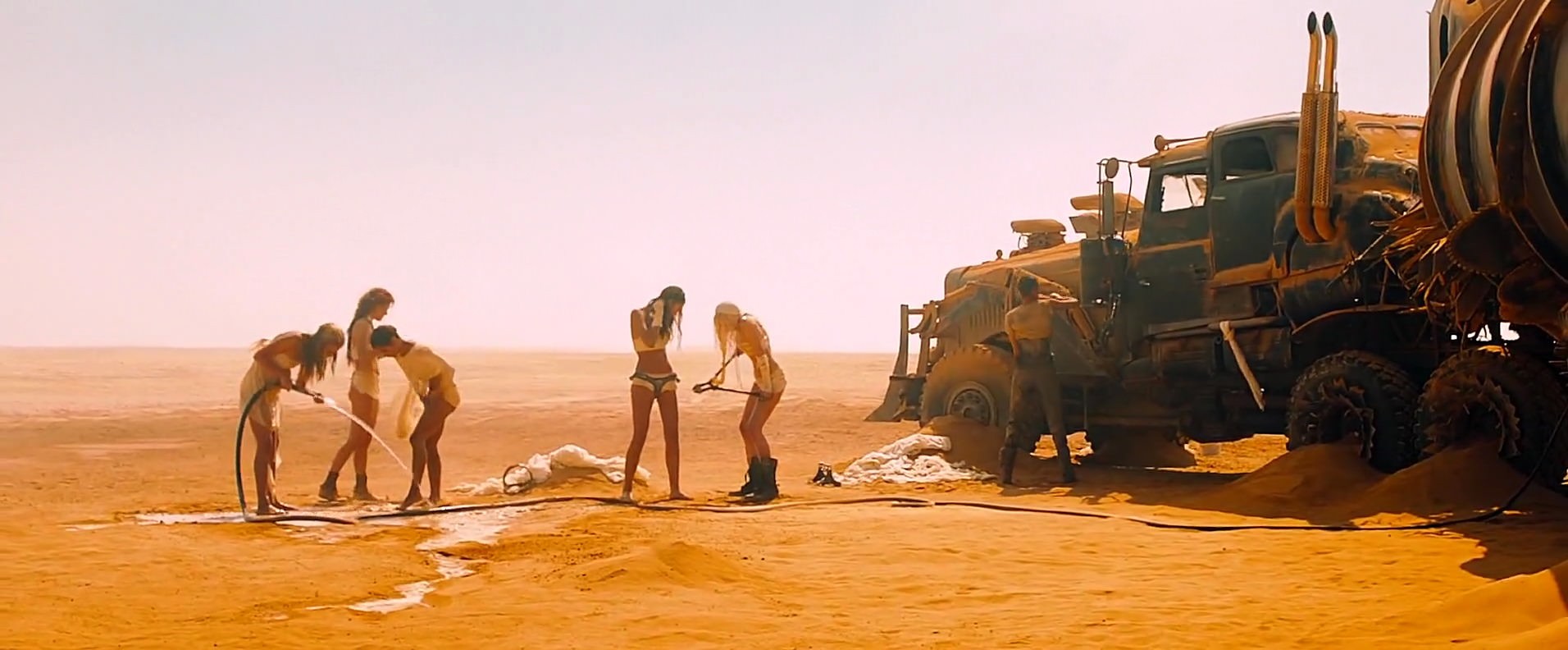
After the storm comes the calmest picture in the first hour: the Wives in white, washing at the War Rig’s hose in open daylight, pale and quiet after all that darkness.
The storm is the effect everyone notices. Most of the film’s 2,000 or so VFX shots are ones you never see: clean-ups that remove wires, rigs and tyre tracks. Iloura did about 1,500 or more of them. Miller’s description changed over the years. In 2014 he was telling Collider it was not a big CG movie, and by 2016 he was telling Studio 360 that CG was involved in an enormous number of shots. I think both are true. The stunts are real, and in a film of about 2,700 shots, roughly three in four have also been worked on digitally.
Some of the hidden work is on the actors. fxguide says Theron wore a green sleeve over her real left forearm, and the VFX team painted it out to leave Furiosa’s stump.
Some of it is in the places. The Citadel’s rock towers were built from photogrammetry of cliffs in the Blue Mountains west of Sydney, a technique that turns many overlapping photographs into a 3D model, and the Jenolan Caves were used for the interiors. So the rock on screen is real rock, moved somewhere else.
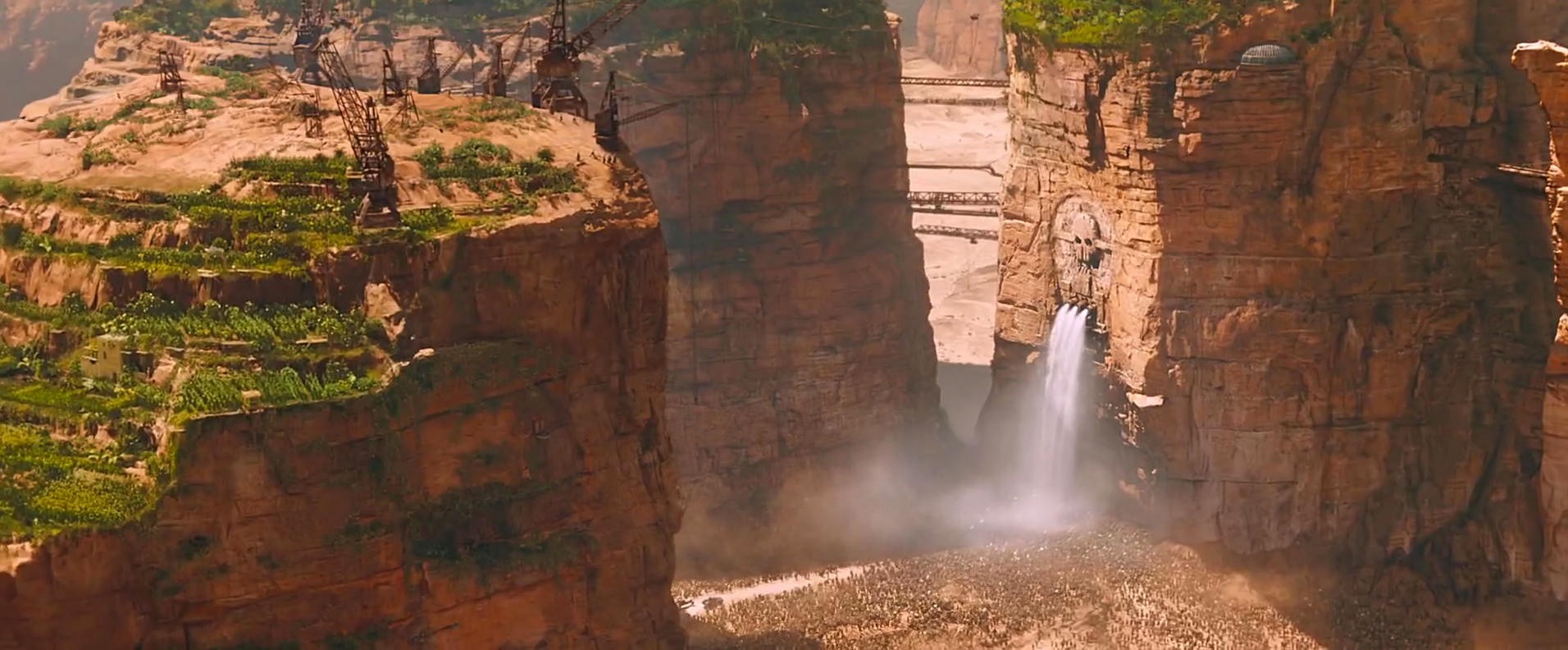
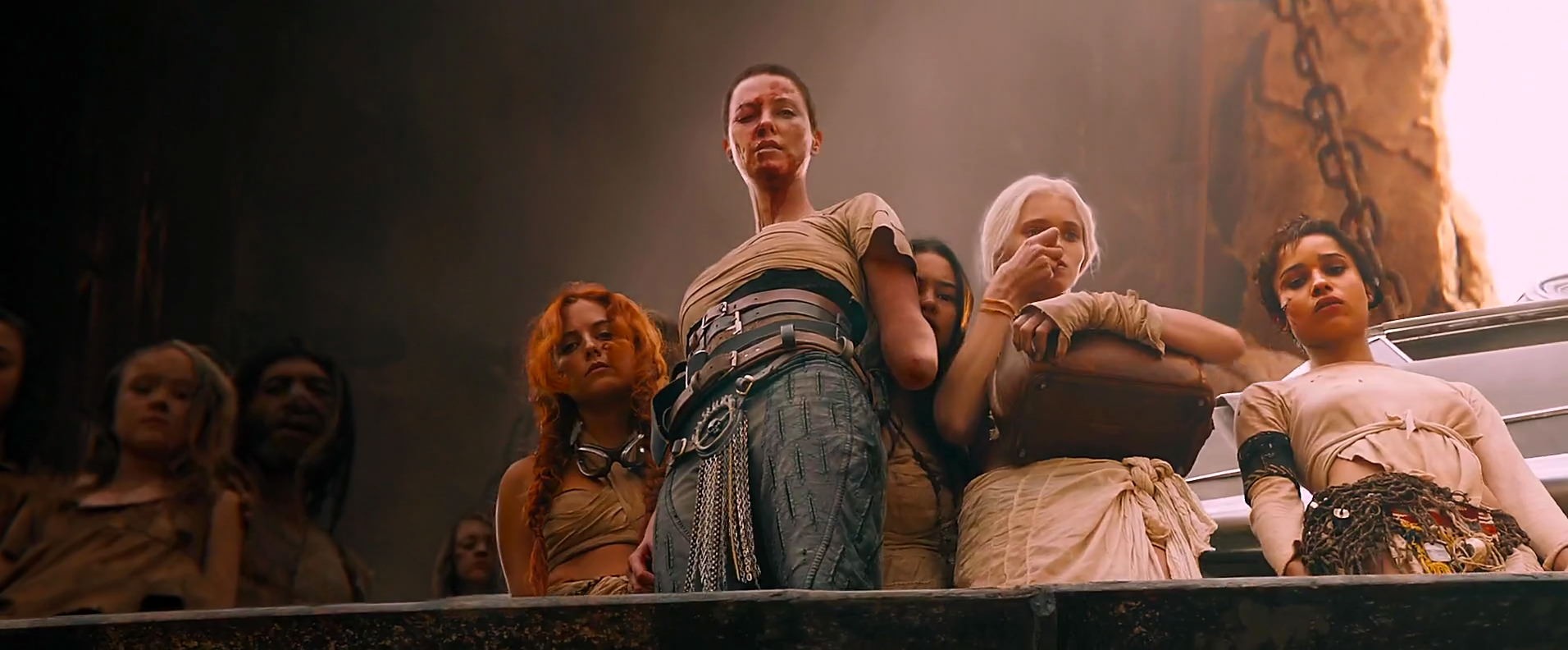
Those two Citadel frames bracket the film. At the start, the camera looks down from high above the towers as Joe lets the water fall on the crowd. At the end, it looks up at Furiosa, bloodied, dead centre at the rail of the lift with the Wives beside her.
The canyon was enlarged in nearly every shot, made taller and narrower, starting from the Namibian location and a photograph of Wadi Rum. Iloura’s Tom Wood puts the increase at a factor of ten, and fxguide says the rockfall was a real quarry blast, filmed separately and composited in. Some of the smallest elements came from a phone: Whipp shot slow-motion debris for the end of the War Rig crash on an iPhone 6 at 240 frames a second.
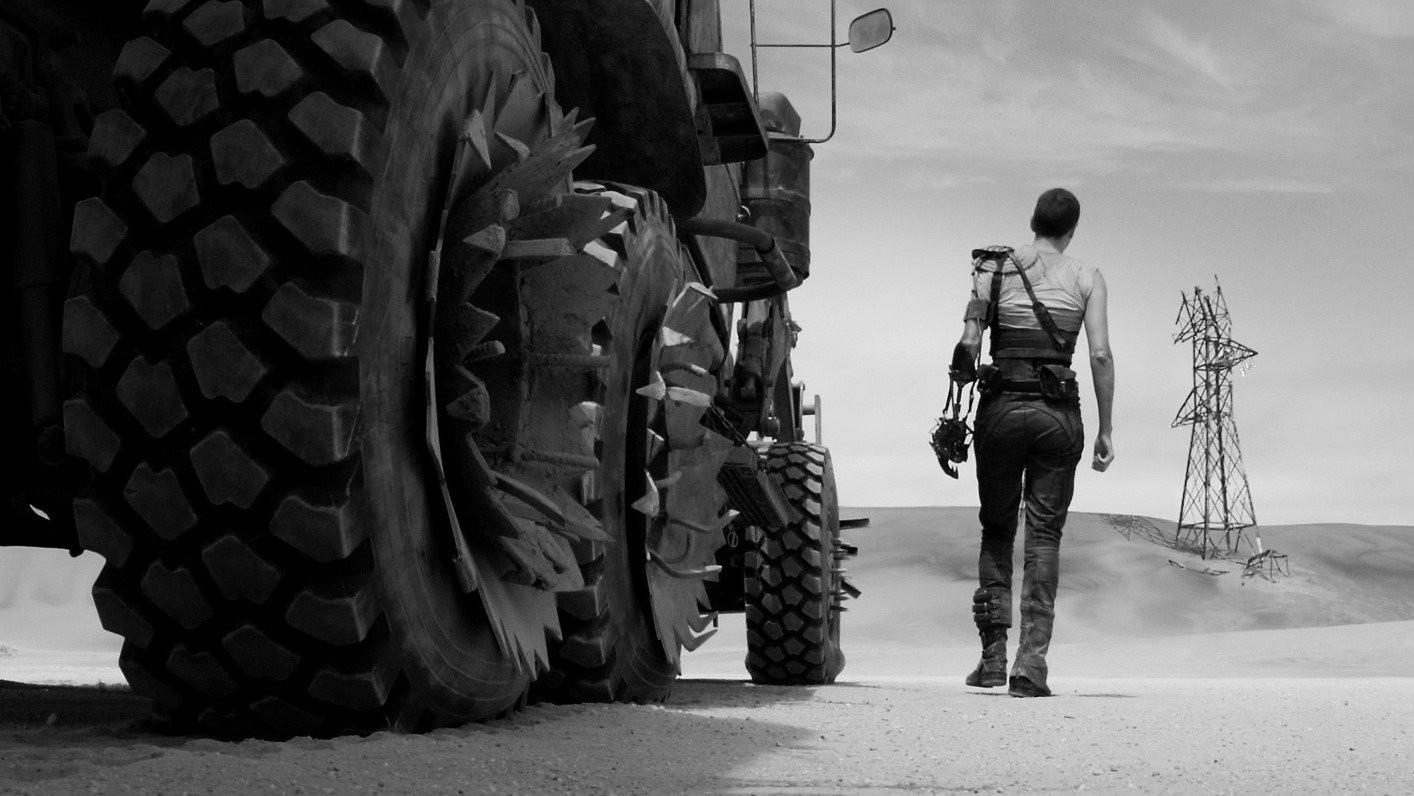
14about 67 min Furiosa walks past the War Rig’s spiked tyres toward a lone pylon on the dunes, in a black-and-white still used here for the Black & Chrome look (it is 16:9, not the film’s 2.39). With the colour gone, the tyre, the figure and the pylon read as dark shapes on pale sand and grey sky.
Furiosa walks out past the War Rig’s spiked tyres toward a lone pylon on the dunes. In black and white the tyre, the woman and the pylon are dark shapes on pale sand and grey sky, and there is nothing else to look at.
Miller wanted Fury Road in black and white from the start, and the studio was nervous about it. He told The Credits, the Motion Picture Association’s site, that he asked Whipp to show him some scenes in black and white with plenty of contrast, and that they looked great.
The best version of this movie is black and white, but people reserve that for art movies now.
6 December 2016.
The Black & Chrome Edition came out in the United States on 6 December 2016, in the High-Octane Collection and as a two-disc set with the colour version and an introduction by Miller.
What interests me most is what monochrome does to the effects. The tanker explosion in the desert was real: 1,360 litres of fuel and 96 detonators, set off while the remote-driven tractor ran at about 50 miles an hour, and the second unit filmed it from every angle. Den of Geek points out that in monochrome, explosions read as white flame and thick black smoke, and that the CG blends more easily with the practical footage. Without the orange and teal, real fire and rendered dust become one material.
It also lays the framing bare. With no colour to sort the picture you notice shape and position, and shot after shot the shape is in the middle.
Seale was nominated for the cinematography Oscar and lost to Emmanuel Lubezki for The Revenant. The film won six Oscars from ten nominations, Sixel’s for editing among them.
When I think about Fury Road now, I think about how much of it was decided before the cameras rolled and after they stopped. Miller drew it first, and Whipp, Sixel and Jackson reshaped it afterwards. In between, Seale’s job was to put cameras in among real trucks and people swinging on poles in a real desert, and keep the subject in the middle. A film this wild is held together by a rule that plain, and I find that more exciting than any of its explosions.