The Matrix
The Wachowskis, 1999
How Bill Pope tinted the Matrix green and the real world a cold blue, lit vast Sydney sets bright enough to shoot at 300 frames a second, and helped turn 120 still cameras into a single moving shot.
The Matrix begins on a screen. There is black glass, and green characters running down it in columns, brightest where each column leads. Then the film cuts into a dark hotel room, and the green comes too. For the rest of the film it sits in the scenes set inside the Matrix, in the walls and in the skin of the actors, and it drains out of the picture whenever the story leaves.
Bill Pope photographed the film for the Wachowskis, in Sydney, in 1998, and he gave the story’s two worlds two kinds of light. The Matrix is tinted green, on purpose, and a little sickly. The real world, where the sun has gone, is cold and blue. Within that scheme he lit huge sets bright enough to run the camera at 300 frames a second, and he worked beside an effects crew that set 120 still cameras along a path around Keanu Reeves to make a single moving shot.
Chapter 01: Bill Pope
Pope was born in Bowling Green, Kentucky, in 1952. He took a master’s in fine arts at New York University in 1977 and spent years in music videos. He shot Sting’s We’ll Be Together in 1987 and co-directed Metallica’s One with Michael Salomon. He shot Sam Raimi’s Darkman in 1990, and before The Matrix came Army of Darkness, Clueless, Gridlock’d, Zero Effect and Bound, the first film the Wachowskis directed.
Bound was made on very little money, and its first cinematographer quit after a single day over the budget. When the production went looking for the cheapest cinematographer it could find, Pope says, it found him. He thinks they hired him for another reason. They had loved Army of Darkness, and he read comics, so he knew what they were talking about. He first heard about The Matrix while they were making Bound; after years of watching Hong Kong and mainland Chinese films and Japanese anime together, he says, he saw them think it up.
The comics went into the planning: Steve Skroce and Geof Darrow, both comic artists, drew a 600-page, shot-by-shot storyboard book of the film’s set pieces. Lana Wachowski told American Cinematographer in 1999 that they had set out on purpose to show audiences pictures nobody had seen before.
…put images up on the screen that people haven’t ever seen before.
In the same magazine, the Wachowskis said Pope enjoys putting black on the screen and likes moving the camera. Both habits run all through the film.
For a film remembered for its effects, Pope describes it as mainly practical, with CG used selectively. At the end of the opening sequence, Trinity runs for a ringing phone booth and a truck drives straight into it. Pope says they put the sidewalk, the booth and the camera together on a huge dolly and drove them into a truck that was standing still. There was no CG in the shot at all.
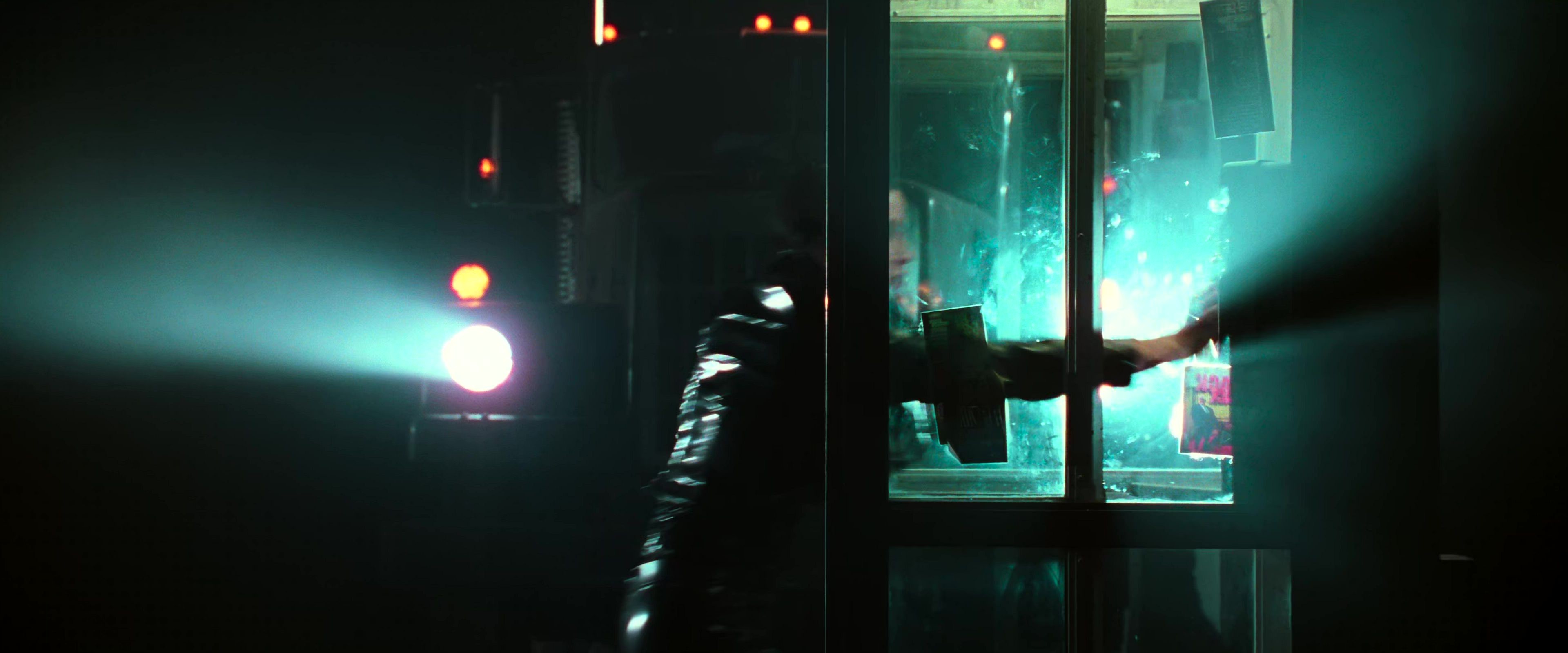
I love the logic of that. The heavy, dangerous object stays put and the street goes to meet it, and because the camera rides on the same dolly as the booth, the booth holds steady in the frame while the truck’s lights swell beside it.
The shoot ran from March to August 1998: 118 days for the first unit, and 90 for the second, whose cinematographer was Ross Emery.
Chapter 02: Format
The Matrix is a widescreen film made without anamorphic lenses. It was shot in Super 35, where ordinary spherical lenses expose the full width of the 35mm negative and the 2.35:1 picture is cropped out of the frame afterwards. An anamorphic lens would instead squeeze a wide view sideways onto the negative, to be unsqueezed in projection. The cameras were Panavision Platinums with Primo prime lenses. They came from Panavision in Woodland Hills, California, because Samuelson in Sydney, which Panavision had just bought, could not meet the demand.
Pope gave American Cinematographer two reasons for going spherical. The production ran so many cameras that he could not find enough anamorphic lenses to go round, and he doubted he could light the huge sets to the stop that anamorphic needs. Years later he gave British Cinematographer a third. Digital effects were still too young to map anamorphic lenses, and all their aberrations, onto the image. Mapping them is how a CG element is made to look as if it came through the same glass as the photography. He has since called the spherical choice his regret.
For stock he used Kodak Vision 500T, 5279, for every interior, and Vision 200T, 5274, for day exteriors and effects shots. The T means the emulsion is balanced for tungsten light, which suited a film lit mostly with tungsten lamps. He liked the look of 5279, and he wanted to see a little grain.
The directors liked their lenses wide. In 2003 Pope told American Cinematographer that on The Matrix the Wachowskis had been in love with the 21mm, and that on the sequel they began asking for the 27mm and 35mm instead. A wide lens keeps the room around a face in the picture.
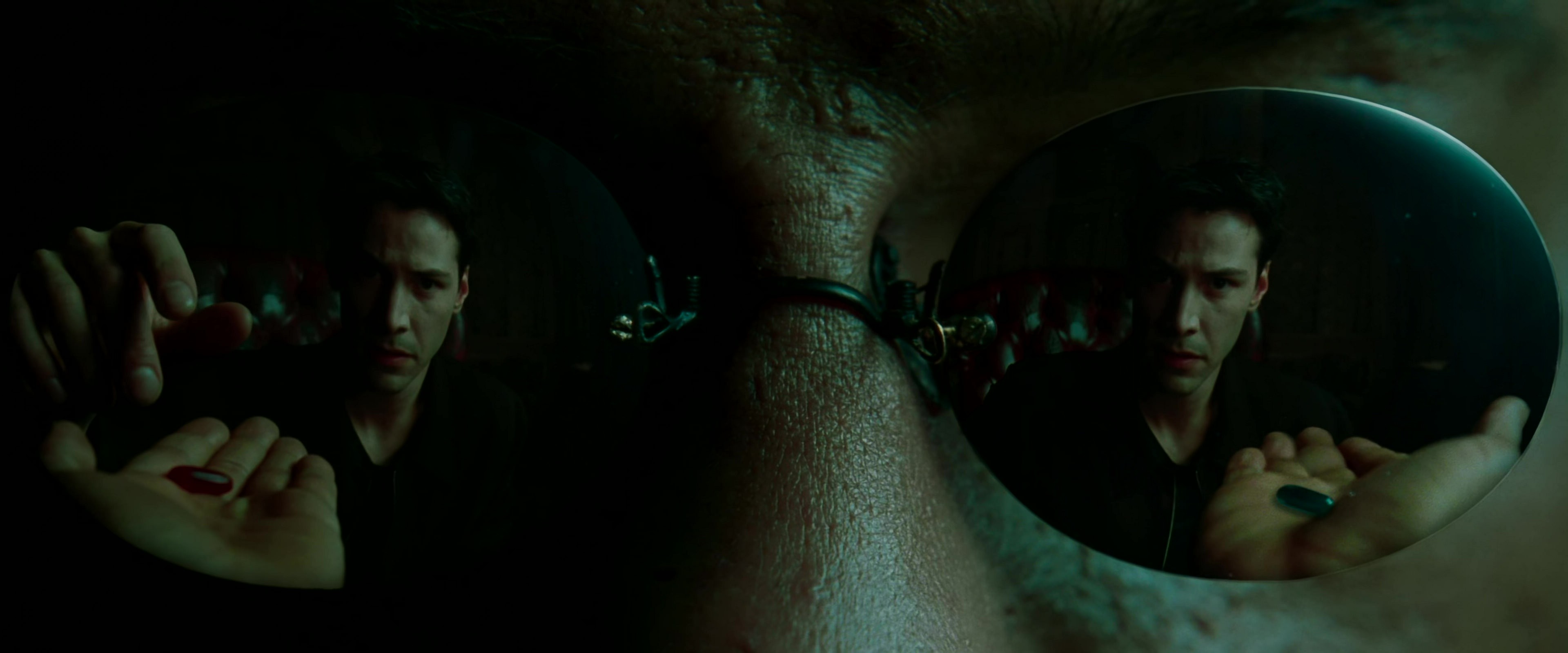
Sometimes the room nearly disappears. When Morpheus holds out the two pills, the camera goes so close to his sunglasses that his face fills the frame, and Neo appears twice, once in each dark lens, with a pill in each reflected hand. Much of the frame falls almost to black, and Neo’s choice is staged inside two small mirrors.
Chapter 03: Green
Inside the Matrix, everything leans a little green. Pope says the Matrix was meant to feel unappealing, so they asked themselves which colour was the least appealing of all, and they agreed on green. Then they gave it a source.
a slightly ‘wrong’ and ominous tint based on the colour of cursors
Some scenes were shot through green filters, and more green went in at the lab. The film was finished photochemically in 1999, so the grade was done by colour timing. The timer sets how much red, green and blue light prints each shot onto the print stock, and Pope had a little green added there. For the release, 150 show prints were made with Technicolor’s revived dye-transfer process, and the other 4,350 were struck on Kodak Vision stock.
The light underneath the tint is soft. Faces on interiors were lit with Kino Flos, fluorescent fixtures that give a broad, even light, and the usual source was a cascade of two of their big Wall-O-Lite units through an 8-by-8-foot frame of light gridcloth, with custom gridcloth sails overhead. Pope also wanted no cheerful blue skies in the Matrix, only bald white ones, so the TransLight backings were altered to show white skies, and real exterior skies were whitened digitally.
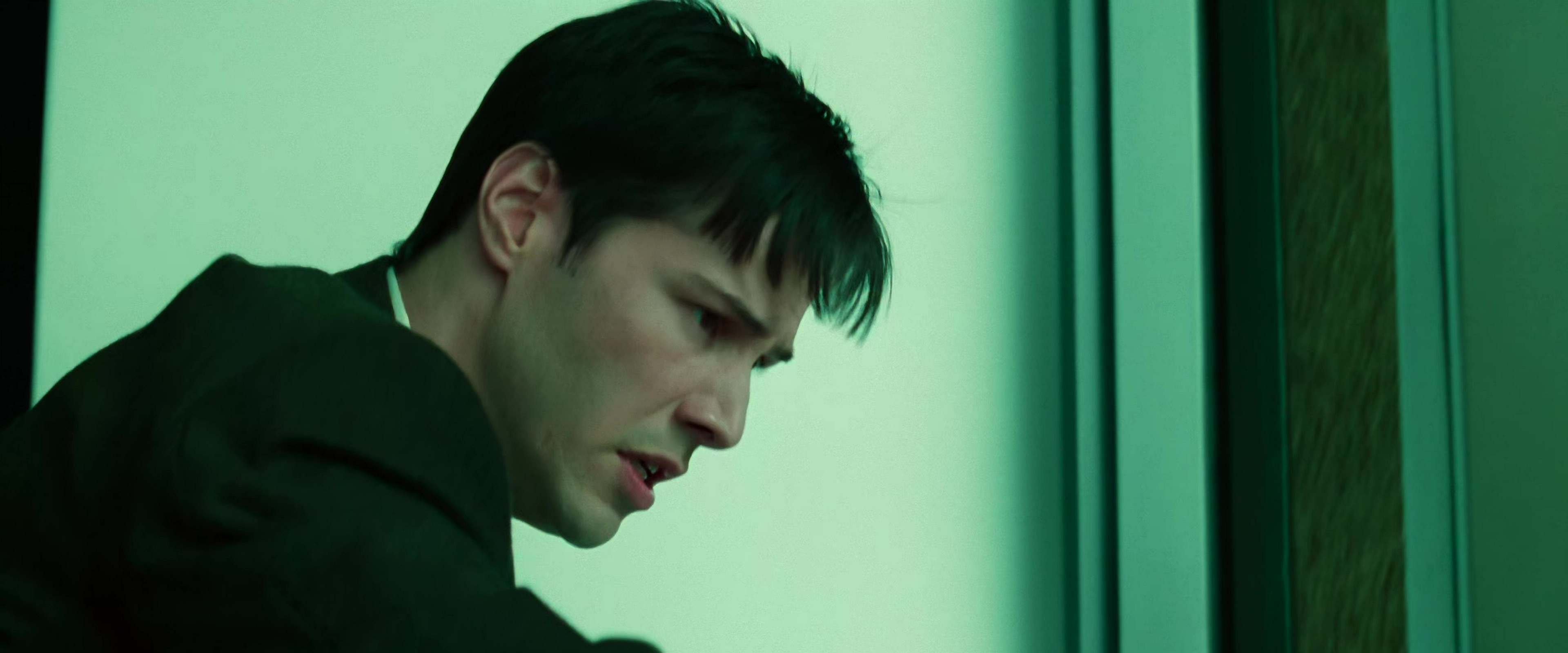
The office scenes show the recipe at its most ordinary. In the first frame below, Neo leans at his office window in soft light, the green cast sits over his face and over the glass behind him, and the window burns almost white, with no blue in it anywhere.
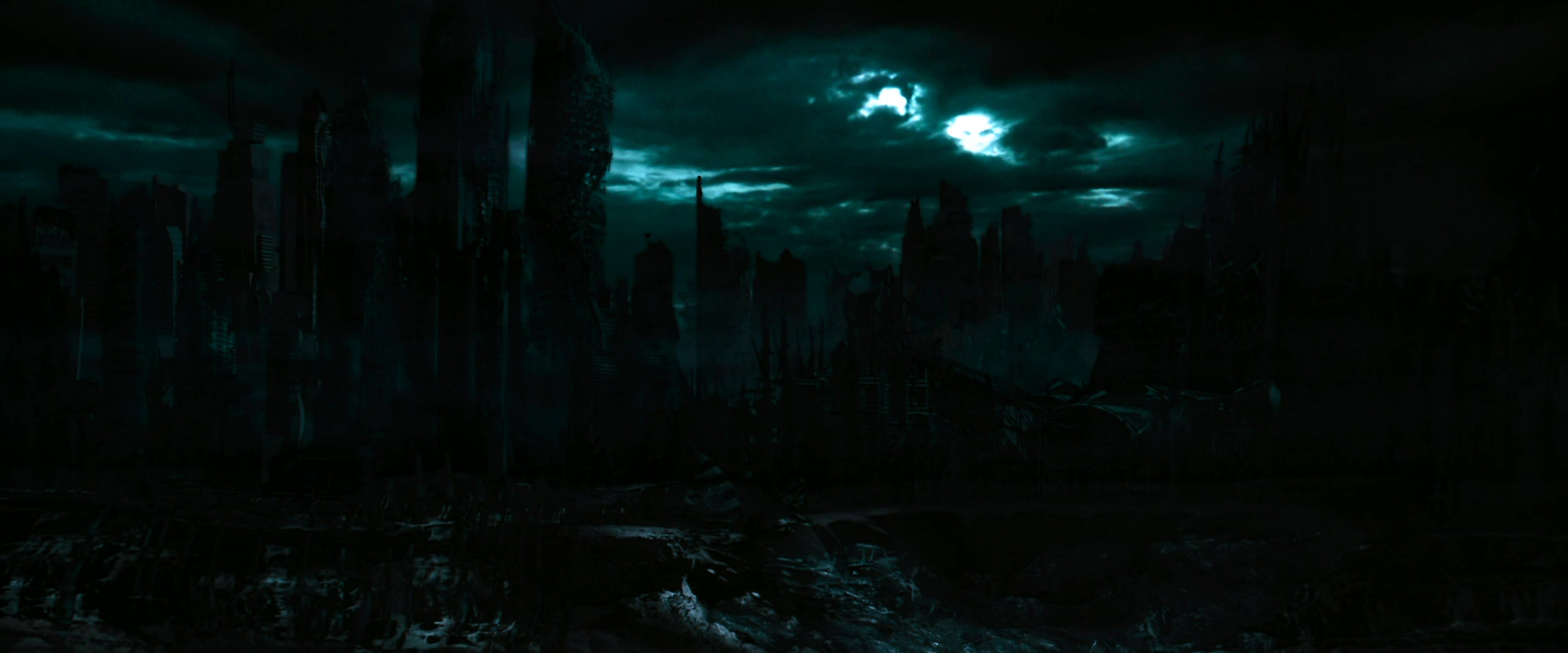
The real world has no sunlight, and Pope says that without the sun the yellow went out of the light and a slight cold blue took its place. On the pod and ship sets the blue came from tungsten lamps gelled with quarter CTB, a pale blue filter that moves their warm light part of the way toward daylight. When Morpheus shows Neo what the world has become, the ruined city runs out under a black storm sky with only a few cold breaks in the cloud. Side by side, the two frames could have come from different films.
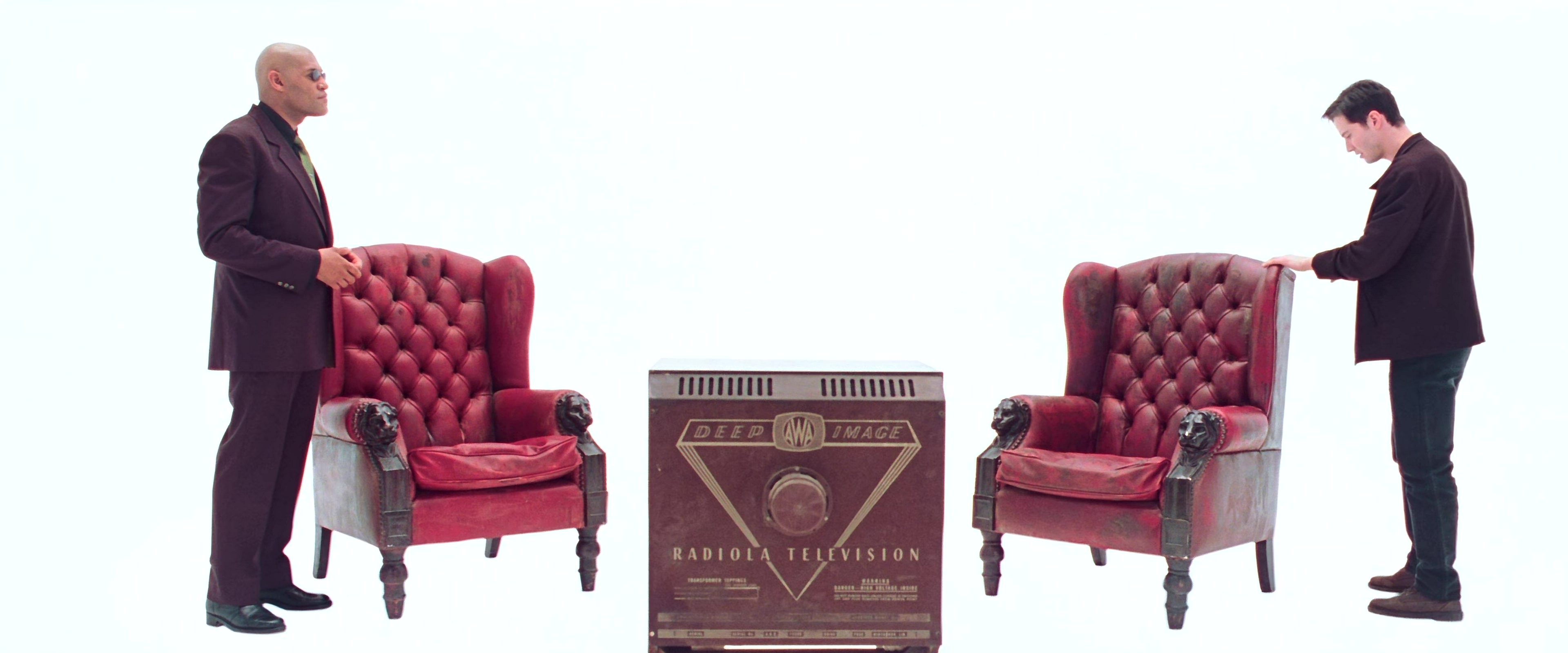
Between the two sits the Construct, the crew’s loading program: an endless white with almost no shadow, and neither green nor blue.
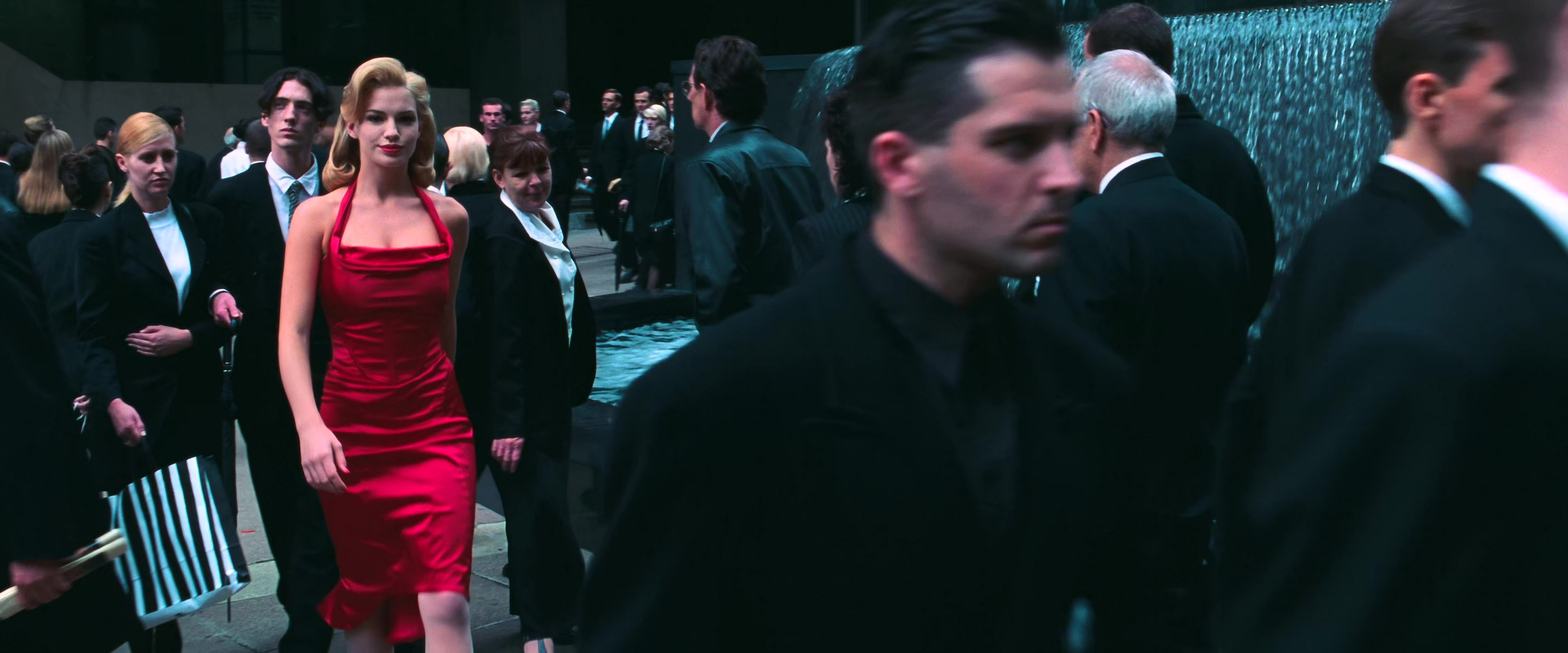
Warm colour is rare in the green world, so it stands out. In a training program a woman in a red dress walks through a crowd of dark suits, put there to catch Neo’s eye, and ours. In a world graded to be unappealing, she is the one thing designed to be looked at.
The green has not held still since. The 1999 VHS, DVD and Laserdisc releases had a weaker, warmer green than people remember. A later transfer pushed it to match the sequels, and the strong green tint of the 2008 Blu-ray divided fans. For the 4K release in May 2018 the original camera negative was given a new 4K scan, and Pope oversaw a new colour and HDR grade that pulled the green back. Which green you remember depends on which copy you watched.
Chapter 04: The Real World
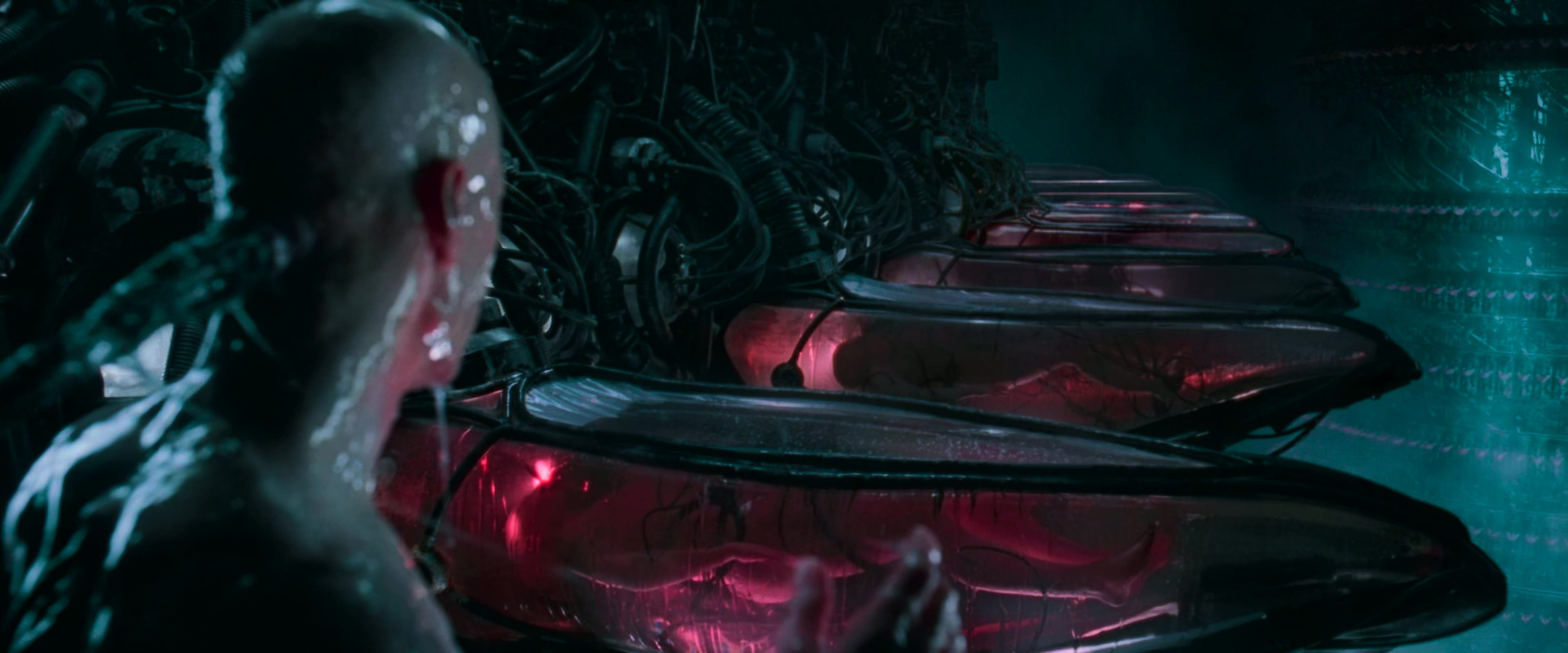
07 Neo wakes in his pod, seen from behind as the pods beside him glow red and run off into a cold blue haze. About six real pods jutted from a 30-by-60-foot wall, top-lit by about 200 Par cans through gridcloth with quarter CTB, with underwater Kinos in the bases.
Neo wakes in a pod of fluid, hairless, with cables plugged into his body, and beside him the other pods run off into a cold blue haze, each glowing red from inside. It is the first image of the real world, and the light changes with it. It comes from above, pale and cool on his wet scalp, and the green has gone.
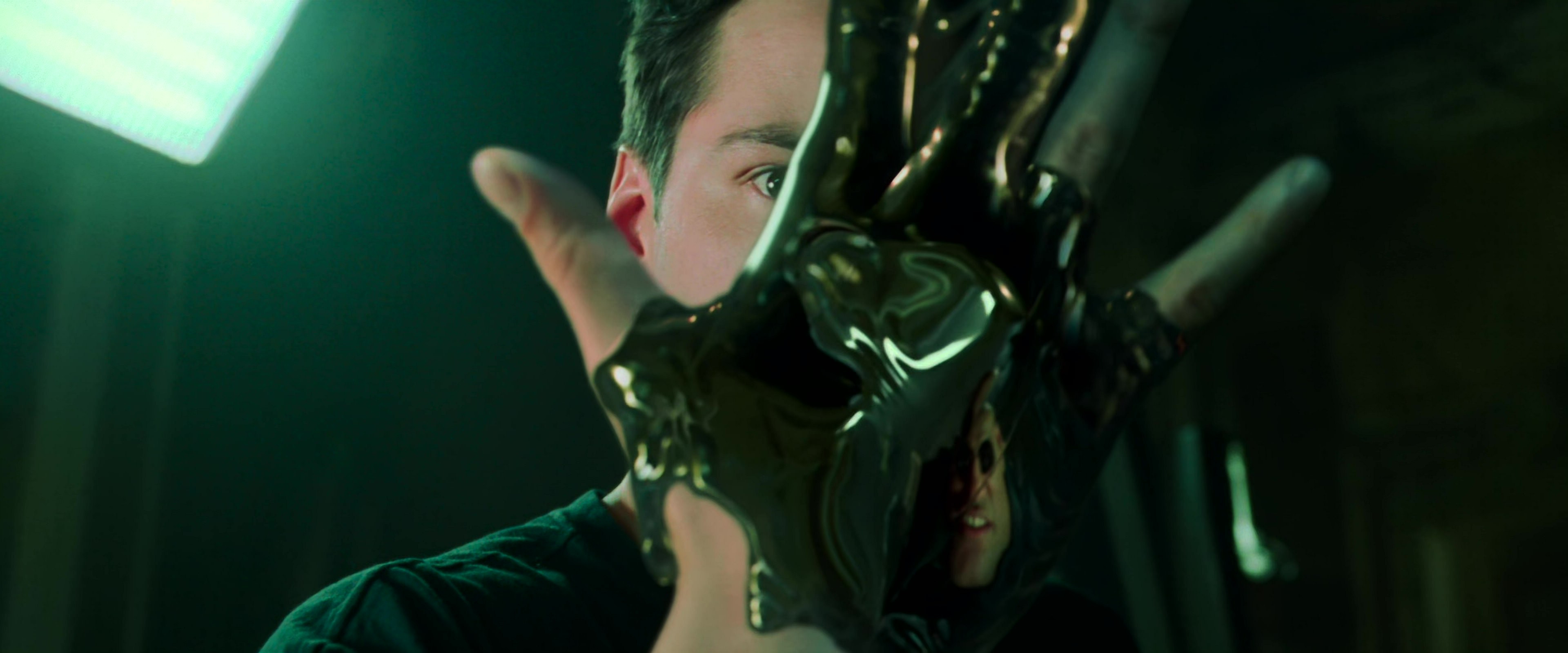
He gets here through a mirror. Just before, still inside the Matrix, Neo touches a mirror and it turns to liquid, flowing over his fingers and up his arm. The Australian studio Dfilm made it, and its artists planned the reflected reverse angles with real physics, so the mirror shows what a mirror in that room would. The liquid itself was keyframed in Houdini by animators, not simulated, and Reeves’s body was tracked limb by limb and locked to the effect with a 2D morph and heavy warping in Cineon.
Only about six pods were built. They were liquid-filled and jutted from a 30-by-60-foot wall, about 15 feet off the floor, and they were top-lit by about 200 Par cans through gridcloth with quarter CTB. Kino Flos placed below and aimed up suggested more pods than there were. Lightning Strikes units, which make sharp electrical flashes, faked the static, and underwater Hydroflex Kinos sat in the bases of the pods.
It is an honest plan. One soft, cold source from above does the real work, and the rest are tricks to make a single wall feel endless.
Aboard the Nebuchadnezzar there was no sky to borrow at all. The main deck was a steel centre section with hydraulic chairs and a porous grating floor. Light came up through the grating but was never allowed to reach the actors, who were lit softly by Kino Flo tubes built in above each chair or set on stands. The surfaces were wetted so they would catch highlights, and 2K Juniors gelled with quarter CTB skimmed the walls. There was no overhead sail, because the set came apart, so the lighting rigs were built into the set itself.
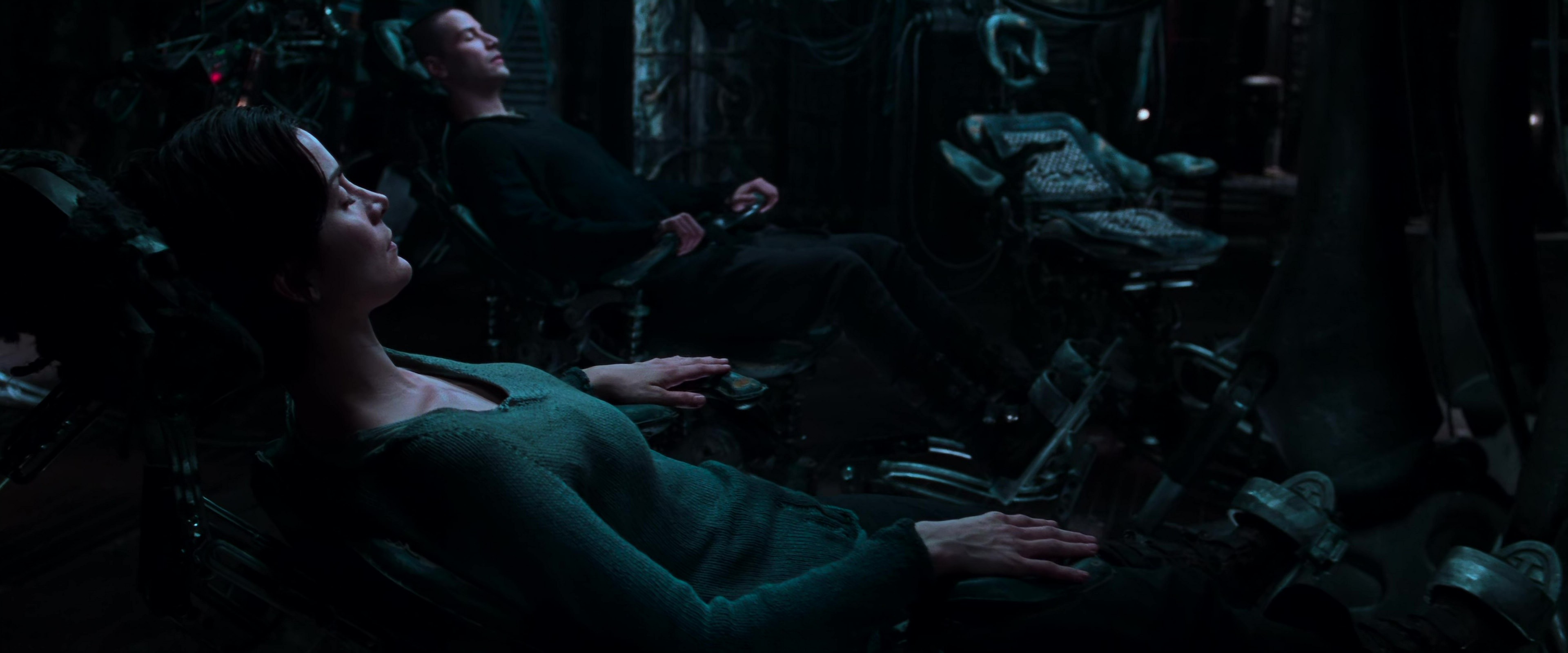
In the frame above, Trinity and Neo lie back in their chairs beside an empty one. Soft light falls on their faces and hands from above, and the rest of the ship is edges: chair rigs and hanging cables picking up a little cold light. The light seems to come from the ship itself, so the real world is lit from the inside.
Chapter 05: Wire Work
The fights were choreographed by Yuen Woo-ping, whom Pope simply calls the master. The four principal actors trained for about four months. Yuen’s team planned the fights with storyboards and stunt viz, homemade videos of the choreography shot in a dojo.
The wires belonged to two departments. Yuen’s Hong Kong team used them mainly to hold actors up inside a fight, and anything that flew, leapt or crashed was rigged by Glenn Boswell’s Australian stunt department. Reeves was in a neck brace after surgery, and Chad Stahelski says he still did at least 95 per cent of his own choreography.
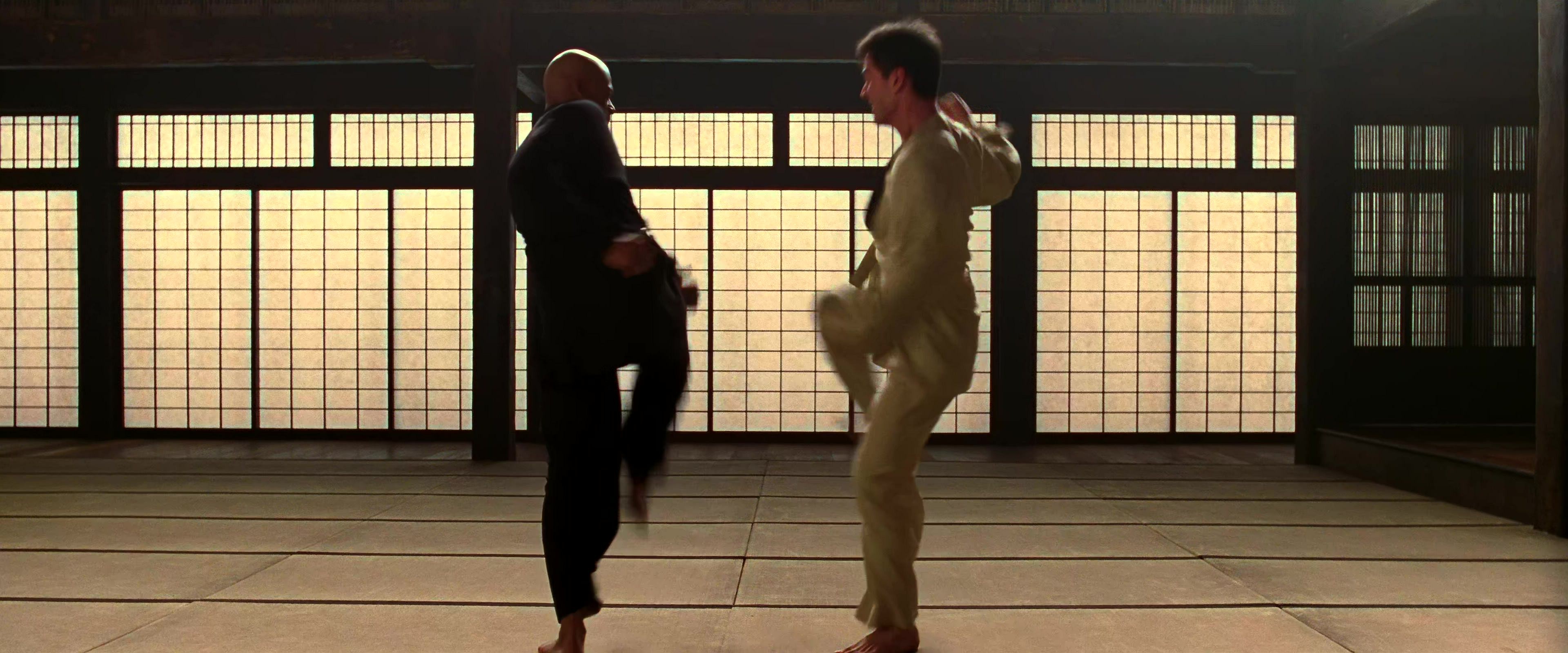
The dojo fight took more than a week to shoot. In one backward flip up a post, Reeves’s hand is resting on a wire, and you never see it. The frame below keeps both fighters whole, head to foot, which a fight like this needs if we are to believe the bodies. Behind them the paper screens of the training program glow a warm amber.
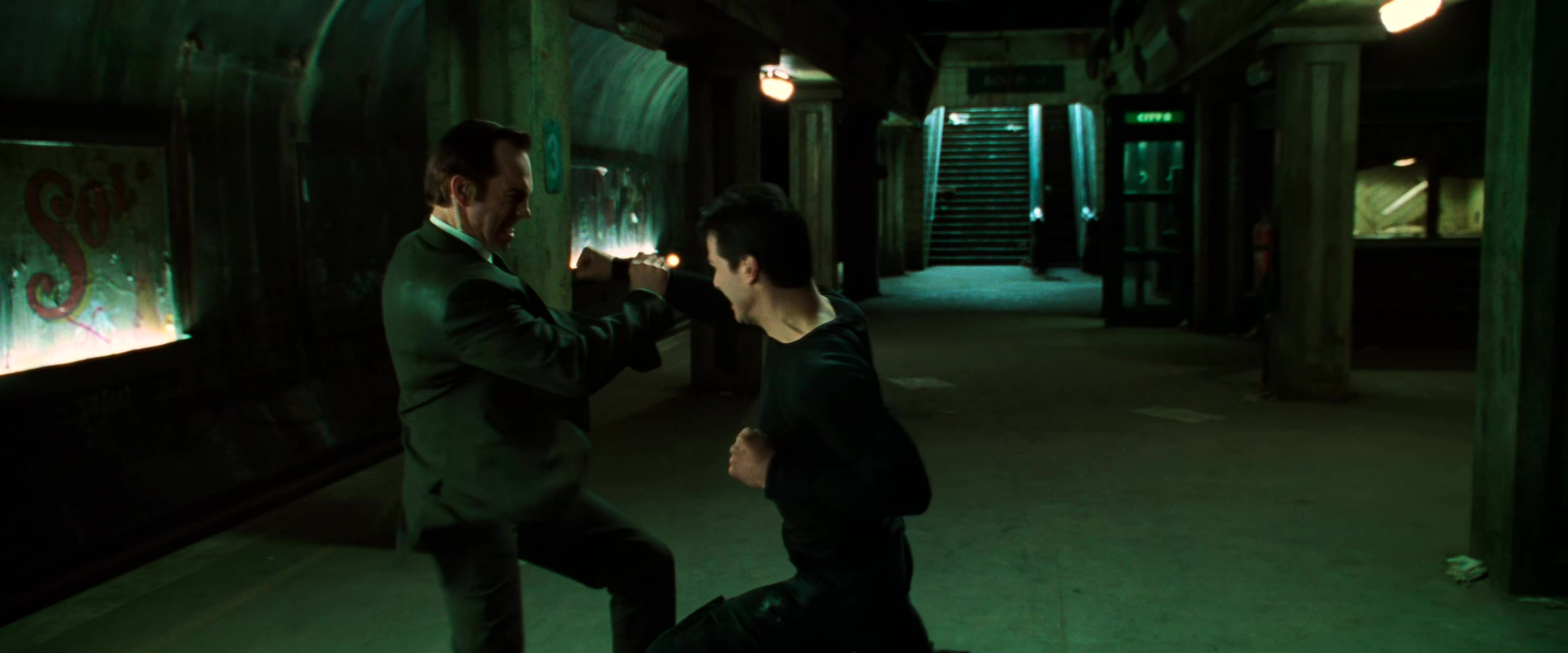
In the subway, doubles were flown up into the tunnel roof, made to look as if they had hit it, then dropped and caught. Reeves did about 40 takes of one wire move there. The station’s fluorescent ceiling fixtures were fakes: hollow housings, with 72 Par cans above each section of the ceiling and, at normal speed, about a dozen of them aimed through each fixture. When the camera ran at high speed, the sections were lifted out and replaced with 8-by-8-foot frames of gridcloth.
On the rooftops, a big stunt crane built on the highest part of a multilevel roof swung doubles down onto the lower levels. Trinity’s 360-degree rooftop leap was Carrie-Anne Moss on a rotisserie rig, which turned her about a horizontal axis, and a double did the dive through the window.
Chapter 06: Light for 300 Frames
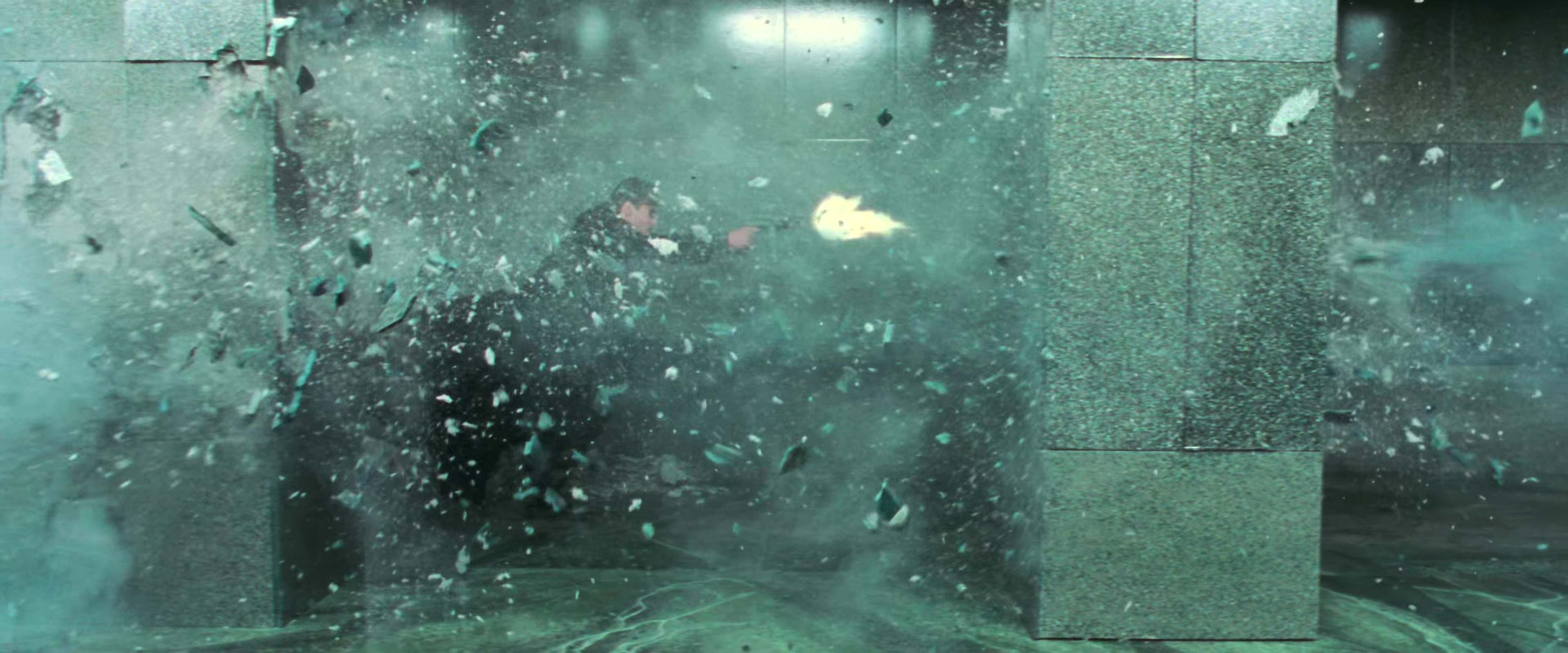
13 Stone bursts from the lobby columns around a firing soldier, the fragments hanging in the air. Much of the lobby gunplay was shot at 300 frames a second, so the set was lit to about T11, largely from nearly 1,000 Par cans in the ceiling, because lenses as wide as 10mm and 14.5mm saw too much of the floor to light it from there.
In the government lobby, stone columns come apart under gunfire, and the fragments hang in the air long enough to count. The Wachowskis wanted much of the action in super slow motion, at up to 300 frames a second, and Pope told British Cinematographer that every set was lit to allow for it.
Speed costs light. With the shutter angle unchanged, a frame at 300 frames a second is exposed for 1/12.5 of the time a frame at 24 gets, a loss of about three and a half stops. Pope’s base exposure on 5279 was around T2.8 or T4, so to run at 300 frames he and his gaffer, Reg Garside, had to light the lobby to about T11, three to four stops brighter, which is about what the frame rate takes away. Each stop doubles the light, so from T2.8 to T11 is sixteen times as much. Garside put it as a rule of thumb: if a T2.8 needs one lamp, a T16 may need 32.
Most of the film was lit with tungsten, and the workhorse was the Par can, a sealed lamp with its own reflector in a plain metal can. Dimming a tungsten lamp turns its light orange, so levels were changed by switching units on and off, which leaves the colour alone.
The heat was its own problem. Practical lamps that appear in shot had to be custom-built to survive it, and the sets were fireproofed, yet Pope says everything still had to look casual. American Cinematographer names Clairmont’s Wilcam-12 as the camera carried for the high-speed work. Pope says that at those speeds he had to rely on his meter more than his eye.
The lobby is where it all comes together. It was shot on very wide lenses, 10mm and 14.5mm among them, and lenses that wide see so much of the floor that the main light could not come from it. It came from above, and the ceiling carried nearly 1,000 Par cans. Pope played the light from one side with very little fill, and at least eight or nine Dinos, each a bank of Par lamps in a single fixture, burned at any one time through gridcloth frames 12 feet and 8 feet square. Dinos and Mini-Dinos on the floor modelled the side colonnades, where the overhead light did not reach, and the walls were dark green.
When I watch it now I think about the light as much as the guns. Every one of those slow-motion frames was exposed under a ceiling of tungsten burning three or four stops brighter than the stock needed at normal speed.
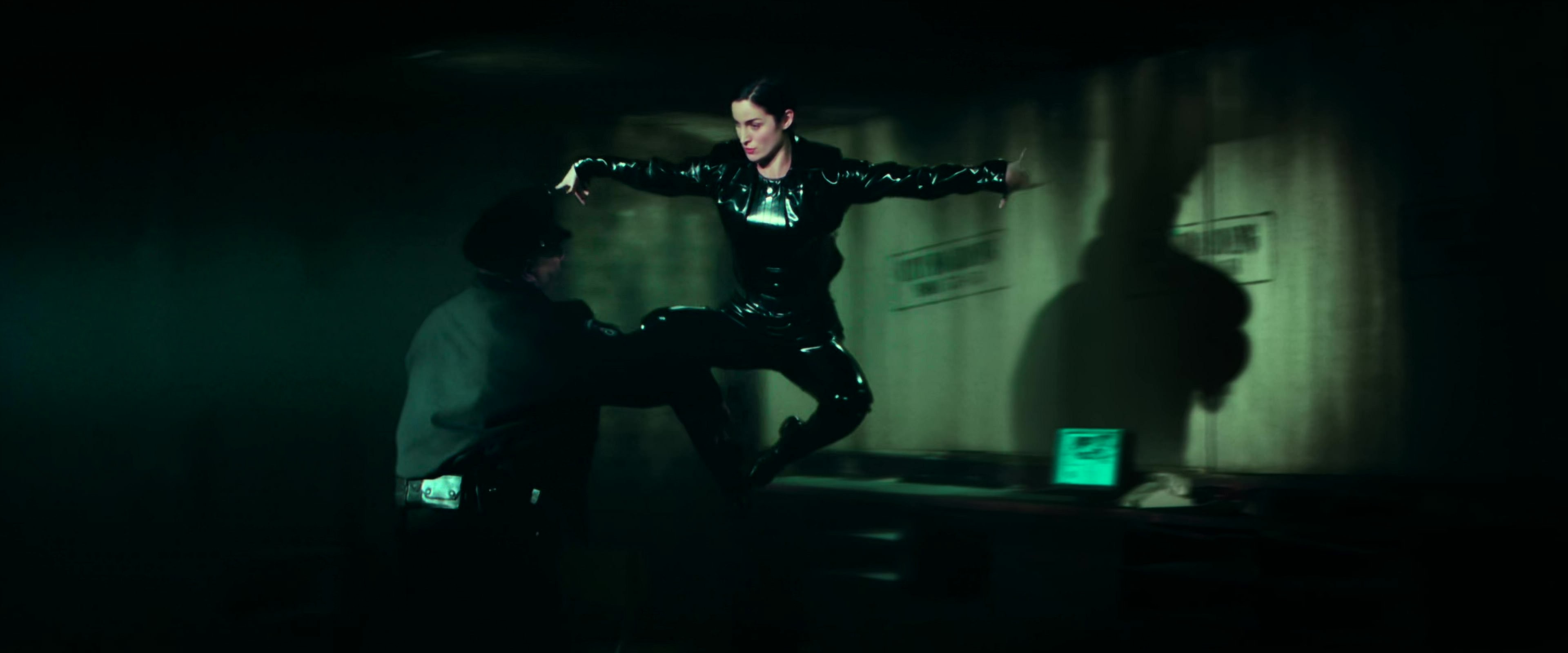
Chapter 07: Bullet Time
02 Trinity held in mid-air, arms spread, as her kick lands on the policeman, while the camera keeps moving around her: camera time and subject time pulled apart in the film’s first scene, the idea behind Bullet Time.
In the film’s first scene, Trinity leaps at a policeman and the film stops her in the air, arms spread wide, while the camera keeps travelling around her. Then she lands the kick at full speed. That split between camera time and subject time is the heart of the film’s most famous effect. Lana Wachowski’s brief was high-speed action in which the camera still seemed to move at normal speed. In preproduction they looked at a rocket camera, to be shot across the set at something like 100 miles an hour while filming at 150 frames a second.
John Gaeta, who later shared the Oscar for visual effects, came up with a different answer: put every camera in place before the action starts. He calls it a hack. As Pope tells it, Gaeta had noticed that a film camera is really taking one still photograph after another, so a line of still cameras could stand in for one moving camera.
The final rig had 120 still cameras, all shooting film, and two motion-picture cameras. In an early 27-camera test, the last camera was a live-action one, so the scene could ramp back to normal speed once the effect was done. Each move was planned first in Softimage 3D. Custom plug-ins laid the still cameras along the virtual camera path, and the data exported from that plan put the real cameras in place on set and set the order in which they fired. A laser-guided tracking system aimed every camera at the right interest point for that move. Kim Libreri, who supervised Bullet Time, says the closest the cameras could sit was about seven inches apart.
The clever part is the firing. If all 120 went off at once, you would have one frozen instant seen from 120 places. They fired in sequence instead, fractions of a second apart, so each frame is a little later in time as well as a little further along the path. Played back at 24 frames a second, that reads as extreme slow motion while the viewpoint keeps moving, which is exactly what the brief asked for.
The raw frames were rough. Pin registration holds each frame of film perfectly still in the gate while it is exposed, and these still cameras did not have it, so the frames shook and the colour drifted, and no two lenses were quite alike. The directors wanted moves that start gently and ease into a push, and 120 jittery photographs seven inches apart cannot do that on their own. The frames in between came from optical-flow interpolation, software that tracks how every part of the picture moves from one frame to the next and draws the frames that should sit in the gaps. Libreri sent frames over the internet to Bill Collis at Snell & Wilcox, who returned the interpolated images.
The backgrounds did not come from the array. The actors were shot on greenscreen inside it, and the world around them was rebuilt afterwards by image-based modelling and rendering, photogrammetry combined with projected photographs, a method George Borshukov suggested after working with Paul Debevec on The Campanile Movie at UC Berkeley. In the subway shot the actors are the only real elements, and the station behind them began as 12 photographs of the full-size set. Manex Visual Effects, which did the Bullet Time work, delivered about 100 complex shots over about two years, each taking about nine months from previs to final by Softimage Magazine’s account.
The rooftop dodge shows how physical the work still was. Glenn Boswell hauled a portable truss up a lift to a 35-storey rooftop and built a custom harness that supported Reeves’s head, to protect his recently operated neck, and the effect was finished in the array in the studio. In the first frame below, Reeves bends back almost flat, his coat hanging, while the bullets trail rings through the air.
Pope adds a detail I love. The rooftop dodge and the subway leap, where Neo and Agent Smith fly at each other with guns to each other’s heads in a nod to John Woo, use exactly the same camera path, because the production could only afford one rig.
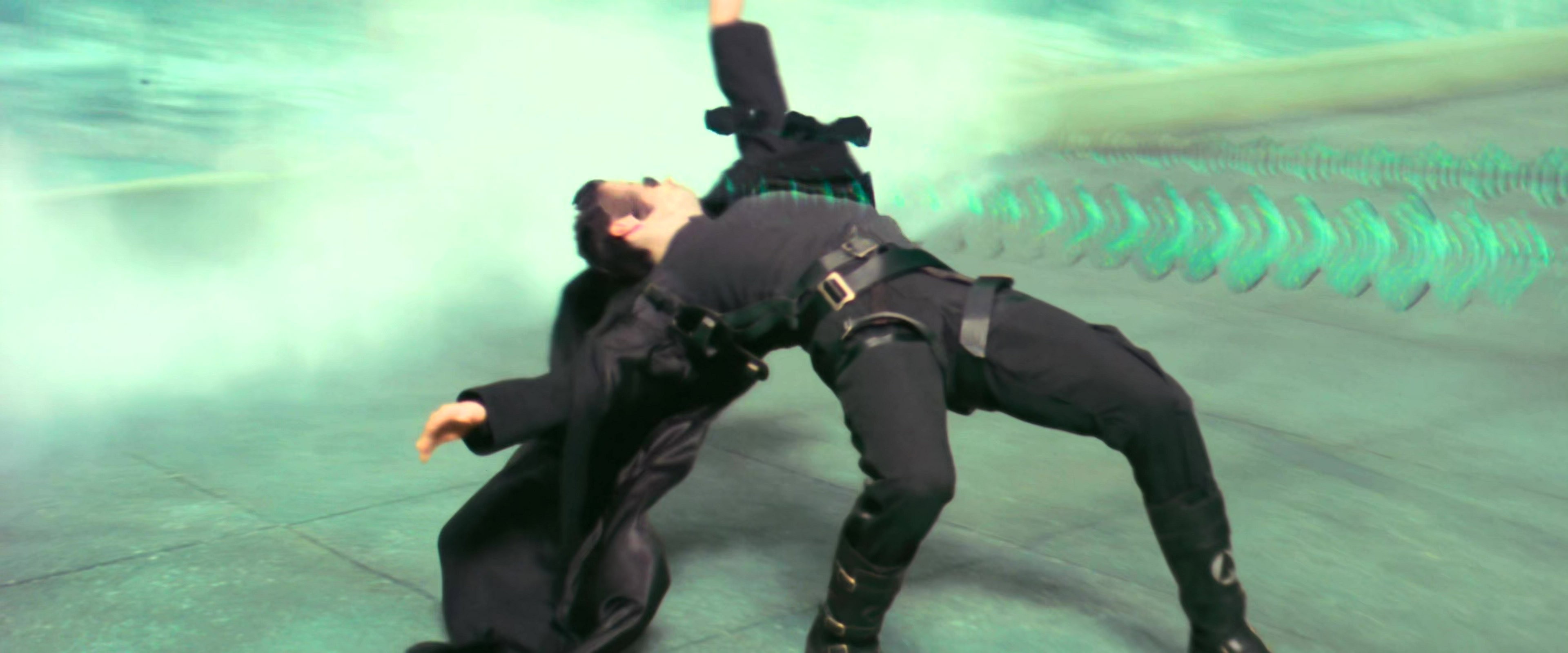
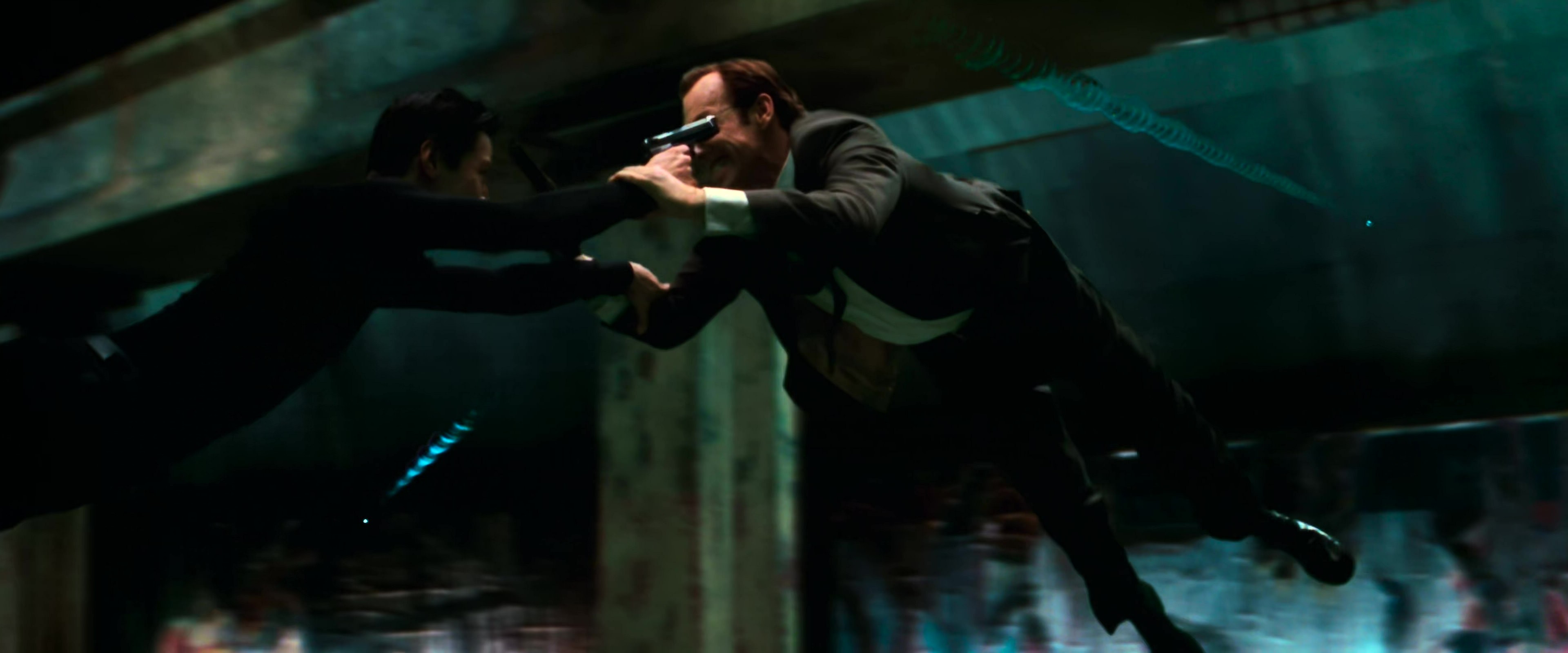
Two of the most famous shots in the film are one camera move made twice, and I find that more impressive than if they had built ten rigs.
Chapter 08: The Helicopter
The production filled virtually every stage in Sydney, including all of Fox’s new studio, finished just in time, and several converted warehouses. The city on screen is Sydney too, including the Hickson Road underpass in The Rocks, a Margaret Street tower that doubled for Neo’s office, Martin Place, and a Kent Street rooftop that stood in for the Bullet Time roof.
The first 40 days of the shoot were spent on downtown rooftops, where the weather changed too fast to light for. Pope worked mostly with negative fill there: black flags that take light away from one side of a face and let the daylight do the shaping.
For the helicopter rescue, the production brought the sky indoors. A full-size helicopter was hung about 20 feet above a stage floor, in front of a TransLight of Sydney 190 feet wide and 40 feet high. A TransLight is a giant photographic transparency lit from behind, and this one had its skies whitened like every other sky in the Matrix. The set and the backing had to reach T11 when needed, so the camera could run at 300 frames a second.
Two hundred 5K Skypans on dimmers lit the backing, 500 Par cans hung in the roof, and four Dinos burned through 12-by-12 frames of light gridcloth. To fake sunlight strobing through the rotor blades, two 70K Lightning Strikes units were run on a fader. Pope estimates that about 12,000 amps came into the building.
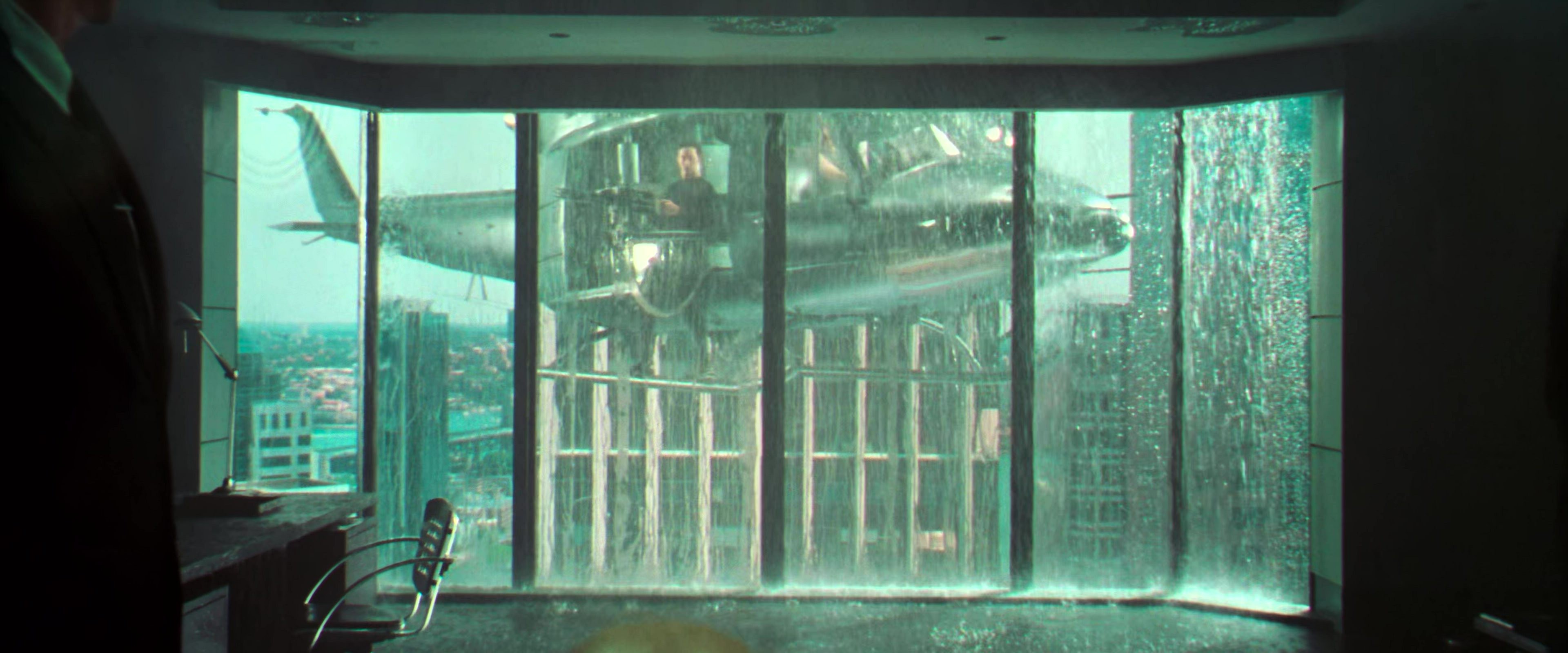
I think the rotor trick is the cleverest idea on that stage. A real rotor turning between the sun and the actors chops the light into pulses, so here the blades’ shadows were made with light, by moving a fader up and down. In the frame above, seen from inside the office, Neo works the minigun in the helicopter’s open door while the window glass pours down in front of him, with the city and a pale sky beyond.
For the flying shots there was a real helicopter as well. Bruce Hunt’s second unit flew one across central Sydney with a stuntman hanging beneath it on a wire, filmed from a second helicopter. The frozen moment in the middle of the rescue went the other way. It is almost entirely CG except Morpheus, who was shot in the Bullet Time array, and the water in it was a particle simulation rendered in mental ray.
Then the helicopter goes into a glass tower, and the whole facade ripples out from the impact like water. The crash is a miniature: a model helicopter swung on an arm into a quarter-scale greenscreen facade of squibbed glass, which the effects crew shattered in an expanding ring. It was shot in a greenscreen valley at the Londonderry WorkSafe test range, in a 20-minute window of sun, and Dfilm composited it, adding some CG. In the frame below, the helicopter has just met the curved glass, and the skyline reflected in it is starting to warp.
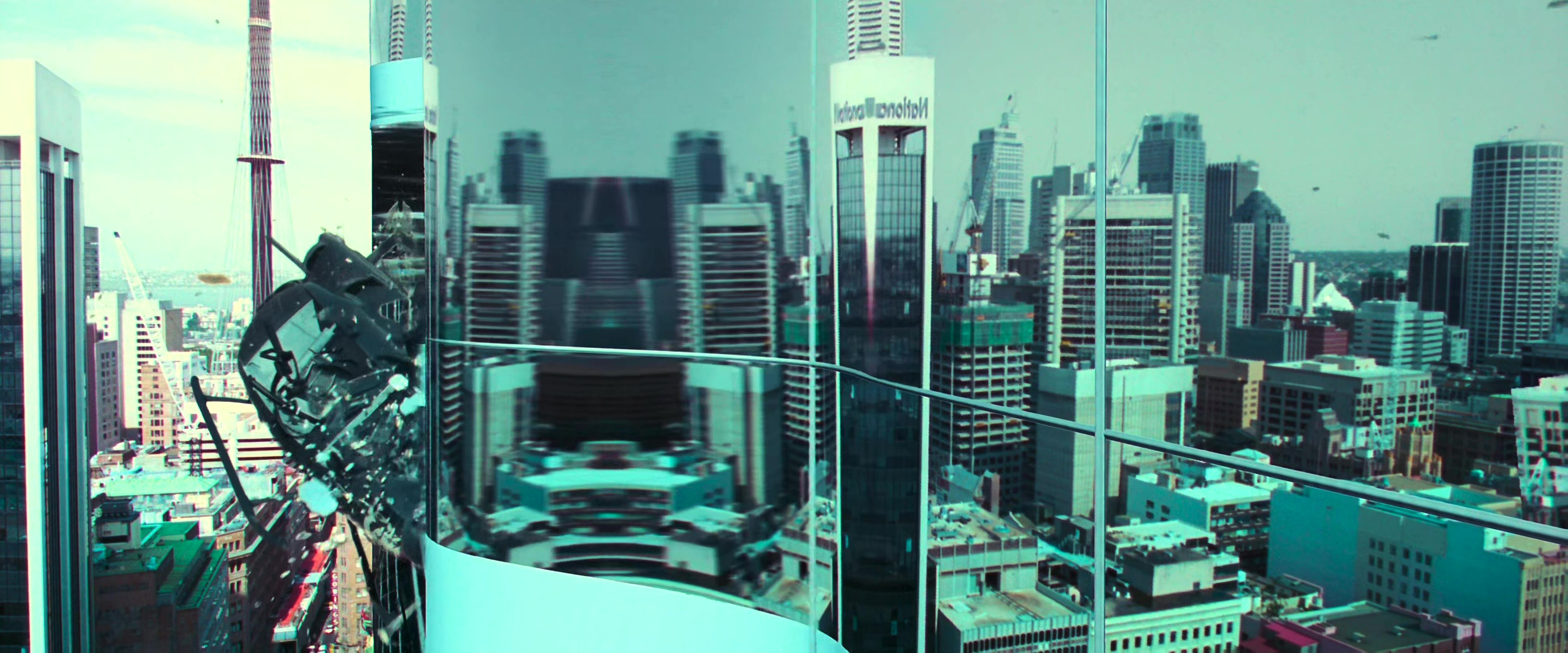
I like that the most dreamlike image in the sequence has a real model, and a real 20 minutes of sun, underneath it.
Chapter 09: The Code
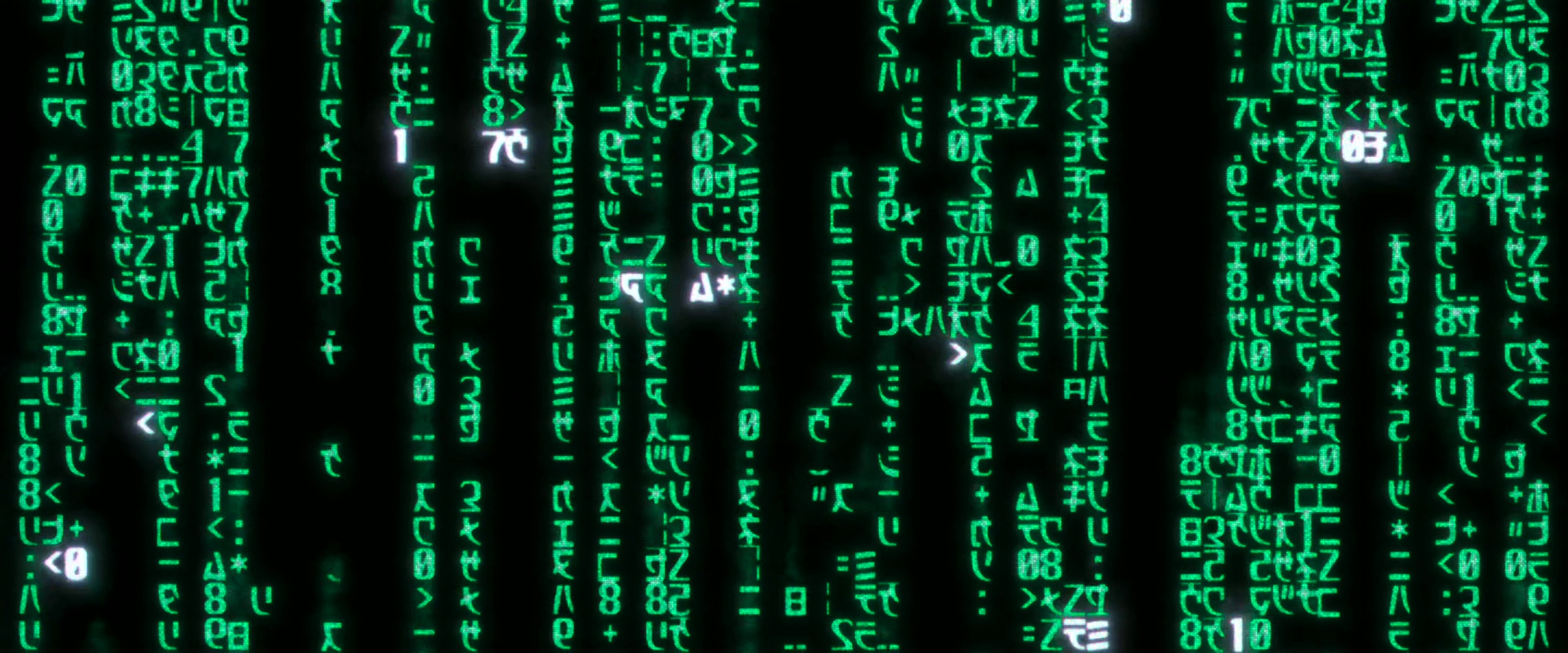
01 The opening titles: mirrored katakana, numerals and a few symbols falling in columns down a black screen, with white-hot characters among the green. Simon Whiteley designed the code at Animal Logic and matched its green to an old IBM green-phosphor screen.
The code was designed by Simon Whiteley at Animal Logic in Sydney, and Justen Marshall did the technical work behind it. Whiteley drew the characters from his Japanese wife’s cookbooks and the alphabet books his children used at Japanese school. He chose katakana, one of the two Japanese syllabaries, for its clean, simple strokes, and mixed in numerals and a few symbols. Then he turned every character back to front, so the code reads as if you were looking at it from inside the screen. Whiteley’s line, in a 2017 CNET interview, that the code is made of sushi recipes was a joke.
The green was matched to the text on an old IBM green-phosphor monitor, the same kind of screen behind Pope’s cursor-coloured tint. The first design was three-dimensional type that tumbled as it clicked over. It became vertical when Whiteley noticed that the cookbooks ran from top to bottom, and Lynne Cartwright recalls that the Wachowskis wanted it to feel like rain falling down a window.
It was animated in Softimage and rendered in mental ray with a custom shader, and it has small faults built in on purpose. Some characters hold in place for a glitch while the ones around them change, and some cells carry two characters at once, at different brightness.
For most of the film the code is a flat plane in front of the camera, as it is in the titles. The last idea is to give it depth. When Neo finally looks down the corridor and sees the world as it really is, the code is mapped onto the floor, the walls, the ceiling and CG Agents, so the corridor is built of falling characters and the Agents are denser, brighter columns of the same stuff.
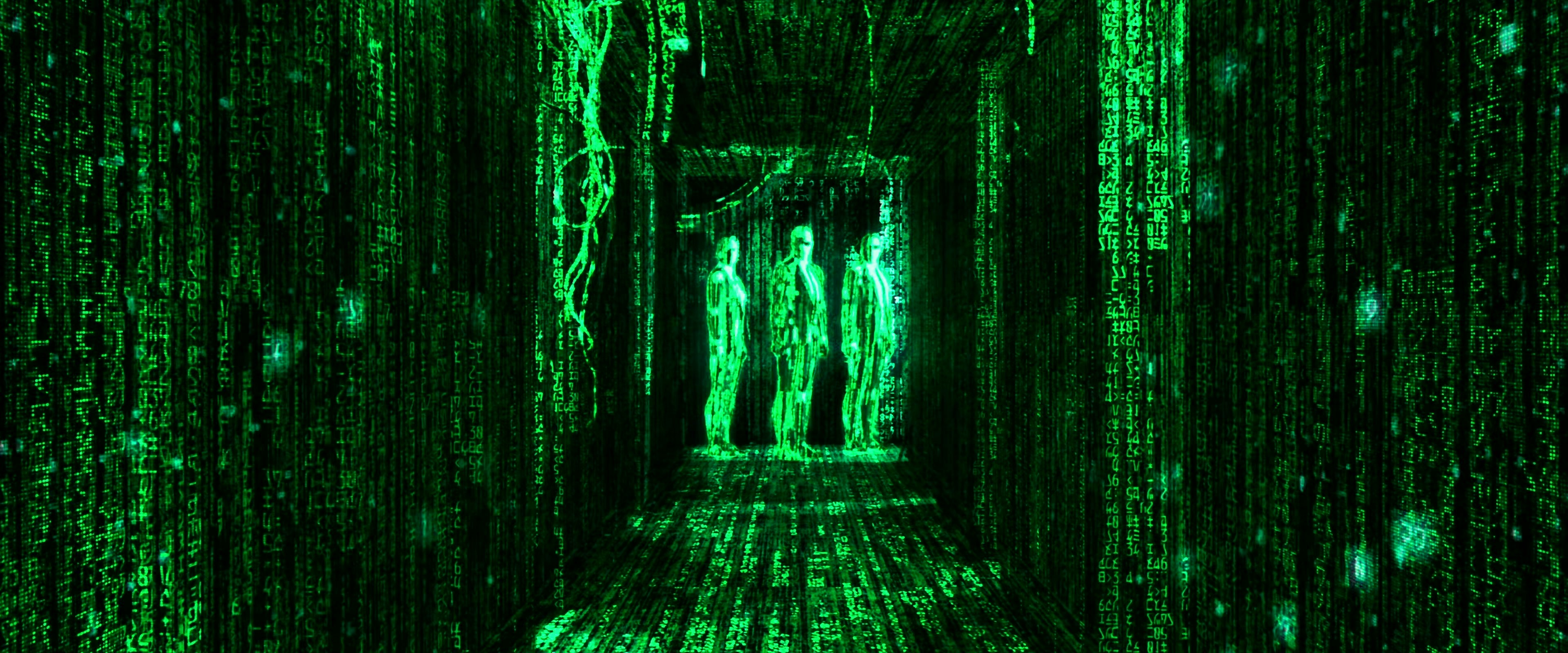
It is the right last image for this photography. For two hours Pope has tinted the Matrix with the colour of a cursor, and here the film shows you where the tint was coming from.
Pope was nominated for the BAFTA for cinematography, which Conrad L. Hall won for American Beauty. The film won four Oscars, visual effects among them, and was not nominated for its cinematography.
Bullet Time takes most of the credit, and it deserves a lot of it. What holds the film together for me, though, is the grade. Twenty-seven years on, I can tell which world a scene is in from a single frame, before anyone speaks, because Pope picked a green designed to feel wrong and took the sun out of everything else. Every effect in the film happens inside one of those two lights, and that is why I believe it.
The Shot List