Top Gun: Maverick
Joseph Kosinski, 2022
How Claudio Miranda photographed Joseph Kosinski’s sequel from inside real Super Hornets, with six Sony Venice cameras in each cockpit, the sun as the only light and the actors switching the cameras on themselves.
Top Gun: Maverick was photographed from inside the jets. The actors rode in the back seats of two-seat Navy F/A-18F Super Hornets, Navy pilots flew them, and six cameras were bolted into each cockpit around them. With a pilot in front and an actor behind, there was no seat left for a camera operator, and nobody on the ground could see what the cameras were recording until the jet landed. Joseph Kosinski explained why he wanted it that way in two short sentences: “You can’t fake the G-forces. You can’t fake the vibration.”
The man who had to make that work was Claudio Miranda, who had already shot three films for Kosinski. He had to light faces he would not be there to see, and set every exposure before the jet took off. Most of what I love about the film comes out of those two problems and the ways his crews solved them.
This essay is about that photography. I have left the story alone apart from the little each shot needs, and organised what follows by craft, starting with Miranda and the film he was answering.
Claudio Miranda
- Frame 01 1.90:1
- Opening montage
- Backlit deck
- After the 1986 opening
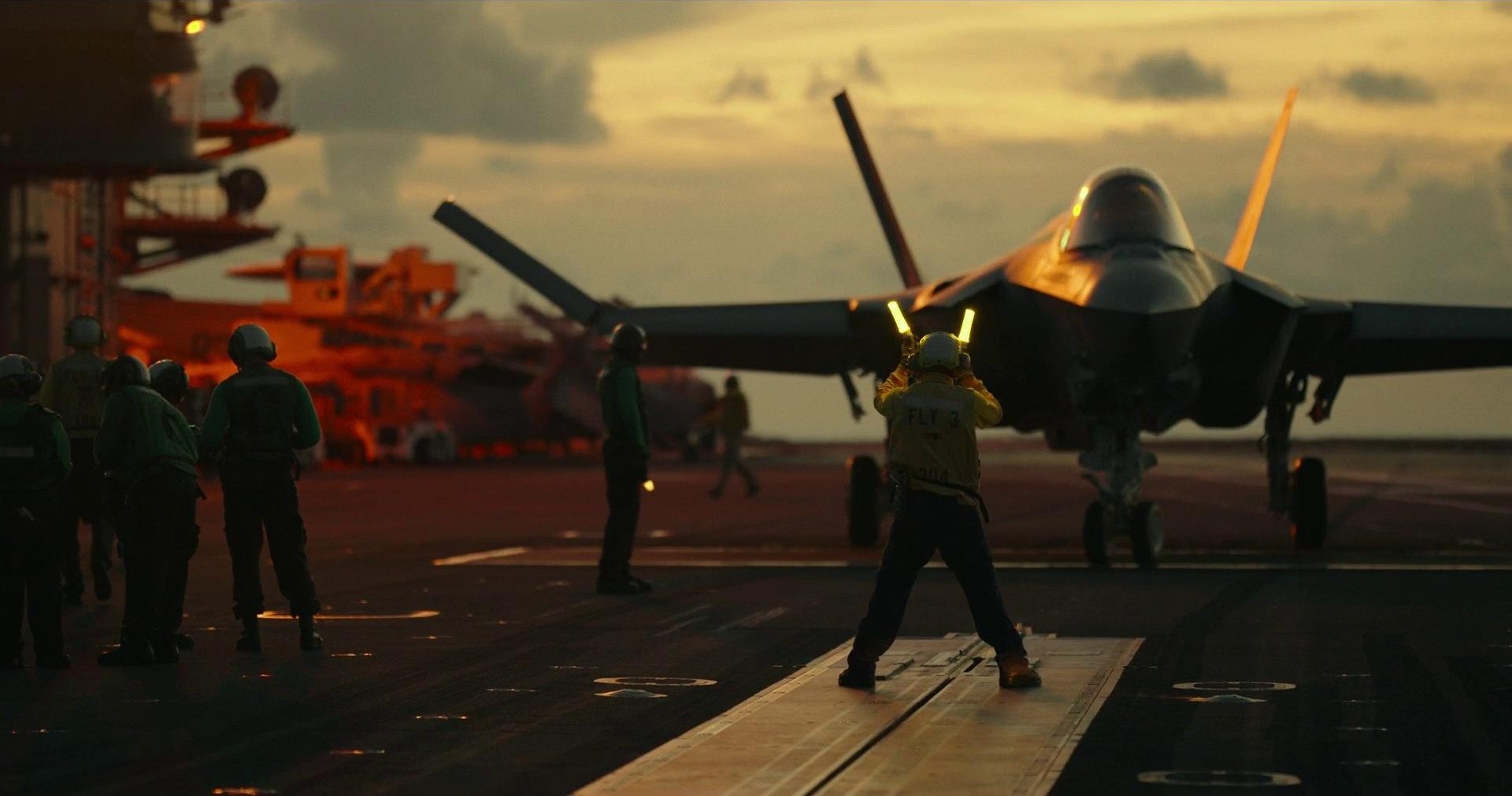
The film opens on a carrier deck. A plane director in a yellow jersey holds up lit wands in front of an F-35C while deck crew stand in near silhouette against an orange sky, and the montage that follows tracks the opening of Tony Scott’s Top Gun from 1986 almost shot for shot. The editor, Eddie Hamilton, says that was Tom Cruise’s idea. It tells you straight away that this film is going to keep looking back at the first one.
Miranda knew Scott’s sets from the lighting side. Before he shot features he was a gaffer, the head of the lighting crew, on Scott’s Crimson Tide, The Fan and Enemy of the State, and on David Fincher’s The Game and Fight Club. He went on to win the Academy Award for cinematography for Ang Lee’s Life of Pi, at the ceremony in February 2013. With Kosinski he had shot Tron: Legacy, Oblivion and Only the Brave; Spiderhead and F1 came after this one.
He set out to echo the photography of the 1986 film, and he briefly consulted Jeffrey L. Kimball, who shot it. Miranda had assumed the original was anamorphic, and Kimball told him it was not. Maverick is spherical too, every frame of it. Anamorphic lenses were ruled out in any case: they were too heavy to carry under G, and they could not focus close enough for a cockpit.
The debt to Scott shows most in the warmth. Miranda used warm graduated filters, and in some scenes longer lenses, as a homage to him, and he calls the result warmer than his other films with Kosinski. Digital grain was added in the final grade.American Cinematographer names the colourist as Stefan Sonnenfeld of Company 3. The added grain is also reported by the Los Angeles Times. The sky in the frame above is the kind of sky the whole film keeps returning to, low and orange, with the deck crew in front of it close to silhouette.
What interests me most is what he chose to leave in. In some cockpit shots you can see a camera, its battery or a faint reflection, and Miranda kept them on purpose, because taking them out would have made the film, in his words, “more synthetic”. He has argued that real capture has an energy that clean computer graphics lack, with long lenses that slightly lose the framing and a camera that shakes. Done in CG, he said, the flying would have felt “floaty and perfect”. I agree with him, and most of what follows is an account of how much work it took to keep the film imperfect.
The Carrier Deck
- Frame 02 1.90:1
- Flight deck
- Launch signal
- Daylight
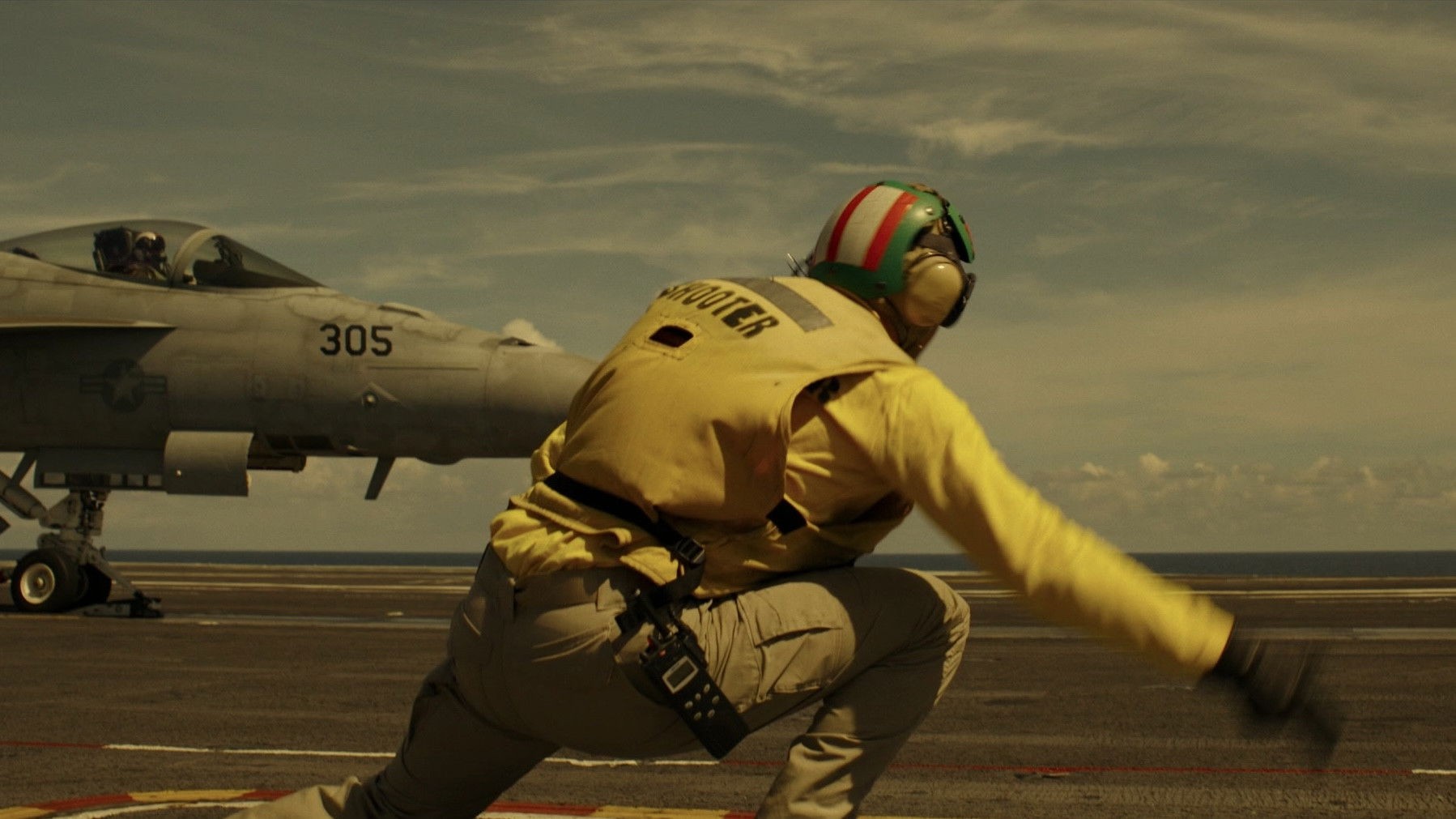
The shooter, the officer who signals a catapult launch, lunges low beside Super Hornet 305 as it waits on the catapult, with the open sea behind. It is plainly daytime, under high cloud. The deck footage was shot on working carriers, two of them: the USS Abraham Lincoln and the USS Theodore Roosevelt. Hamilton says the deck montage was the first footage shot, in the summer of 2018, and that there was a second carrier shoot in April 2019.The sources disagree about which carrier hosted the 2018 shoot for the opening, so I have left it unnamed. He cut the montage from somewhere between 15 and 18 hours of deck footage; the figure changes from one interview to the next.
On a ship, the light is set by steering. Miranda had the carrier turned to put the sun where he wanted it: heading due east at four in the afternoon, for example, and then round through 180 degrees for the reverse angles. In the afternoon the sun is in the western sky, so a ship steaming east carries it astern, and a camera looking aft along the deck looks into it. Turn the ship around and the same backlight is waiting on the other side. It is the most expensive way to move a light I have ever heard of.
I had always assumed the opening was shot at magic hour. Hamilton told Art of the Cut that quite a lot of the deck footage was not, because crews do little at sunset, when visibility is bad for the pilots. That changes how I watch the montage. The warm, backlit look owes a good deal to the ship’s heading, Miranda’s filters and the grade, and the frame at the top of this section is warm in plain daylight.
The deck is also where Cruise’s own launch was filmed. According to the Los Angeles Times, his catapult shot was made on the Theodore Roosevelt, and Miranda has pointed to “another little drop” as the jet leaves the deck, the sink before it starts to climb. It is a tiny thing, a moment of a heavy aircraft settling before it flies, and it is exactly the kind of detail nobody would think to animate.
Format
- Frame 14 2.39:1
- Third act
- Vapour cones
- Valley partly real
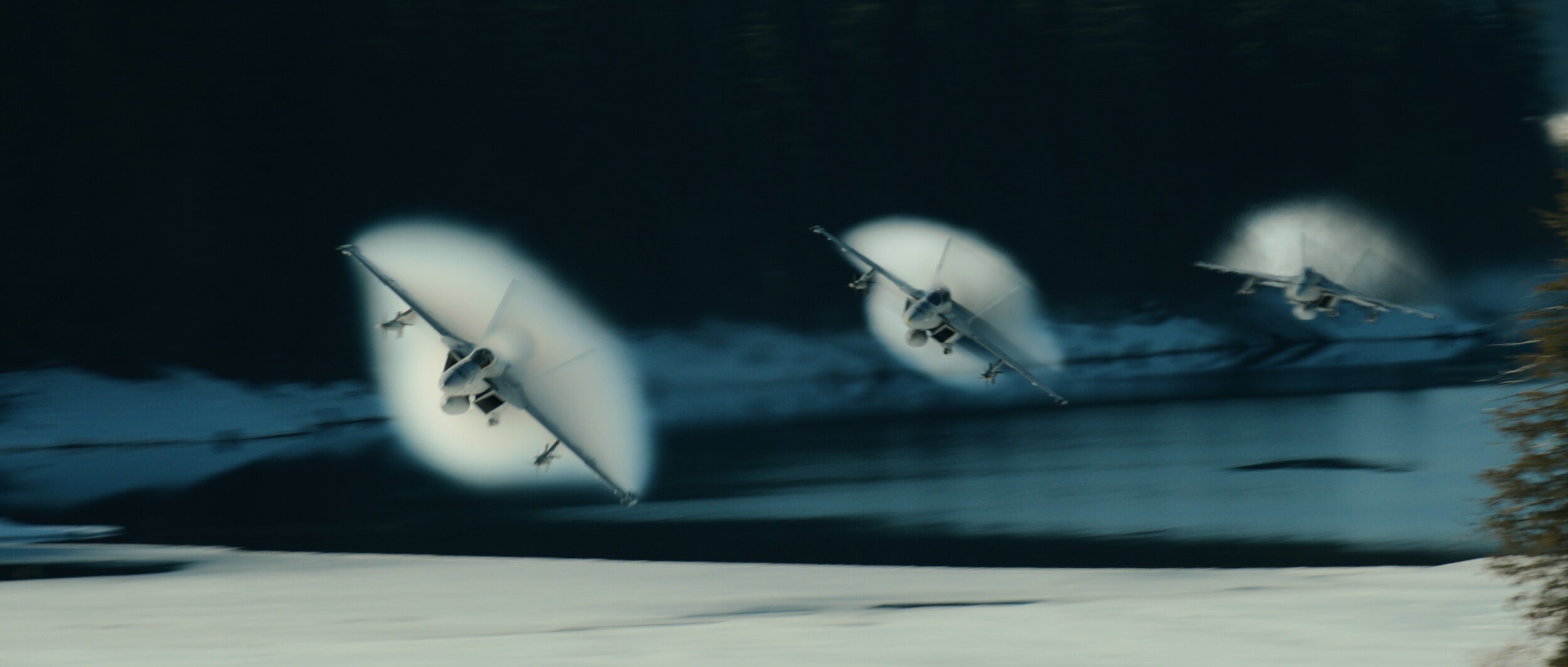
Three Super Hornets bank hard and low over a snow-covered valley floor, each wrapped in a vapour cone, with the dark forest behind them smeared into streaks. The valley the jets fly through in the third act is partly real and partly a digital extension. For the snowy terrain the production scouted the Cascade Range in Washington, working out of NAS Whidbey Island. The frame above is in the film’s wider shape, with the jets and the valley floor packed into a thin band. The taller shape is the subject of this section.
The film was shot on Sony Venice cameras, generally in 6K full frame, with Super 35 lenses run at 4K. It was released as a “Filmed for IMAX” title, shot on IMAX-certified Venice cameras, and Miranda framed it for two shapes at once: 2.39:1 for ordinary screens and 1.90:1 for IMAX. In IMAX screenings the picture opened up to the taller frame, with up to 26 per cent more image. According to IMAX, nearly an hour of the IMAX version runs at 1.90:1, including all of the flying.
Here is the difference on a single frame.
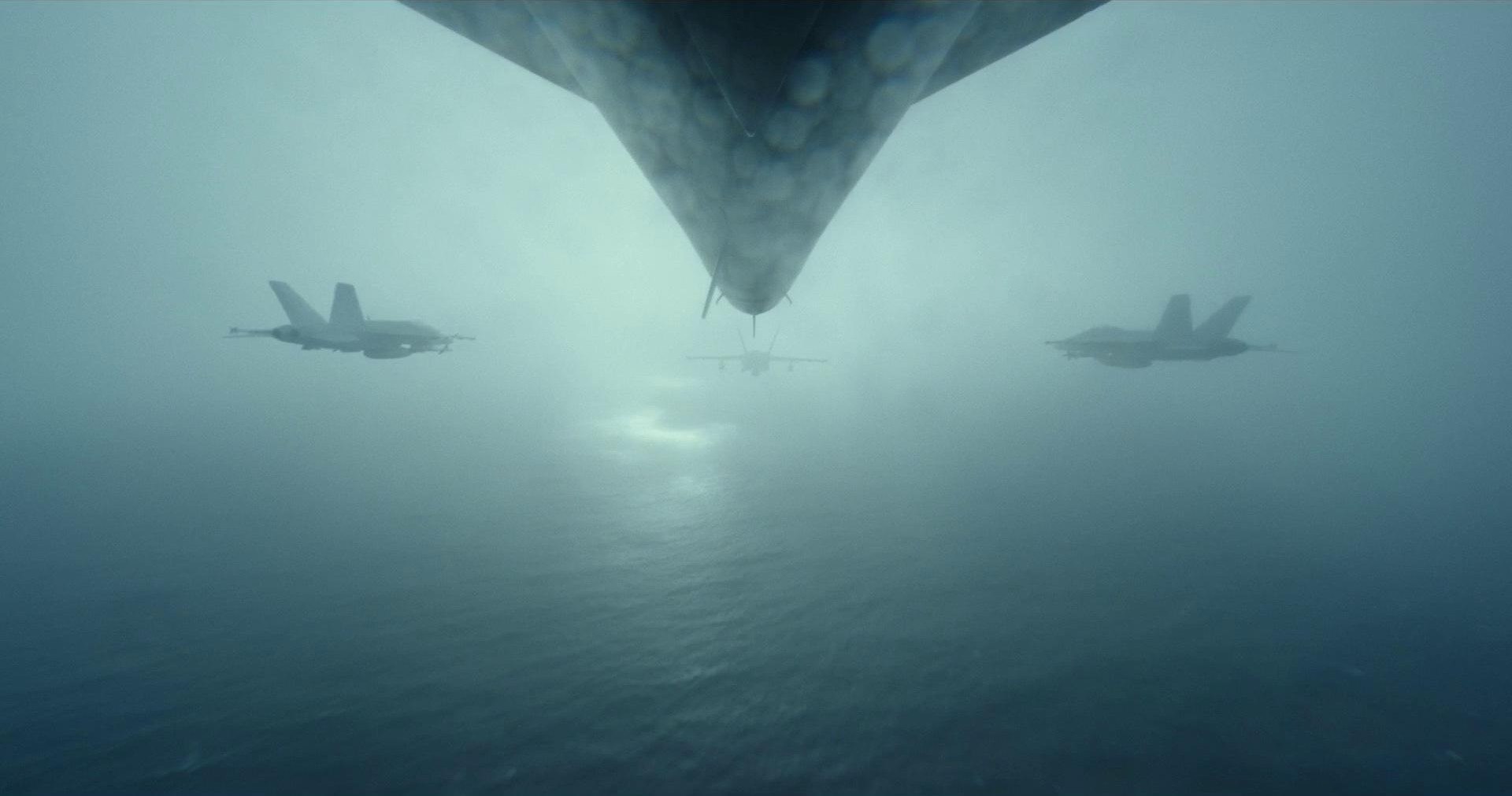
2.39:1Masked to 2.39:1, centredFull 1.90:1 frame: about 26 per cent taller at the same width
The arithmetic is simple. At the same width, a 1.90:1 frame is 2.39 divided by 1.90 times as tall as a 2.39:1 frame. That comes to about 1.26, which is where the 26 per cent comes from. The width stays where it is and the extra picture arrives at the top and the bottom. In the frame above, the taller shape gives more of the fogbound sea below the three jets and more of the nose overhead, and in a film about where the horizon is, that space matters. The flying works in both versions, but I find it easier to breathe in the taller one.
The production also shot a great deal. Principal photography produced 813 hours and 51 minutes of footage.Kosinski told Empire it was about 800 hours, as much as all three Lord of the Rings films combined. Hamilton watched dailies with Kosinski every day. Footage from the jets was checked as soon as the pilots landed, and shots that did not work were flown again.
Cameras in the Cockpit
- Frame 08 1.90:1
- Cockpit camera
- Facing forward
- No operator
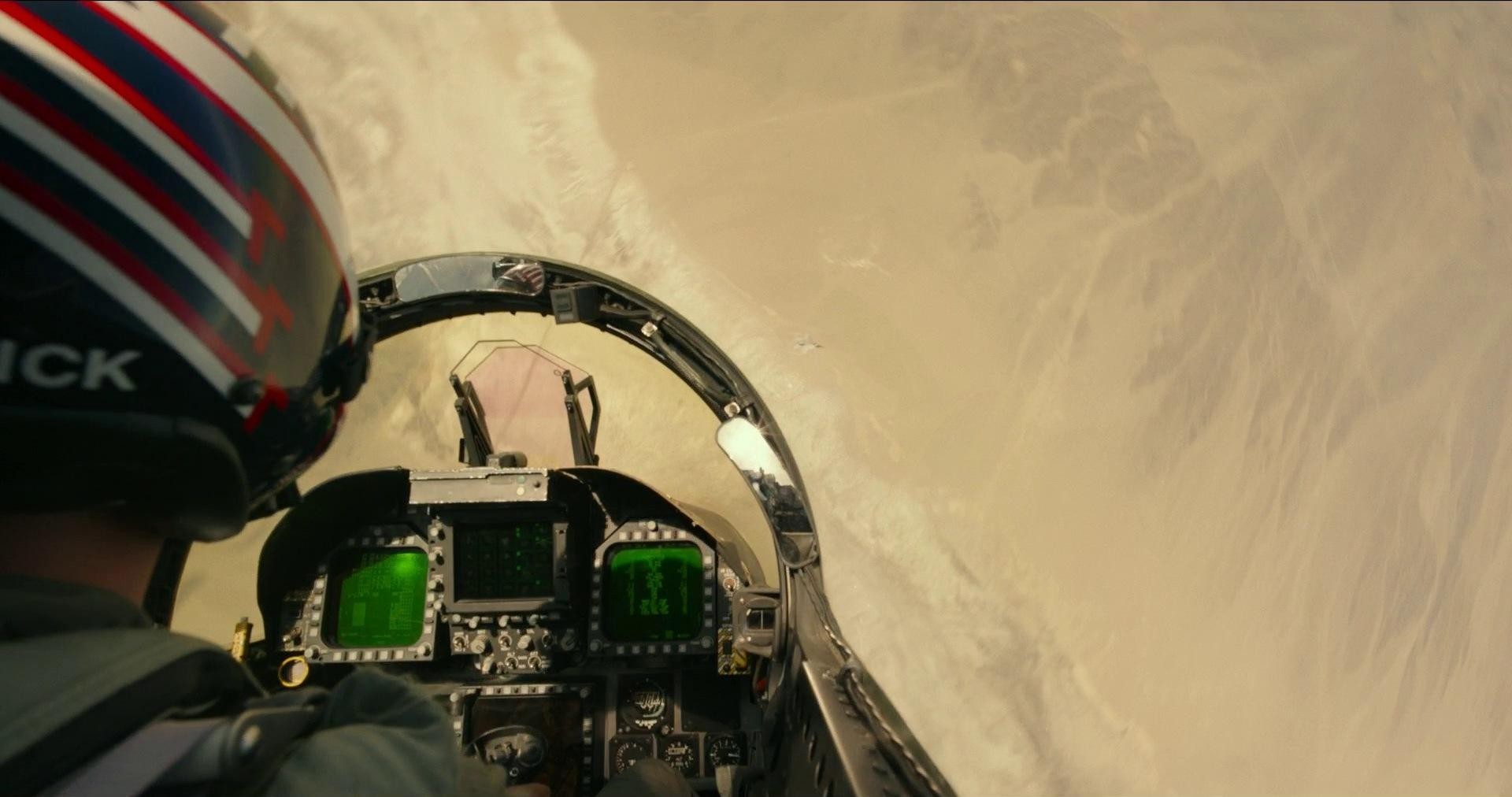
The view above looks forward from inside a Super Hornet, past a helmet at the left edge of the frame and over the instrument panel, with the jet banked so steeply that the desert fills the canopy. Nobody was holding the camera that took it, and nobody saw the shot until the jet was back on the ground.
The cockpit shots depend on one piece of equipment. The Venice Extension System, known as the Rialto, separates the Venice’s sensor block, with the lens on it, from the body of the camera, and joins the two with a cable. The body can go wherever there is room, and only the small head has to go where the picture is. Sony announced the system in June 2018, alongside James Cameron’s plans to use it on the Avatar sequels, so it was not built for this film. Miranda says his team went to Japan to advise Sony on its design and engineering, and the Rialtos used on Maverick were prototypes.
Each cockpit carried six cameras: three standard Venice bodies and three Rialto heads. Four faced back at the actor and two faced forward. In American Cinematographer’s description, the rear-facing Venice bodies sat on the glare shield above the instrument panel, one Rialto pointed back at the rear seat, and the other two looked forward over the pilot’s left and right shoulders, with their sensor blocks inside the canopy and their bodies stowed behind the rear seat.Film Independent describes four rear-facing Venice cameras over the glare shield, a small difference. Every source agrees on six cameras, four facing the actor and two facing forward.
V1Venice body on the glare shield, facing back at the actor
Captured The actor, face on, with the canopy and sky behind
Position Zone documented (glare shield above the instrument panel, in front of the actor). Spot along the glare shield illustrative.
- V1 Venice body on the glare shield, facing back at the actor. Captured: The actor, face on, with the canopy and sky behind. Zone documented (glare shield above the instrument panel, in front of the actor). Spot along the glare shield illustrative.
- V2 Venice body on the glare shield, facing back at the actor. Captured: The actor, face on, from a second angle. Zone documented; spot illustrative.
- V3 Venice body on the glare shield, facing back at the actor. Captured: The actor, face on, from a third angle. Zone documented; spot illustrative.
- R1 Rialto head pointed back at the rear seat. Captured: The actor in the rear seat. Only its direction is documented. Its place in the drawing is illustrative.
- R2 Rialto head looking forward over the pilot’s left shoulder. Captured: The view forward through the canopy to the horizon. Sensor block inside the canopy, left of the centreline; body behind the rear seat on its cable. Exact mount not documented. The sources say the pilot’s shoulders without naming the seat. Its place in the drawing is illustrative.
- R3 Rialto head looking forward over the pilot’s right shoulder. Captured: The view forward through the canopy to the horizon. Sensor block inside the canopy, right of the centreline; body behind the rear seat on its cable. Exact mount not documented. The sources say the pilot’s shoulders without naming the seat. Its place in the drawing is illustrative.
- Bodies Rialto bodies, stowed behind the rear seat. Documented for the two forward-facing heads. Where R1’s body sat is not documented.
Getting them in was a campaign of its own. The Navy first said six cameras would not fit. The production found older F/A-18Fs without the modern heads-up display, and took out video recorders and other hardware to make room. The cameras ran on their own batteries instead of the aircraft’s power, and they were bolted down. They also had to stay clear of the ejection path, so no lens could stick out past the glare shield.
The lenses had to be small. Miranda used manual still-photography lenses on the Venice’s native E-mount: Voigtländer Heliars at 10, 12 and 15mm, and Zeiss Loxias at 21, 25, 35 and 50mm. There were no matte boxes or front filters; the Venice’s built-in ND filters did that job. Weight mattered at every step. Under 5 to 7 G, Miranda says, 10 pounds becomes 50 to 70 pounds, and even bolted down, one camera failed from vibration during the shoot.Film and Digital Times reports that the cockpit cameras recorded XAVC 4K full frame to SxS cards because Raw recorders would not fit, and that Miranda framed them for 16:9 and cropped in post, since a fixed camera could not be adjusted and the jet was sometimes upside down.
Then somebody had to run them, and it was the actors. They switched the cameras on and off themselves in flight, and Keslow Camera built a single button that started all of them at once. Kosinski could not see any of it live, because there was no feed, so he could not direct a take from the ground. The cockpit scenes were worked out in rehearsal and then left to the people in the jet.
The first week’s footage taught everyone something. The cockpit shots looked too level, so Hamilton asked the pilots to keep the horizon moving and the actors to exaggerate their head movements. The reason is in the mounting. A camera bolted to the airframe moves with the jet, so inside the frame the cockpit stays put, and only the world outside the canopy can show you that the aircraft is turning. If the horizon sits still, so does the shot. That is why so many of the forward views have a horizon that will not settle, and in the frame at the top of this section the bank is steep enough to lose it altogether.
Light
- Frame 07 2.39:1
- Cockpit camera
- Facing the actor
- Sunlight only
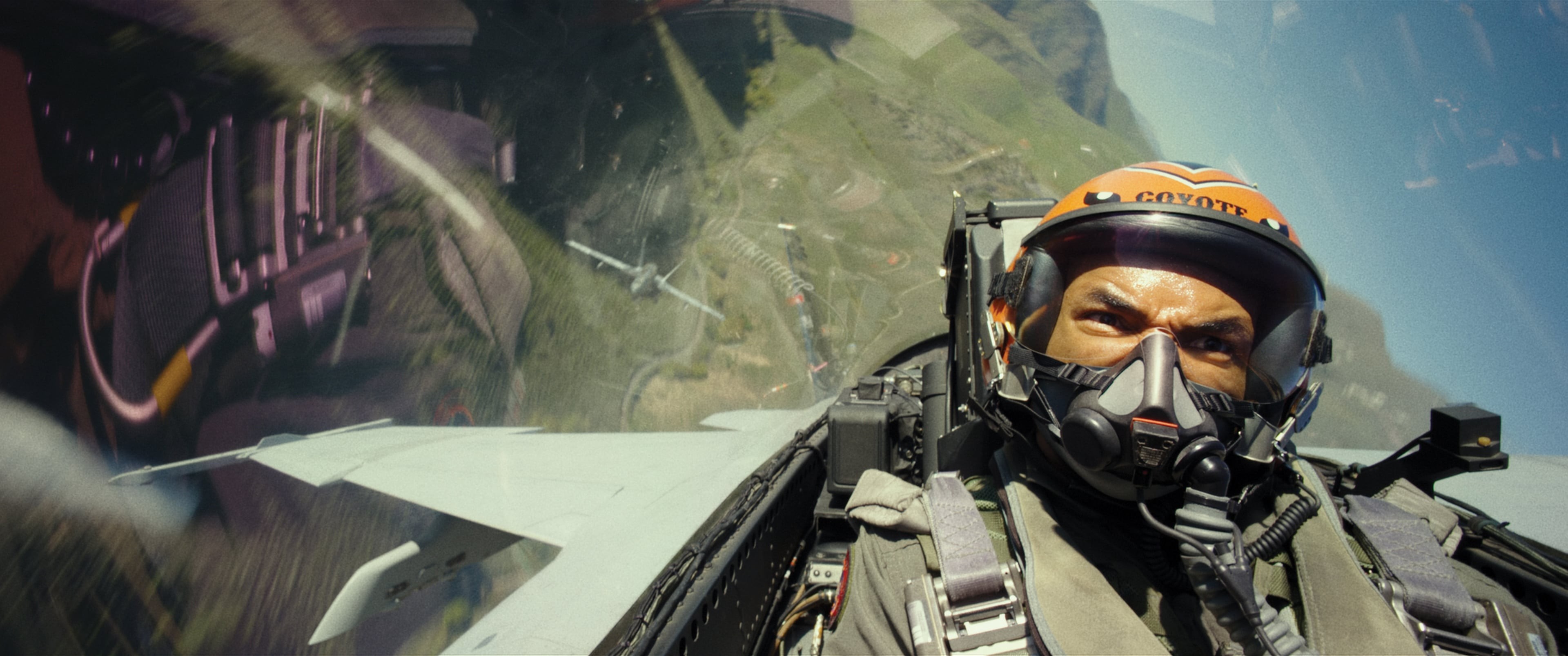
The face above belongs to Greg Tarzan Davis, as Coyote, straining under load in the middle of a hard turn, mask on, with the ground tilted steeply through the canopy beside him. The only light on him is the sun.
That was the rule in the air: the cockpit was lit by daylight alone. Miranda wanted the actors backlit, with the sun three-quarters behind them, and the pilots oriented the jets to keep it over the actor’s shoulder. If they flew into it, the sun burned hot spots onto the faces. With the sun behind, the face sits in its own shade, and the brightest light lands on the helmet and the edge of the cheek, away from the eyes. So each pilot was holding a lighting angle as well as flying the manoeuvre, which must be one of the stranger jobs a Navy aviator has been given.
Exposure had to be decided in advance. With no feed and no auto-exposure, Miranda worked out ahead of each flight where the jets would go, using Google Earth, and set the cameras by hand before take-off. He told Film and Digital Times that he got the exposure right 99 per cent of the time. I find that number almost harder to believe than the flying. He was exposing for a face he could not watch, in light that would shift every time the jet turned.
The preparation started on the ground. Rehearsals took place in a cockpit mock-up, where Miranda told the actors where the light should be and put a small lamp in the mock-up to remind them. In the air, according to the Los Angeles Times, the actors also looked after their own marks, light checks, makeup and eyelines. On a normal set each of those is somebody’s whole job.
Low flying needed its own plans. For the canyon runs Miranda scouted each canyon and prepared two lighting plans, one for the morning and one for sunset, depending on how deep the jet would fly. Deep in a canyon, the walls decide when the sun reaches you.
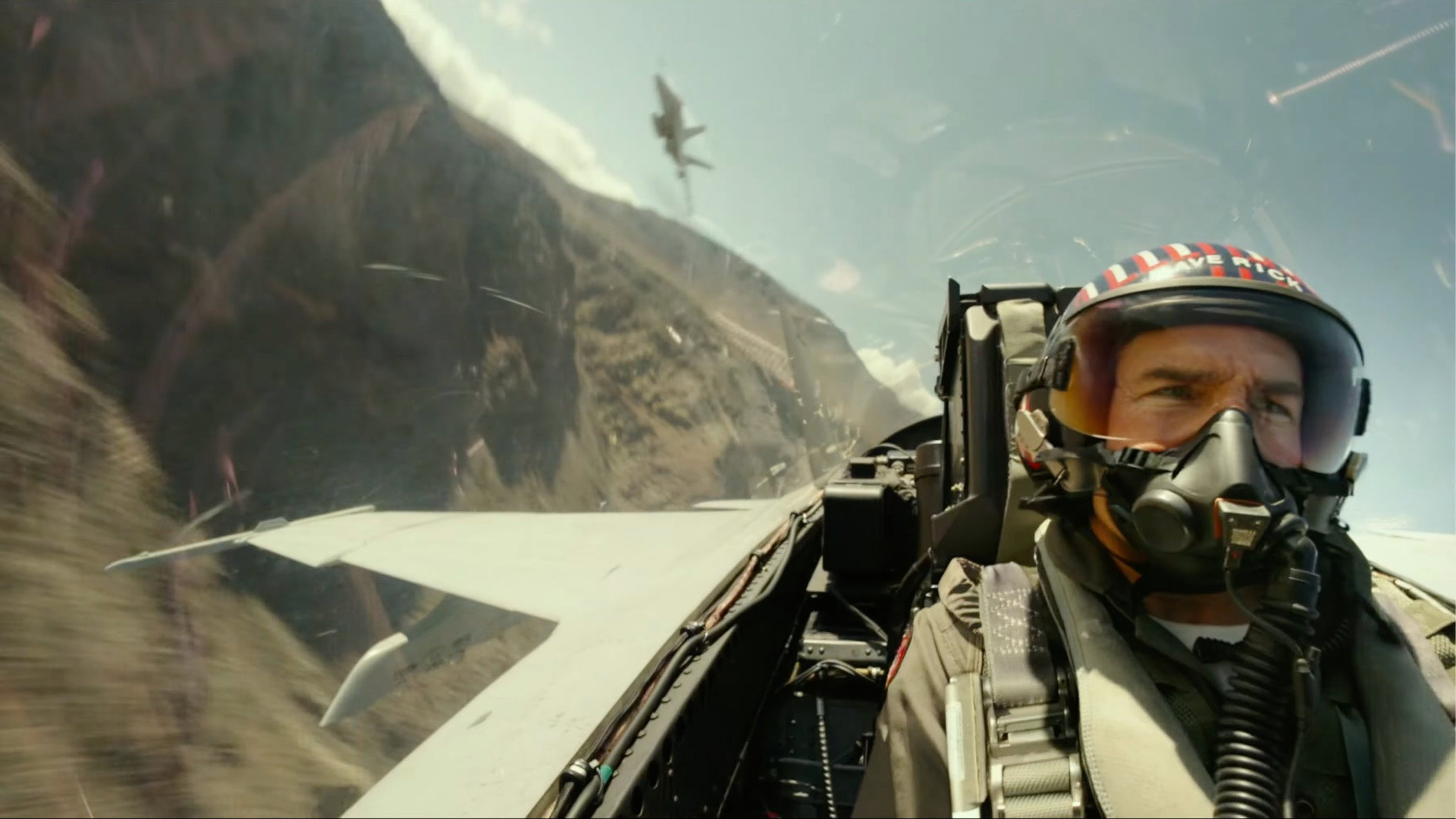
In the frame above, Maverick banks past a rock wall that fills the left of the frame, close enough to blur, with another Super Hornet ahead and above him. According to a profile of the pilot Frank Weisser, one of the canyon scenes was filmed in Nevada’s Toiyabe Range, with the jets flying from NAS Fallon.
G-Force
- Frame 11 2.39:1
- Cockpit camera
- Inverted
- Weisser flying
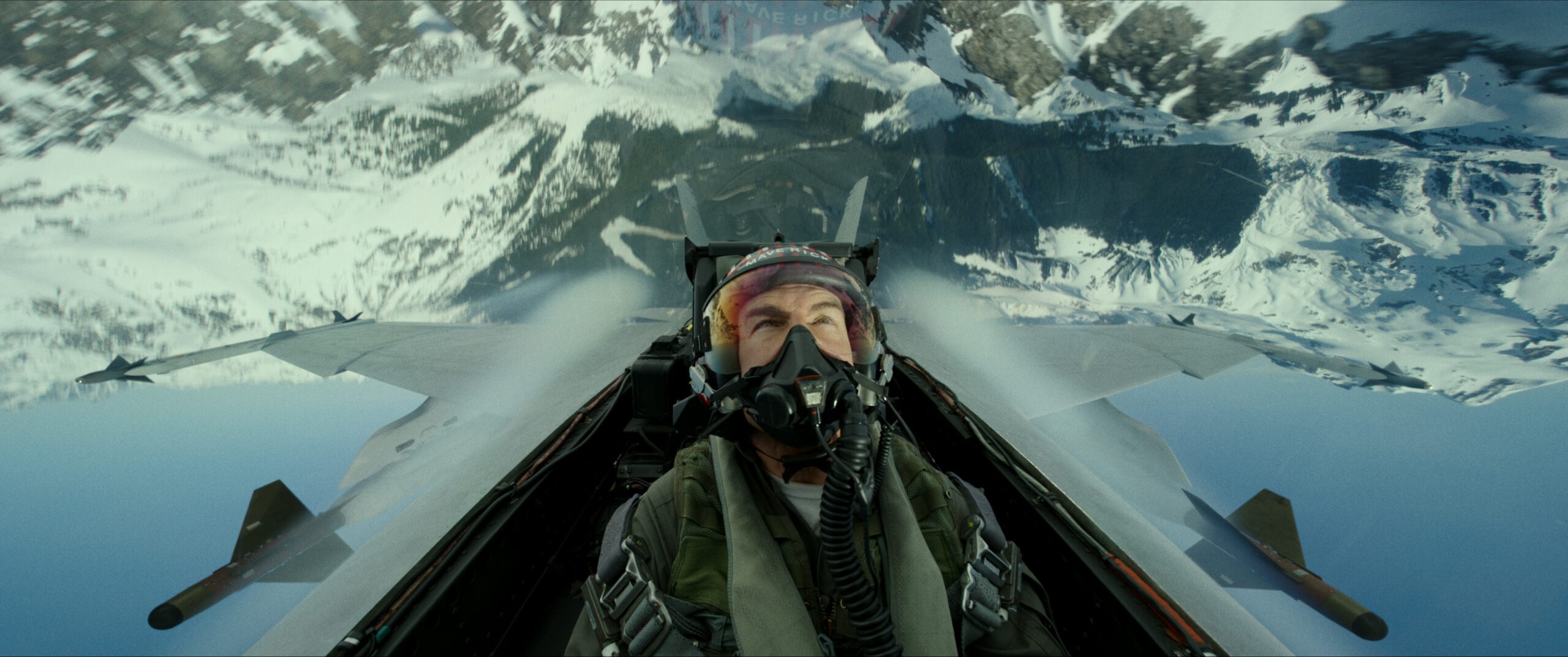
In the frame above Maverick is upside down, snow-covered mountains over his head and the sky below, and the camera facing him is recording an actor who is not flying the jet. In Maverick’s F/A-18 the front seat belonged to Frank Weisser, a Navy commander who served two stints as a Blue Angels pilot. A Pentagon rule bars civilians from controlling Defense Department aircraft, so Cruise did not fly the Super Hornet.
Getting the cast ready to ride took about three months. Cruise designed the course himself, and Kosinski describes it as starting in simple propeller planes. It built up in stages: a Cessna 172, then an Extra 300 aerobatic plane to build tolerance to G, then the L-39 jet trainer, and finally the F/A-18. Miranda went up as well. Before the shoot he flew in an L-39 to 4 G himself, and tested cameras and lenses on it as a proof of concept for the Navy.
In the Super Hornet the actors pulled about 7.5 to 8 G, which Cruise has put at 1,600 pounds of force. On camera that load does something no actor can do on purpose. It pulls the face down and out of shape, and Cruise and Greg Tarzan Davis have each said that you could not act it. The face at the top of the previous section is Davis’s, and it shows what they mean.
It also made people ill. Many of the actors got sick, and Kosinski says the cameras in front of them made it worse, because they blocked the actors’ view. Hamilton has said that the actors sometimes reached forward to switch the cameras off, so that they would not be filmed being sick.Hamilton told Awards Focus this. No Film School also reports that Miles Teller hit his head on the canopy when his jet inverted, and that the moment stayed in the final cut.
I think this is the film’s real special effect. When a jet turns hard, the face in the frame tells you how hard, and you do not need a cut to the outside to believe it. The performances are partly made by the aircraft, and the actors had the nerve to let that show.
The Aerial Unit
- Frame 06 1.90:1
- From a cockpit
- Super Hornets
- Desert
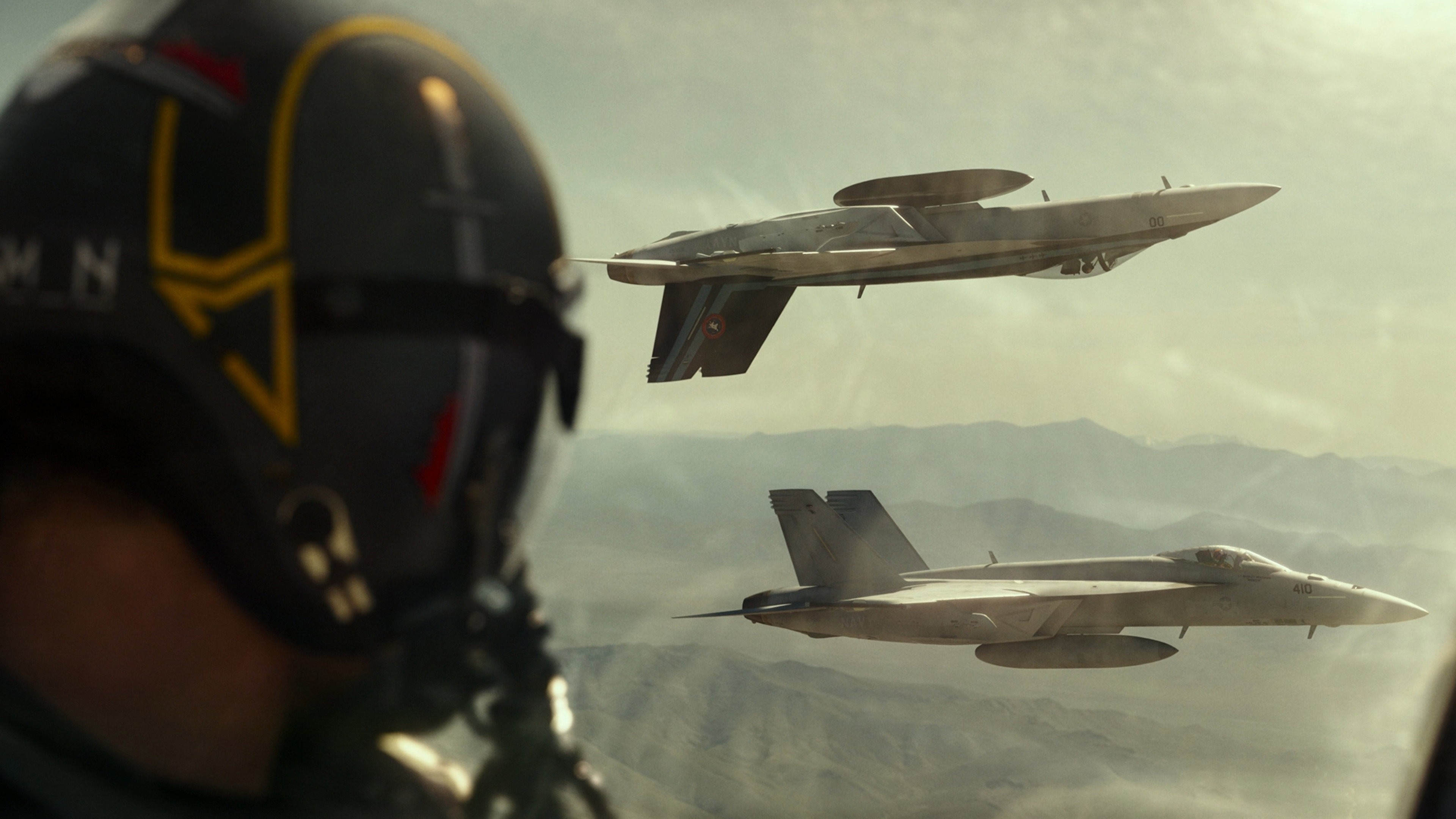
The frame above is shot from inside a cockpit, past a pilot’s blurred helmet, toward two Super Hornets over desert mountains, the upper one flying inverted. Shooting the jets from outside was the job of a separate aerial unit. Kevin LaRosa II was the aerial coordinator and lead camera pilot, and David B. Nowell and Michael FitzMaurice were the aerial directors of photography.
The main camera platform for the dogfights and the low-level work was the CineJet, a modified Aero L-39 Albatros with a gyro-stabilised Shotover F1 camera head in its nose. For longer flights over water the unit added an Embraer Phenom 300 jet with two F1 heads, one in the nose and one in the tail. For low passes LaRosa flew a Helinet Airbus H125 helicopter carrying a Shotover K1; American Cinematographer gives the example of the helicopter hovering low while a jet crossed the terrain at more than 300 knots. The F1 heads carried Fujinon Cabrio zooms, 20–120mm and 85–300mm, and the K1 a Cabrio 25–300mm.
From the ground the lenses got longer. Ground-to-air cameras used Fujinon Premier zooms up to 400mm and rehoused Canon 150–600mm and 1,000mm lenses with 2x extenders, and crews on mountaintops followed distant jets with modified rifle scopes mounted on the cameras. This is where Miranda’s argument about imperfection is easiest to see. At those focal lengths a fighter crossing the sky is a small, fast target, and a frame that slightly loses it and catches up again feels like someone was really there trying to follow it.
One Super Hornet carried cameras on the outside: Venice bodies on the belly centreline facing forward and back, one under the wing facing the fuselage, and a rear-facing Rialto behind the cockpit, up to four at a time. A jet with external cameras could not pull full G, so the flights with actors aboard carried no external mounts.The sources differ on the limit. American Cinematographer says the jet could not pull 7.5 G or roll; Film Independent puts the limit at 3.5 G.
At the peak, about 27 cameras rolled in a single day: six in each of two jets, three or four on the exterior jet, and the mountain crews, helicopter and jet units and ground cameras on top. A typical day had four flights, each giving 20 to 40 minutes of footage. The two halves of a moment were often filmed far apart, too: cockpit interiors were shot months before the air-to-air exteriors they cut with.
Visual Effects
- Frame 03 1.90:1
- Full-scale mock-up
- Skunk Works
- Hangar
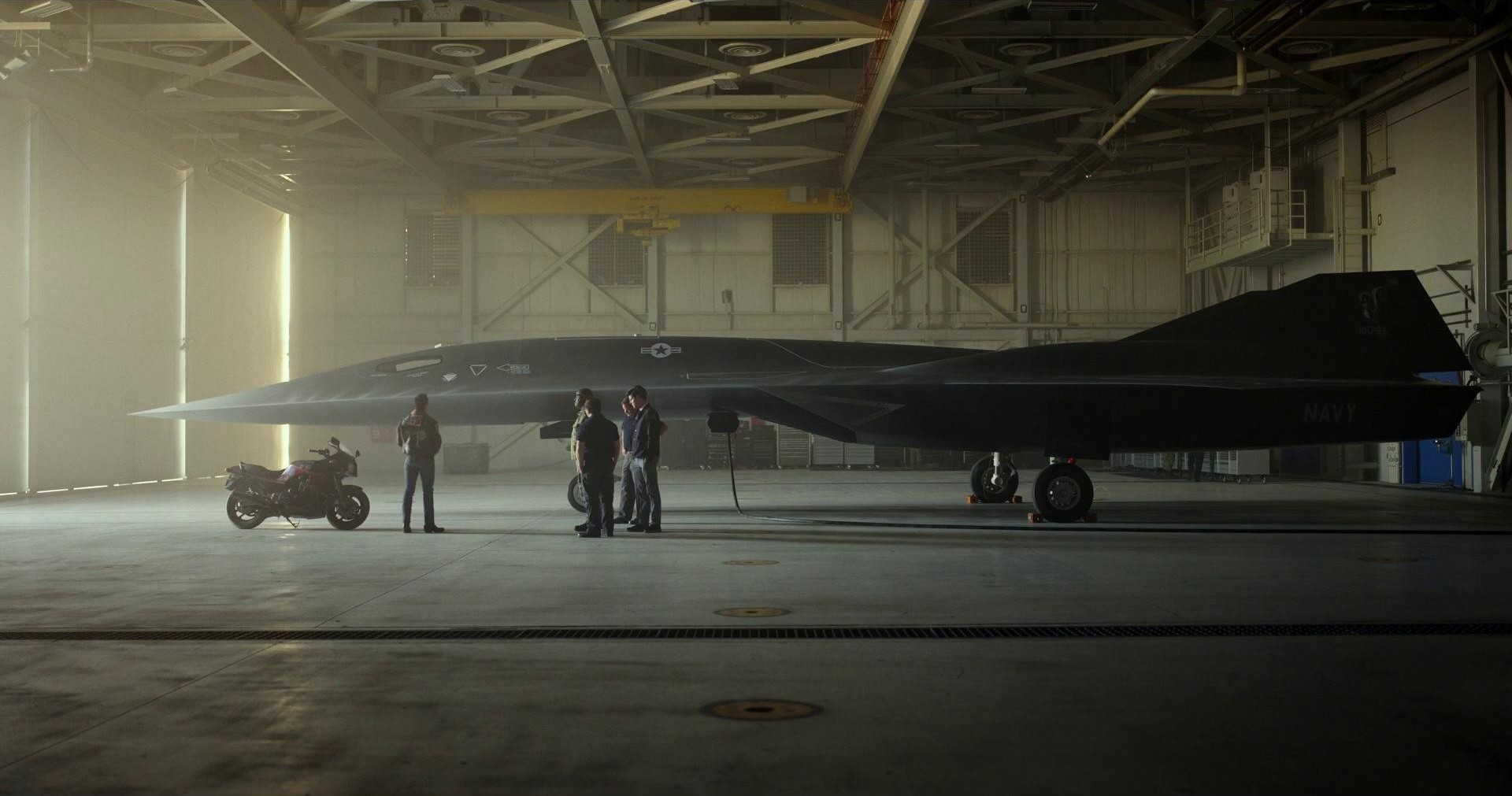
The Darkstar stands in a hazy hangar, lit by daylight from the open door, with Maverick beside his motorcycle at its nose. On the ground the aircraft is a full-scale mock-up, built with Lockheed Martin’s Skunk Works; Kosinski says it was based on the SR-71. For the shots on the tarmac it was towed, and the tow vehicle was removed digitally. In flight the Darkstar is CG, and its cockpit was mounted on a gimbal.
Its takeoff shows the film’s method in one shot. The low pass over the guard shack was flown for real at China Lake, by Weisser in a Blue Angels F/A-18 at less than 50 feet, and it tore the roof off the shack while Ed Harris, as Hammer, stood his ground in the road. The Darkstar is a digital replacement for the jet, so the damage is real and the aircraft causing it is digital.
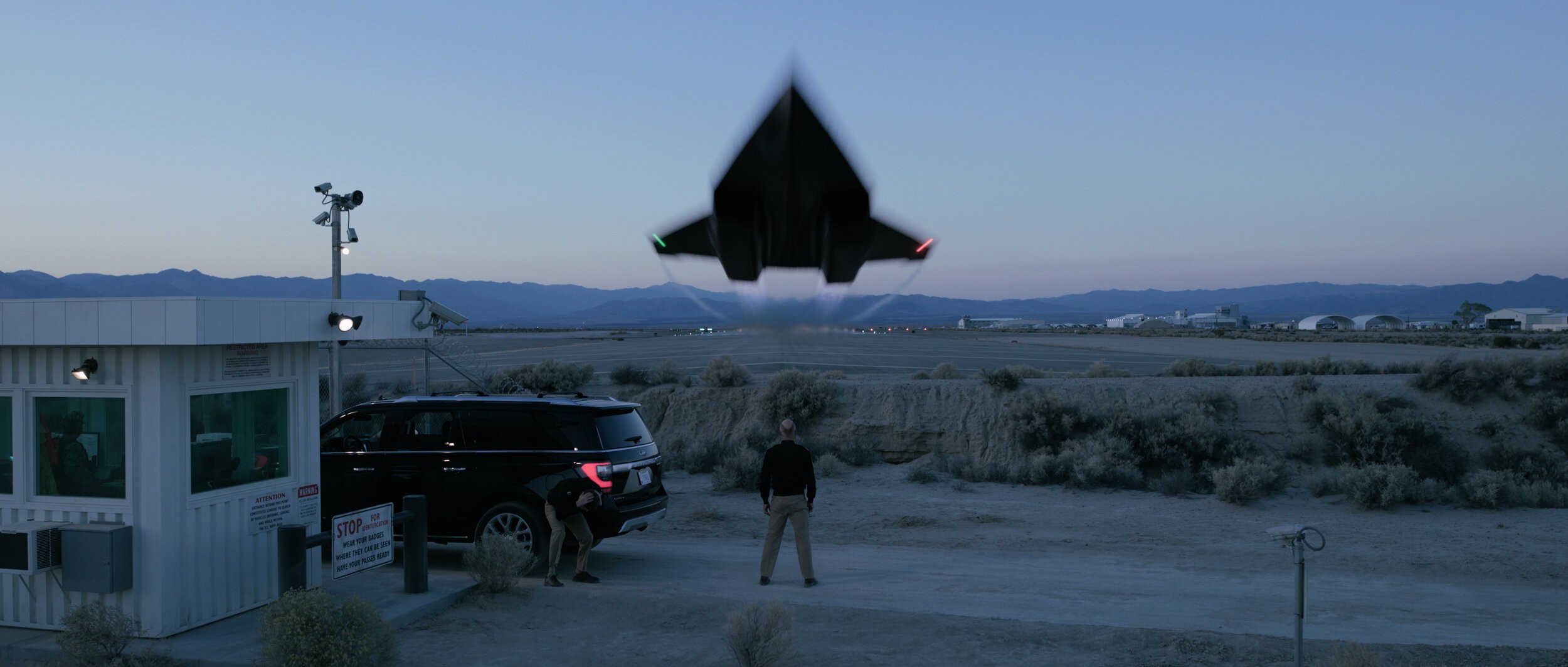
That was the pattern across about 2,400 effects shots, led by the production’s visual effects supervisor, Ryan Tudhope, with Method Studios doing most of the work alongside MPC, Lola and Blind. Real F/A-18s were photographed, and the missiles and armament were added digitally. Formations were often shot with one or two real jets and filled out with digital ones. To build the digital jets, a real F/A-18 was turned on the tarmac in the same light, as reference. The enemy valley was partly real and digitally extended, and the enemy base was built in CG on top of real footage.
Miranda’s line on all this is blunt: “This is not just green screen nonsense.” Most of the effects work adds what could not be flown, such as the missiles and the extra jets, or takes out what should not be seen, such as the Darkstar’s tow vehicle, and the photography underneath is real.
The exception is the last dogfight, which is where the film is most digital.
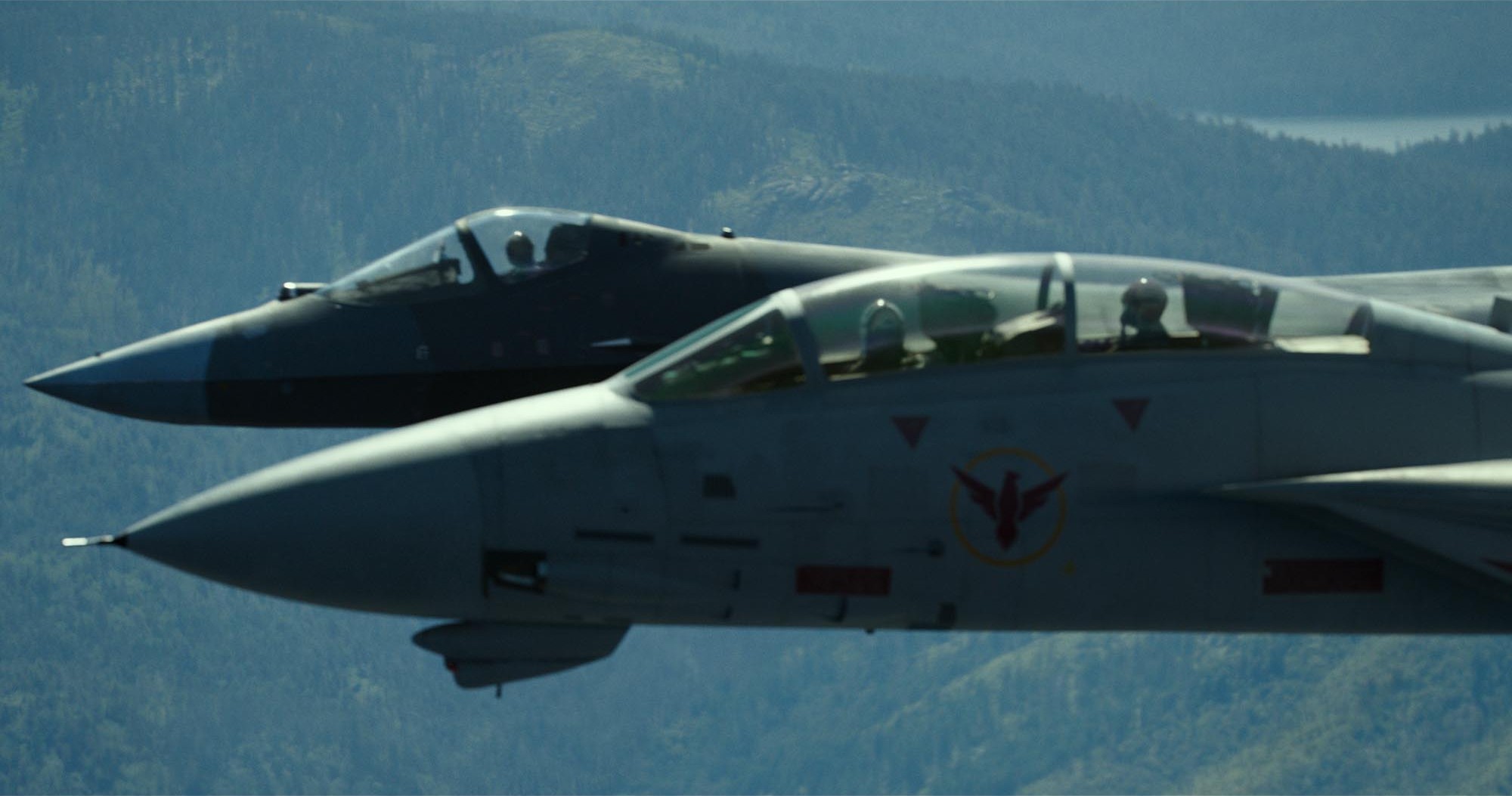
A decommissioned Tomcat, a museum airframe, was used for the ground scenes, but in the air the F-14 is CG, and so are the Su-57s. Real jets, F/A-18s and L-39s, flew their parts and were reskinned, and animators added moves no real stand-in could fly. The actors’ performances still come from real cockpit footage. In these shots they were cut out of the real cockpit plates and placed inside CG cockpits. This is the one stretch where I feel the seams. The faces are real, but the aircraft around them move more freely than anything else in the film, and after so much real flying I notice the difference.
Ground Photography
- Frame 05 2.39:1
- Built set
- Breakers Beach
- NAS North Island
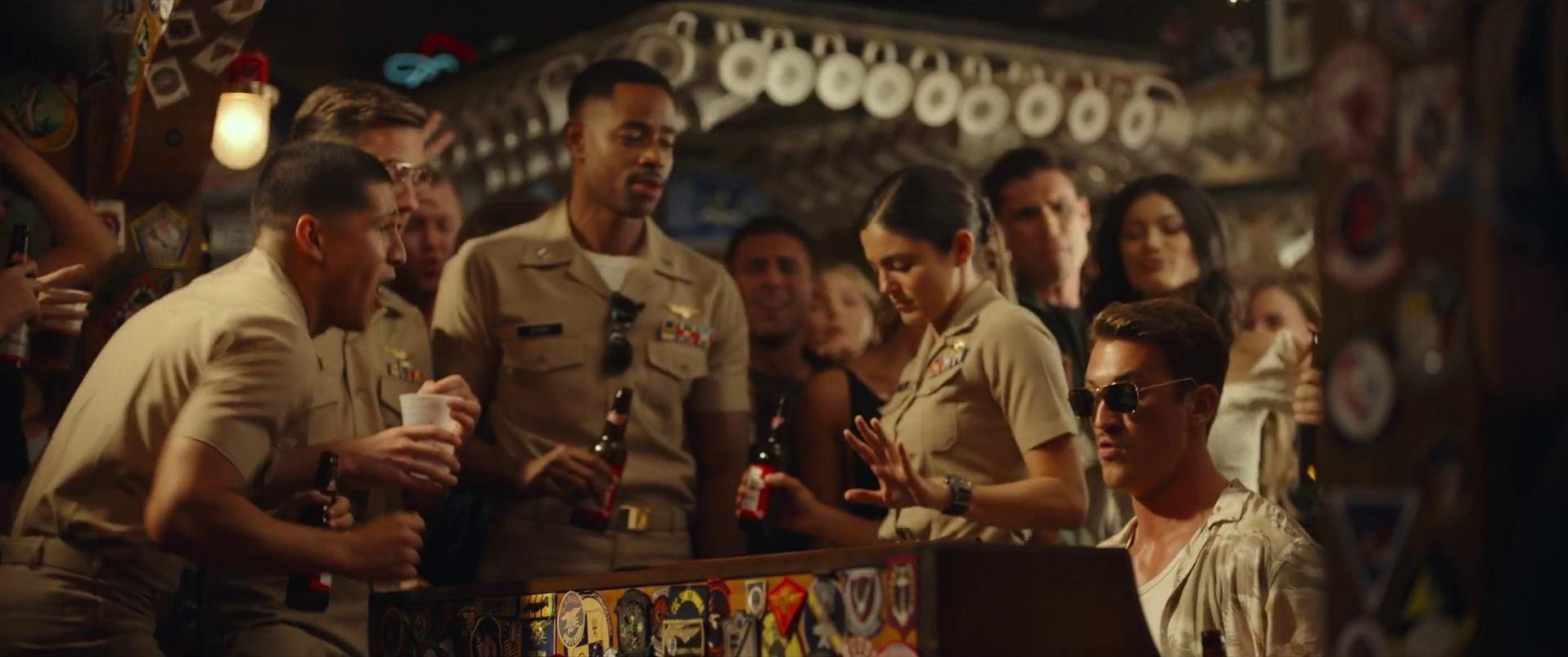
The young pilots crowd round the piano at the Hard Deck, with Rooster at the keys. The bar was a set, built on Breakers Beach at NAS North Island in October 2018, because the real bars on the base were too small for the cameras and the angles. After the cockpits, a frame this crowded is a relief, with people layered in front of people and warm light all the way back.
On the ground the lenses changed. The main unit used Sigma FF High Speed primes at the wide end, Arri/Zeiss Master Primes from 50mm up, Fujinon Premier and Premista zooms, and Zeiss Compact Zooms.
My favourite light on the ground is the night farewell outside the bar. Miranda told Film Independent that he played it as if the actors were “lit by the bar from far away”, with some shallow focus. It feels like the cockpit rule brought down to earth: the light seems to come from one place, some way off.
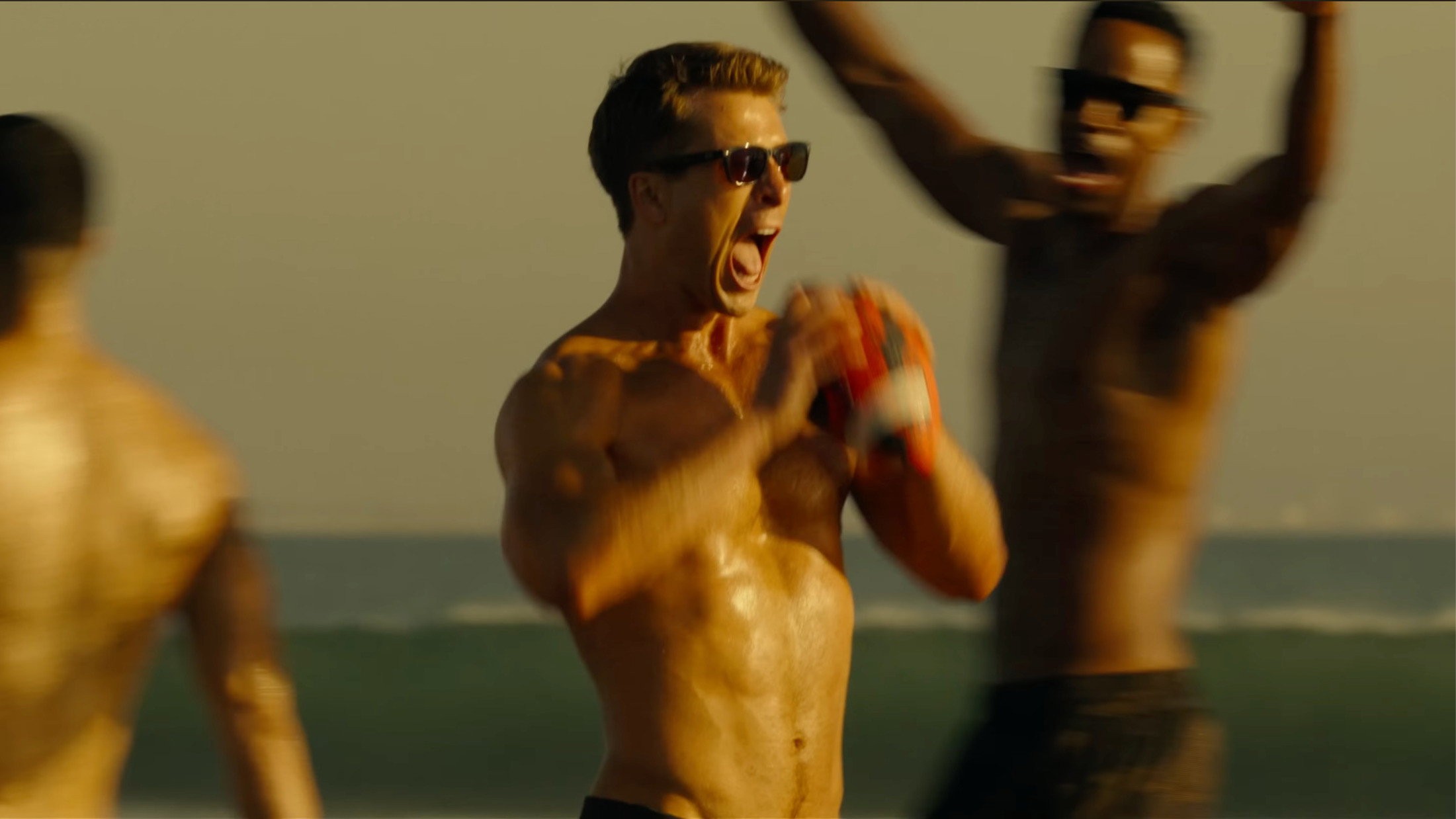
The beach football game has some of the film’s warmest daylight. In the frame below the players are in low, warm sidelight with the sea behind them, and the light catches the sweat on their skin. Hamilton says there were 11 hours of footage for about two minutes on screen, more than 300 minutes shot for every minute used.
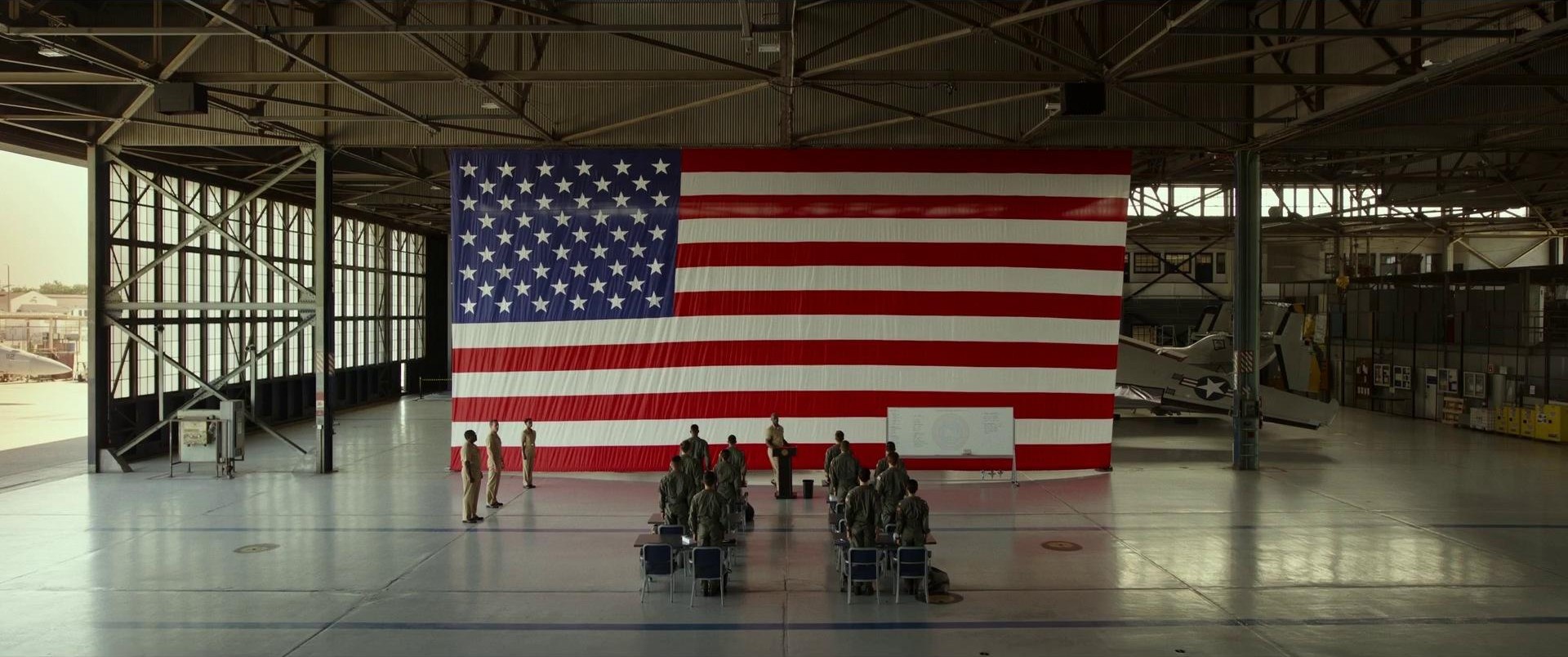
Indoors, the film goes still. The frame below is a high, symmetrical wide of a hangar: the pilots stand at two blocks of desks facing an officer at a podium, under a huge flag, in even daylight from the windows. After so much footage from cameras bolted to jets, a room of people standing still is a rest for the eye.
The film begins and ends at Maverick’s hangar, which, according to Vintage Aviation News, was filmed at Inyokern Airport in California. The P-51 inside it is Cruise’s own, an F-6K photo-reconnaissance Mustang. The Navy would not let him fly the Super Hornet, but he flies the Mustang himself, on screen.
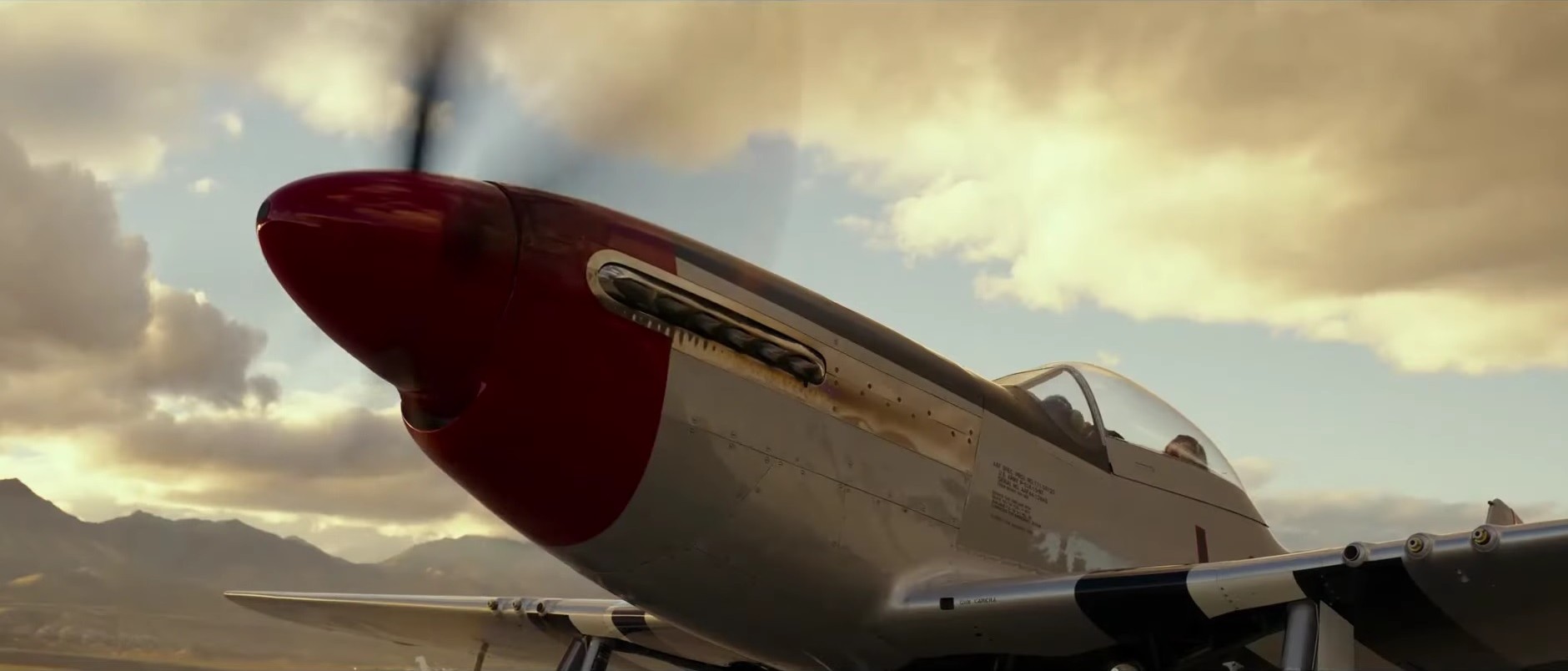
In the frame above the Mustang is on the ground with its propeller turning and two figures under the canopy, shot low from the red nose under a cloud-streaked sky. I can’t find any production account of how the closing flight was lit or which aircraft filmed it, so I will only say what is in this frame: warm light, gold in the clouds, and a polished nose picking it up. The film ends in the light it began with.
When I think about Top Gun: Maverick now, I think about how much of it Miranda had to hand over. The framing went to cameras nobody could adjust, the exposure was fixed before take-off, the light was held by the pilots, and part of every performance was done by the G-force. His job was to set all of that up and then let it happen without him. The film looks the way it does because he trusted that what came back from the air would be better than anything he could control from the ground, and he was right.
The Shot List